Supreme Court: Bail Under UAPA Cannot Be Denied Solely Because the Accused Is a Foreign National
Court said foreign national’s entry itself must be illegal to trigger bail restriction.
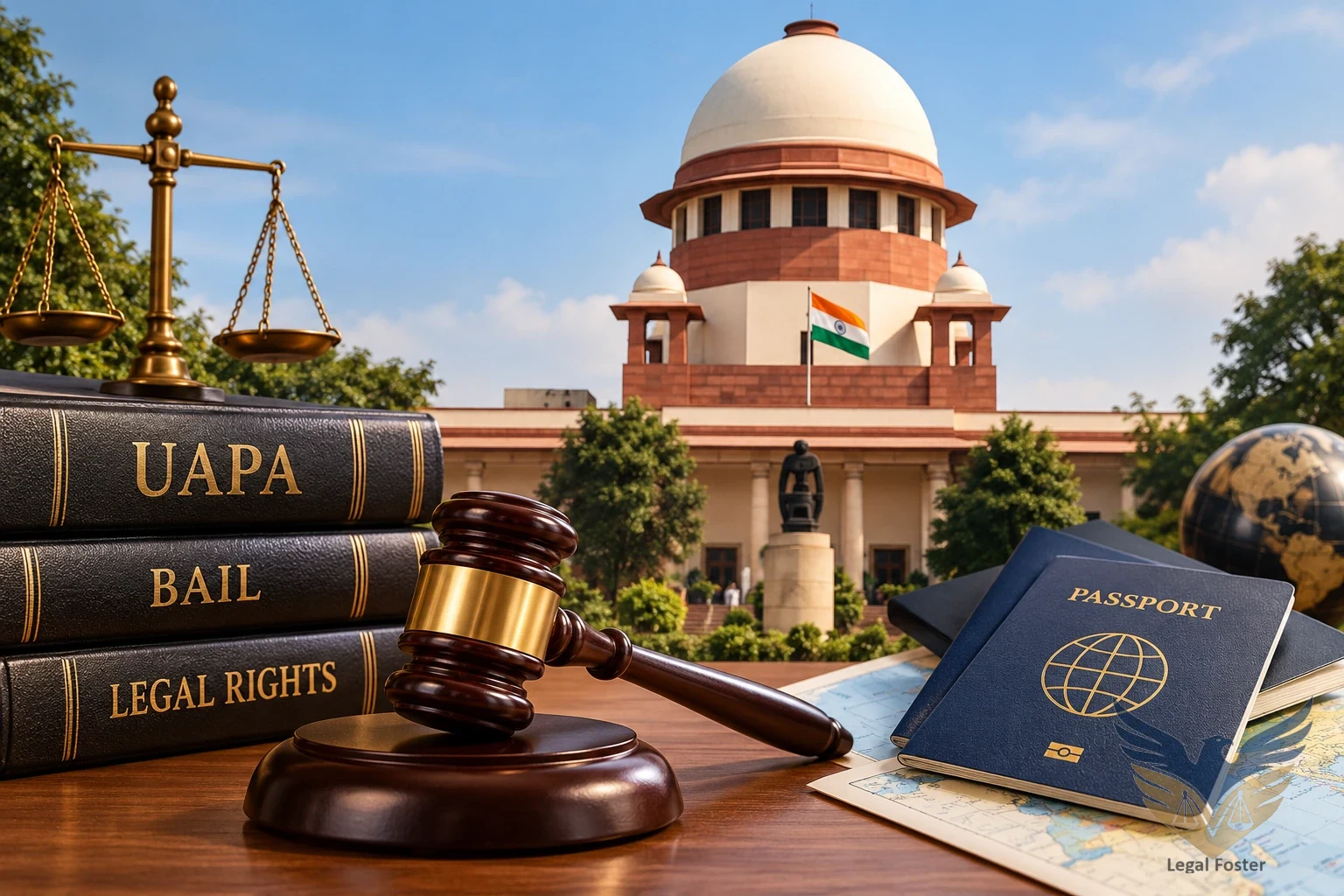
On Tuesday, the Supreme Court ruled that merely because an accused is a foreign national, he cannot be denied bail under the Unlawful Activities (Prevention) Act (UAPA). [Union of India v. Mohamed Rifas]
However, a Bench of Justices Aravind Kumar and Vipul M Pancholi noted that Section 43D(7) of the UAPA, which restricts bail for foreign nationals, applies only where the foreign national has also entered India illegally or without permission.
“A person who has entered India lawfully and his authorisation is subsequently revoked or he continues to stay illegally thereafter would not be sufficient to invoke Section 43D(7). Merely because a person is not an Indian Citizen will not suffice to trigger the rigors of sub-section (7) of Section 43D,” the Court observed.
The Court further explained that such foreign national’s entry into India cannot be said to be unlawful. “What is required and necessary is that when such person entered India initially, such entrance itself was unauthorised or illegal.”
The Court was considering the Union government’s appeal challenging the High Court’s decision to restore bail granted to Mohamed Rifas. The prosecution had accused Rifas of being a Sri Lankan national.
In 2018, Rifas was arrested in connection with an FIR alleging a conspiracy to promote enmity between different groups on grounds of religion and cause disruption to communal harmony in the state, etc. The accused obtained default bail in July 2018 from the learned Sessions Judge since the prosecution did not file its chargesheet within the stipulated time.
In January 2019, the NIA took over the investigation and filed its chargesheet in January 20 21.
In another FIR registered in November 2019, the prosecution accused Rifas of entering India on a passport issued by Sri Lanka, overstaying the permitted time on a tourist visa, and obtaining an Indian identification card illegally.
In April 20 22, the prosecution moved the NIA Special Court seeking cancellation of bail on the grounds that Rifas had hidden the fact that he was a foreign national and Section 43D(7) prevented him from being granted bail.
The special court allowed the plea and cancelled bail. However, the High Court quashed this order in December 20 23. Aggrieved, the Union government approached the Supreme Court.
The Supreme Court said that at no point did the prosecution produce any material to even prima facie show that Mohamed Rifas had entered India illegally.
The Court noted that “even the subsequent FIR registered against the accused…states that he had entered India with a valid visa and stayed beyond the permitted period after the visa expired”.
While dismissing the appeal, the Bench addressed the prosecution’s claim that Rifas had “concealed the fact that he was a foreign national”.
The Court pointed out that he was granted default bail because the chargesheet was not filed by the prosecution in the prescribed time. This was his statutory right under Section 167(2) of CrPC, which is made applicable to UAPA proceedings by Section 43D(2).
“In our view, Section 43D(7) cannot override Section 43D(2) and bar default bail.…” it held.
The Bench further clarified that “distinction must be drawn between setting aside an illegal order or perverse order granting bail and cancellation of bail in light of subsequent conduct or fresh material coming on record. Even in the absence of any such subsequent circumstances, exercise of the power to cancel bail must be supported by good and sound reasons and shall be exercised sparingly, since it is the liberty of the accused that is in question”.
Refusing bail cancellation only because a chargesheet was subsequently filed by the prosecution, the Court observed, “We find that no special and strong ground has been established by the prosecution for cancellation of bail granted to the accused.…”
It therefore dismissed the appeal and allowed the High Court’s judgment which restored the accused’s bail.