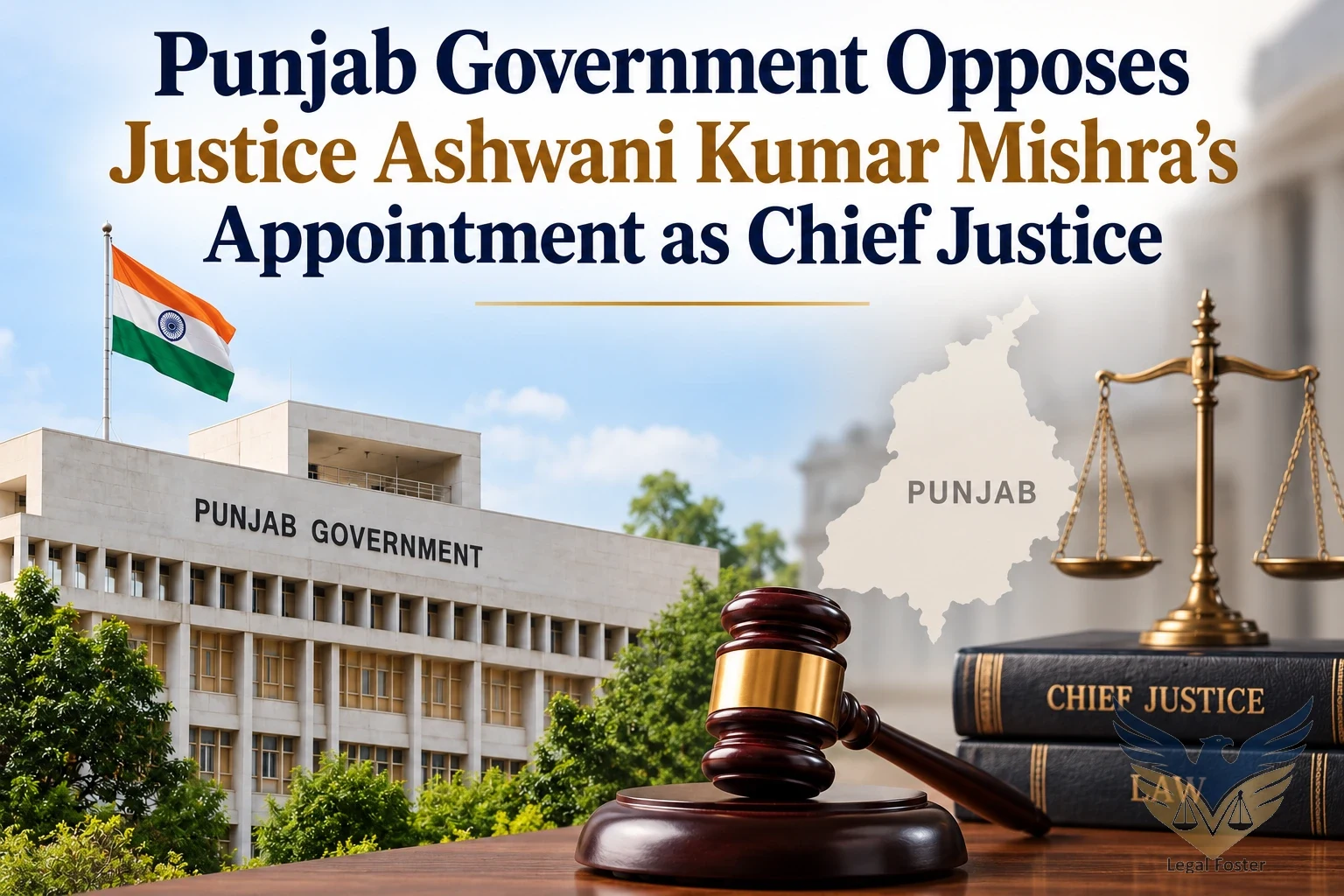
Punjab Government Opposes Justice Ashwani Kumar Mishra’s Appointment as High Court Chief Justice
Acting Chief Justice of Punjab and Haryana High Court Justice Mishra Orders Bail For Accused In Case Of Police Officer’s Murder, Alleges Political Vendetta
The Punjab cabinet on Sunday passed a resolution opposing the Central government’ decision to notify the appointment of Justice Ashwani Kumar Mishra as Chief Justice of Punjab and Haryana High Court.
The Supreme Court Collegium recommended Justice Mishra’ elevation on August 6. On Saturday night, the Central government cleared the recommendation and notified Justice Mishra’ appointment as Chief Justice.
The State government has now said that the decision was taken without its consent. Justice Mishra will be administered the oath of office at Punjab Lok Bhavan in Chandigarh on Monday. A few hours before the scheduled ceremony, the Punjab cabinet held an emergency meeting through video conferencing to oppose the Centre’ decision to appoint Justice Mishra as Chief Justice.
In a resolution passed during the meeting, the Punjab government requested the Governor not to allow Justice Mishra to take oath until the government gives its consent for the same.
“Taking serious exception to the appointment of Justice Ashwani Kumar Mishra as Chief Justice of Punjab and Haryana High Court without awaiting the views of the Punjab Government as is required under the Memorandum of Procedure… the Cabinet resolved that the said appointment and administration of oath should be put on hold till the views of Punjab are obtained and duly considered”, the Punjab government said in a statement.
Further stating that as per the ‘Memorandum of Procedure for Appointment and Transfer of Chief Justices and Judges of High Court’ union minister of Law, Justice and Company Affairs will seek the views of the concerned State government after receipt of a recommendation from the Chief Justice of India.
“After receipt of the views of the State Government…will submit proposals to the Prime Minister who will then advise the President as to the selection” it added.
However, the State government further said that while its views were sought by Minister of State for Law & Justice Arjun Ram Meghwal on August 12 this year, the Union government quickly notified the appointment of Chief Justice without waiting for its response.
According to the statement, “there is no fixed time-limit prescribed either for the State Government or the Governor to send their recommendation” in matters concerning appointment of Chief Justice.
Drawing contrast it brought attention to the instance of Chief Justice of Himachal Pradesh High Court Gurmeet Singh Sandhawalia who was recommended to be appointed as Chief Justice of Madhya Pradesh High Court in 2024.
“The Ministry of Law and Justice did not notify this proposal for reasons best known to it despite the recommendation being with it for more than two months on account of non-receipt of recommendation from the State Government of Madhya Pradesh”, said the Punjab government.
Later Justice Sandhawalia was appointed to his parent High Court of Himachal Pradesh.
“This is just a sample incident which clearly proves that Central Government has been discriminating against Punjab”, Punjab government claimed.
“As such, the feeling of perceived discrimination gets solidified in the sense that when a case of a Judge of the State of Punjab is to be considered, it is dealt differently as that in a case of another Judge from another High Court getting appointed in the State of Punjab,” the government further said.
It said it was important that Justice Mishra’ appointment be put on hold and oath be not administered till the views of Punjab are obtained and duly considered by the appropriate authority.
“Thereafter, the matter may be proceeded with in accordance with the procedure prescribed under the said Memorandum,” the government further said in the statement.
Talking to media after the meeting, Punjab Chief Minister Bhagwant Singh Mann tweeted on X saying that the Central government was attacking Punjab rights repeatedly.
“Heartfelt gratitude to Punjab Cabinet for unanimously passing an important resolution today. Centre Govt is continuously attacking the rights of Punjab. Today the battle is on the issue of appointing CJ-P&H High Court. The decision is violative of established Constitution norms,” Mann tweeted.
Reacting to the Cabinet’s resolution, the Punjab and Haryana High Court Bar Association on Monday came down heavily upon the government’s stand.
“The reported convening of an emergency meeting of the Punjab Cabinet specifically to deliberate upon the appointment of the Chief Justice of Punjab & Haryana High Court raises serious concerns regarding Executive intrusion into a matter squarely governed by the constitutional mechanism for appointments to the Superior Judiciary,” the Bar body said in a statement.
“This unnecessary and futile confrontation creates an impression of Executive/Political pressure being exerted upon the Judiciary. This has the potential to diminish public faith in the delivery of justice which would be harmful for our constitutional democracy,” it added.
Justice Mishra had obtained his LL. B. degree from Campus Law Centre, Delhi University. He was appointed as an additional judge of Allahabad High Court on February 3, 2014 and was confirmed as a permanent judge of the High Court on February 1, 2016.
He served in the Allahabad High Court till July 2020 till he was transferred to Punjab and Haryana High Court and took charge on July 2120.
Justice Mishra was appointed as the acting Chief Justice on June 1 after the elevation of then Chief Justice of Punjab and Haryana High Court Sheel Nagu to the Supreme Court.
In August, a Bench led by Justice Mishra had ordered the Punjab government to release up-dated arrears of pending installments of dearness allowance/ dearness relief (DA/DR) to all the employees and pensioners.
“The Punjab Government is spending crores of rupees on freebies every month. It spends huge amount every month on advertisements… However, despite Rs 63,000 crore fund lying with the State Government, it miserably fails to release legitimate dues of its own employees…” the Bench observed.