Chhattisgarh High Court Rules Sharia Body Cannot Decide Divorce Status of Muslim Women
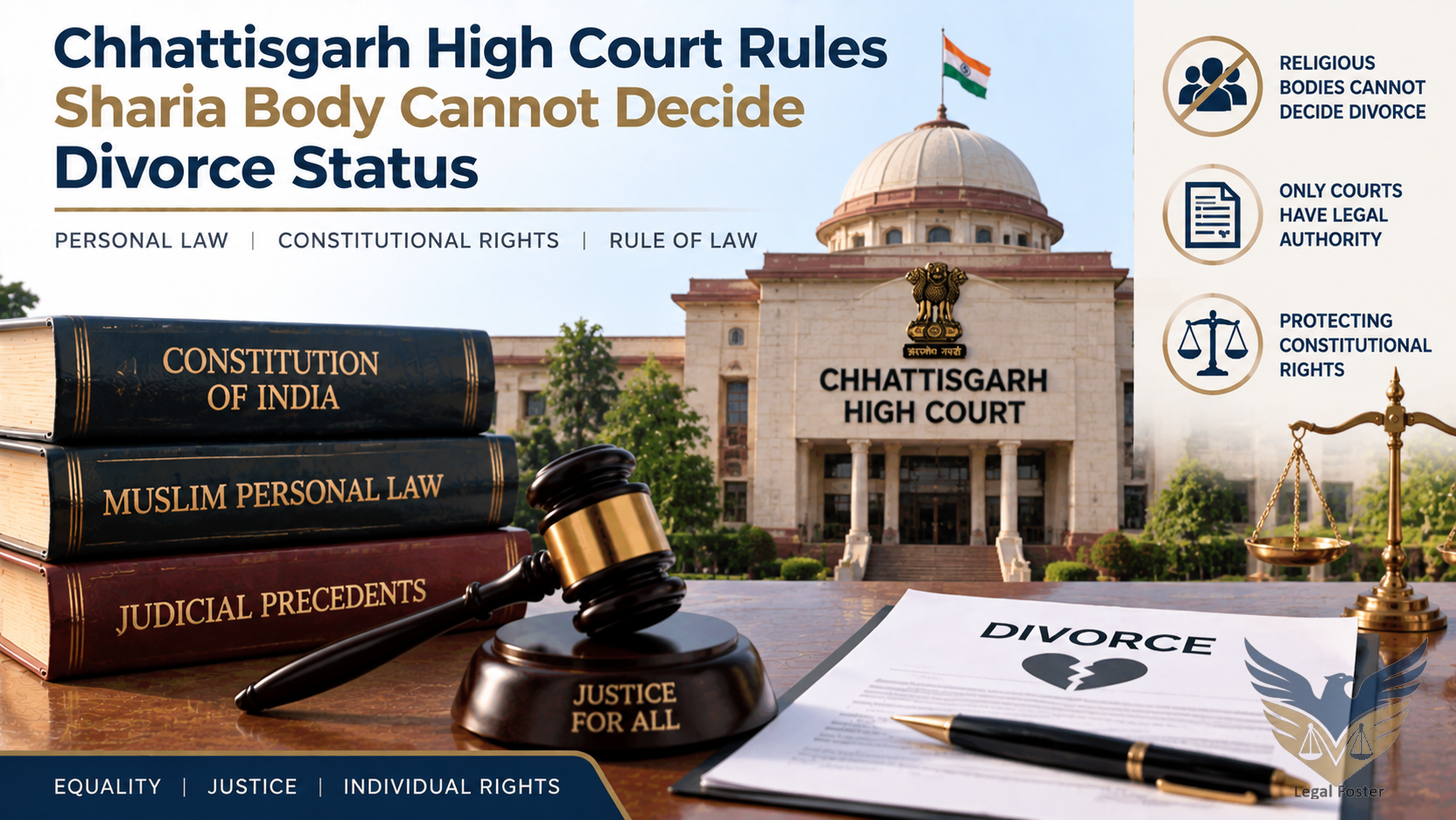
A private Sharia council/body has no jurisdiction to determine whether a Muslim woman has been divorced by her husband in terms of law nor can they determine that her status qua marriage is that of divorced, the Chhattisgarh High Court ruled recently.
“Religion can and does influence the conscience of an individual and guide him personally in matters of faith. But we cannot permit any religious institution or private association to arrogate to itself the function of a Court instituted by law under the garb of religious belief and practices to determine the legal status and rights of an individual. The rule of law and the Constitution would always prevail”, Justice Amitendra Kishore Prasad observed while pronouncing the September 7 judgment.
The petitioner woman had moved the Court challenging a communication dated January 20, 22 by the Idara- E- Shariya Islami Court at Raipur. In the impugned communication, the Idara had declared that she had been divorced by her husband.
Setting aside the declaration by the Idara, the Court held that no private institution can exercise powers that are judicial or quasi-judicial in nature.
“You cannot create jurisdiction by your own declaration,” Justice Prasad ruled.
The woman had married secondly in July 2020 after her first husband died. She and her second husband subsequently fell out and the latter wanted to divorce her, the petitioner said. Alleging harassment and cruelty at his hands, she managed to get an FIR registered in November 2021 under Section 498A IPC (cruelty to wife).
The husband told the High Court that he had divorced her by way of Talaq-e-Hasan in three stages vide communications dated 31.08.2021, 30.09.2021 and 30.10.2021. The husband submitted that the Idara-E- Shariya had neither adjudicated upon his right nor hers but had only recorded his communications pronouncing divorce.
In its reply, the Idara-E-Shariya, which is learnt to be affiliated to the All India Muslim Personal Law Board (AIMPLB), submitted that it was only a religious organization functioning as an advisory body and had no statutory/judicial powers to adjudicate upon anyone’s rights. Citing the Supreme Court’s 2014 decision in Vishwa Lochan Madan v. Union of India, it said Muslim bodies such as Dar- ul- Qazas or those issuing fatwas were not part of the system of justice as recognised by law.
“In law, their opinion is not binding and this Court while relying upon the decision of the Apex Court held that fatwa or decision pronounced by any such Darul- Iftaa or Dar-ul-Qazas is not a decree and has no force of law. It cannot, therefore, be sought to be enforced by coercive means”, the High Court ruled.
It clarified that even religion cannot permit any religious body to usurp or substitute the position of a court recognised by and established under law.
“We reiterate that the declaration by the 1st respondent (Idara-E- Shariya) could not create any right, nor could it extinguish any right that was legally enforceable or alter the legal status of marriage of the petitioner. Nor was it competent to determine whether the petitioner was divorced or not”, the Court ruled.
“The 1st respondent cannot adjudicate upon the rights of parties to a marriage. It has no jurisdiction to decide the marital status of the petitioner. It was also not competent to pass any order which in law determines whether the petitioner stands divorced by her husband”, Justice Prasad added.
The High Court made it clear that it was not expressing any opinion on the constitutional validity of Talaq- e- Hasan itself. “The validity of Talaq-e- Hasan is already a subject matter which is pending consideration before the Apex Court. Till such time the question as to its validity is left open”, it said.
Appearing for the petitioner was advocate Devershi Thakur. The Union of India was represented by Additional Government Advocate Abhishek Banjare while Additional Advocate General RK Gupta appeared for the State of Chhattisgarh. Representing the husband was Senior Advocate Fouzia Mirza assisted by advocate Ali Afzaal Mirza.