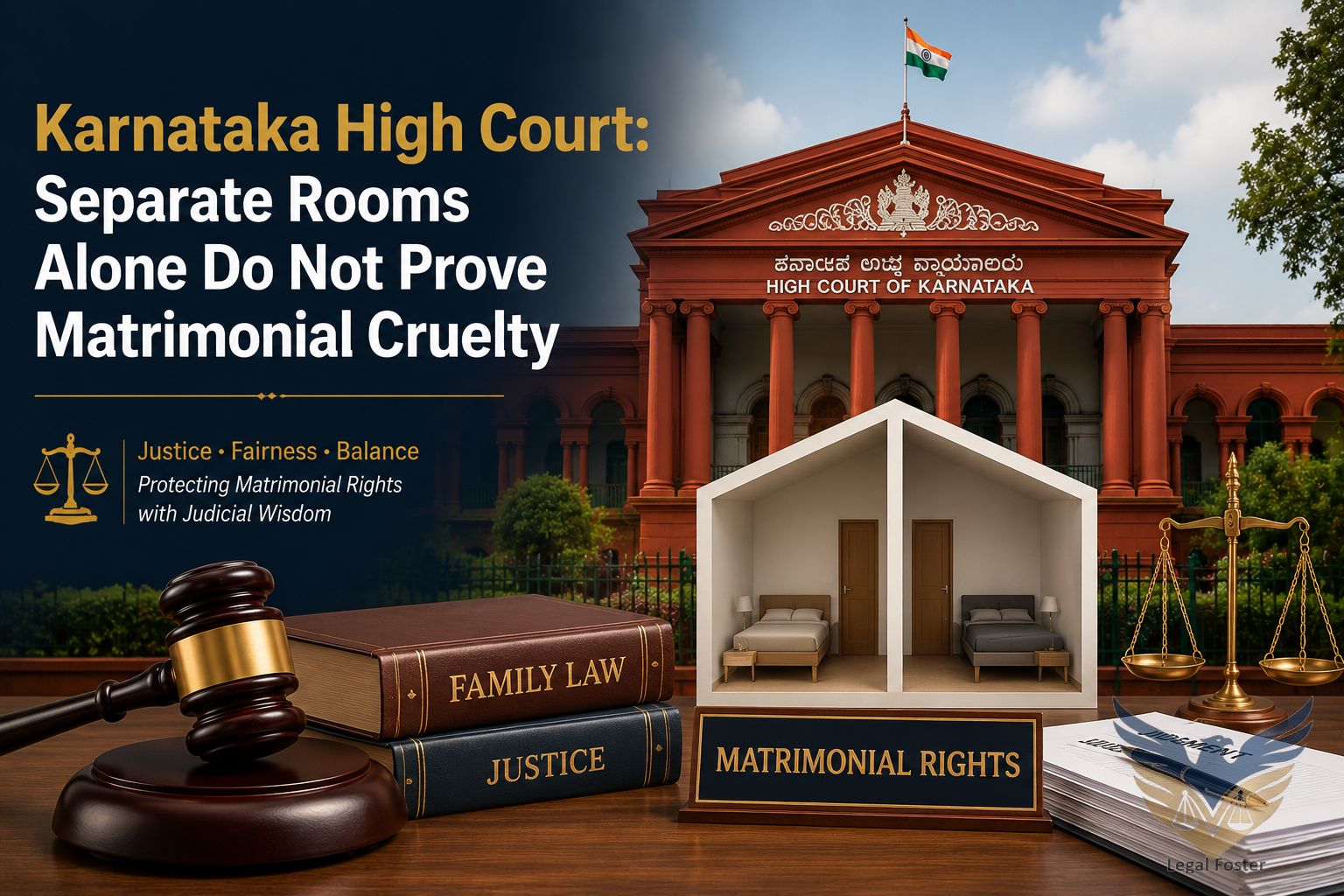
Karnataka HC Holds That Husband and Wife Using Separate Rooms Is Not Sufficient to Establish Cruelty
“A continuous course of conduct such as protracted marital discord, period of separation, behaviour of parties and efforts made for reconciliation failing, would amount to cruelty” the Court said.
“In our considered opinion, mere fact that parties are living in separate rooms though under the same roof, cannot by itself tantamount to matrimonial cruelty,” the Karnataka High Court had observed recently.
A Bench of Justices DK Singh and H Shanthi Bhushan further said that such living separately may become relevant when considered along with the general course of matrimonial conduct of parties.
“This case is replete with admissions of the husband himself that parties had been living in separate rooms for a significant period of time. Standing by itself, such an arrangement cannot be treated as cruelty. The mere fact that parties occupied separate rooms under the same roof, without more would not justify a finding of cruelty,” the Bench made it clear.
The Bench held that the parties living separately could not be viewed in isolation and was only one of the incidents in a series of marital disputes and matrimonial history which included mutual allegations of physical abuse, years of staying estranged, an earlier matrimonial proceeding, reconciliation attempts and ultimate failure.
The Bench made the above observation while dismissing an appeal by a man against the Family Court judgment which had granted his wife a divorce decree dissolving their marriage on the ground of cruelty and also ordered him to pay permanent alimony of ₹25,000 per month.
Matrimonial Dispute and Allegations
The couple had got married since November 11, 2001 and had two children. The wife in her petition had alleged that her husband was constantly physically abusive towards her, uttered verbal abuses against her, was emotionally cruel towards her and neglected her. She said that he treated her with suspicion and was extremely possessive towards her. She also claimed that he had alienated her from her family members and relatives.
While the parties continued to live under the same building, they resided in different rooms and led separate lives. She left the matrimonial house with her two children.
In his defense, the husband denied all such allegations levelled against him. He claimed that his wife was under the influence of her parents and other relatives. He further alleged that his wife alone was responsible for the failure of the marriage.
The Bench noted that “the appellant-wife has consistently and incontrovertibly testified that parties continuously fought. She was verbally abused by the appellant husband. She was emotionally neglected by him.
The appellant husband kept suspecting her and behaved possessively. Parties lived separately though under the same roof. Appellant had certain habits as alleged by the respondent-wife. Despite attempts at reconciliation by the family, the parties could not live together.”
It said that all this evidence of the respondent-wife had to be seen in the matrix of admissions by the appellant-husband and facts and circumstances of the case.
Criminal Complaint and Matrimonial Cruelty
Refusing to treat the wife’s complaint under Section 498-A IPC, filed earlier by the wife which had resulted in the husband’s acquittal, as an act of matrimonial cruelty as alleged by the husband, the Court said:
“The mere filing of a criminal complaint by one spouse against the other, in our considered opinion, does not amount to matrimonial cruelty in every case.”
“The appellant-wife had earlier filed a criminal complaint against the respondent husband u/s 498-A IPC. He was acquitted of the charges levelled against him. The acquittal alone cannot lead to a finding that the complaint was false and malicious,” the Bench added.
“In the facts and circumstances of this case, the complaint was made in the backdrop of longstanding matrimonial discord. Attempts were made by family members of both the parties to bring about reconciliation between the parties. Parties did cohabit for a while but the attempt at reconciliation failed,” the Court noted.
Cumulative Effect of Marital Discord
“Reliance placed by learned counsel for the appellant on individual incidents would not help the appellant husband. The cumulative effect of protracted period of discord between the parties, their living separately, periods of temporary reconciliations followed by their ultimate failure would lead to the conclusion that the wife has suffered mental cruelty at the hands of the husband”, the High Court ruled.
“It cannot be expected of her to put up with such conduct for an indefinite period of time. Such conduct clearly causes mental pain to the person who is subjected to it and destroys the basic foundation of companionship, trust and matrimonial security which are essential in every marriage,” the Bench held.
This cumulative effect of prolonged discord between parties, living separately, attempts to live together followed by failed reconciliation was held to be enough to establish mental cruelty as per Section 13(1)(ia) of Hindu Marriage Act.
Permanent Alimony
The Court also dismissed the husband’s contention against the family court’s order directing him to pay ₹25,000 per month as permanent alimony to his wife on the ground that she had sufficient means. It held that the wife’s employment and income was not a ground to deny her permanent alimony.
Senior Advocate SG Muniswamy Gowda appeared for the husband.
Advocate Swaroop S appeared for the wife.