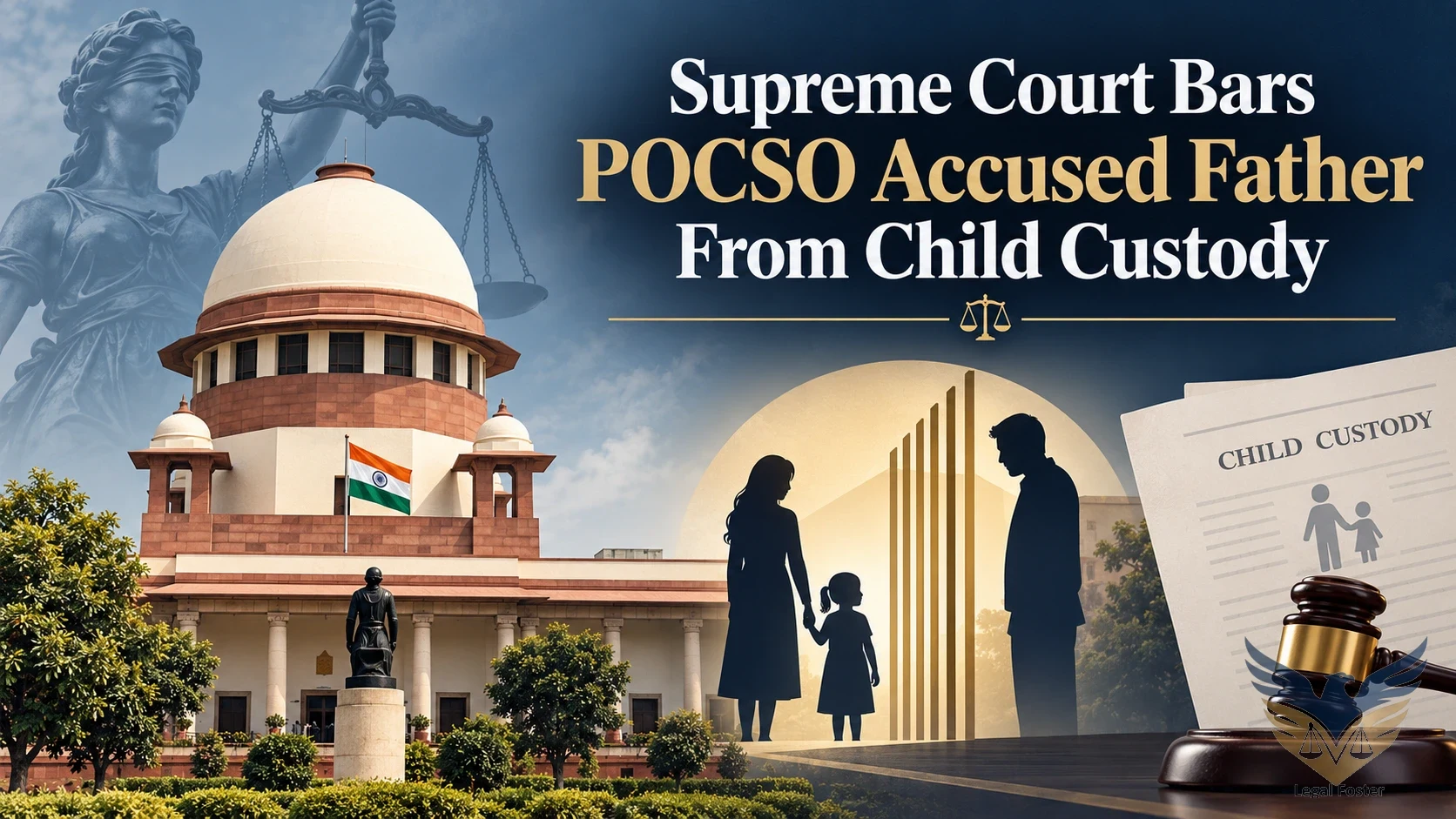
Father Accused Under POCSO Act Not Eligible for Child Custody, Rules Supreme Court
“The Court also expunged the Delhi High Court’s remarks that the sexual abuse allegations against the father were motivated.”
SC says father facing POCSO case cannot be granted custody of children
The Supreme Court on Wednesday said that a father against whom a criminal case is underway under the Protection of Children from Sexual Offences Act (POCSO Act) for sexual abuse of his son, cannot be given custody of his children.
“A Bench of Justices Vikram Nath and Sandeep Mehta said that if the son is placed in the custody of his father, the possibility of free and fair deposition by the son in the POCSO proceedings would virtually be nonexistent.”
“If the son is kept away from the father, there would be no adverse impact on the father-son relationship as the children are already aging and have been living away from the father for several years,” the Court added.
“It said, “Under no circumstances, the respondent father, as long as he is facing prosecution, can be considered to be a person entitled to custody of the children.”
The Court was dealing with appeals filed by the mother challenging the Delhi High Court judgment which dismissed her plea against a family court order granting father the sole custody of the couple’s two children, aged approximately 13 and 7 years.
The couple had married in 2011 and the wife moved out of the matrimonial house in 2018 while she was pregnant. She complained of being physically assaulted by the father. She has been in custody of their son and their daughter born in 2019 since then.
In 2023, the son began exhibiting aggressive behaviour and was taken to NIMHANS, Bengaluru for treatment where he made disclosures that he had been sexually abused by his father in the past.
Senior Advocate Zoheb Hossain, appearing for the mother, submitted that she was the natural caregiver of the children for years together. She added that her change in jobs were necessitated by the conduct of the father.
He further submitted that as per the wishes of the children and reports of the counsellors, they do not want to be in the company of the father and that the observations made by the High Court regarding the POCSO proceedings were made at a nascent stage and were premature.
Senior Advocate Shyam Divan, appearing for the father submitted that this was a classic case of parental alienation. Divan further argued that the children’s mother lives in the United Kingdom and if the children are kept in her custody, they will be taken abroad and would lose their Bengali roots.
“The Court said that once the police has filed a chargesheet against the father after investigation in respect of allegations which constitute an offence under the POCSO Act. In that backdrop, granting custody of the child to the father would be totally unwarranted and unjustified.”
“The Court further held that even if the FIR is quashed, the subsequent outcome of the criminal proceedings, by itself, cannot efface the matrix of circumstances in which the disclosure was made.”
Rejecting the father’s argument that the children would lose their Bengali roots if sent abroad, the Bench said,
“There cannot be any presumption that by mere relocation to another country, the children would lose their cultural values.”
It also stated that from his conduct both before and after the proceedings commenced against him, it clearly showed the vindictive approach of the respondent father.
Therefore, allowing the appeal and permitting the mother to take the children to UK and get them admitted in the school there.
She shall place the details of schooling on affidavit within six weeks and file an undertaking to produce the children whenever asked by the court.