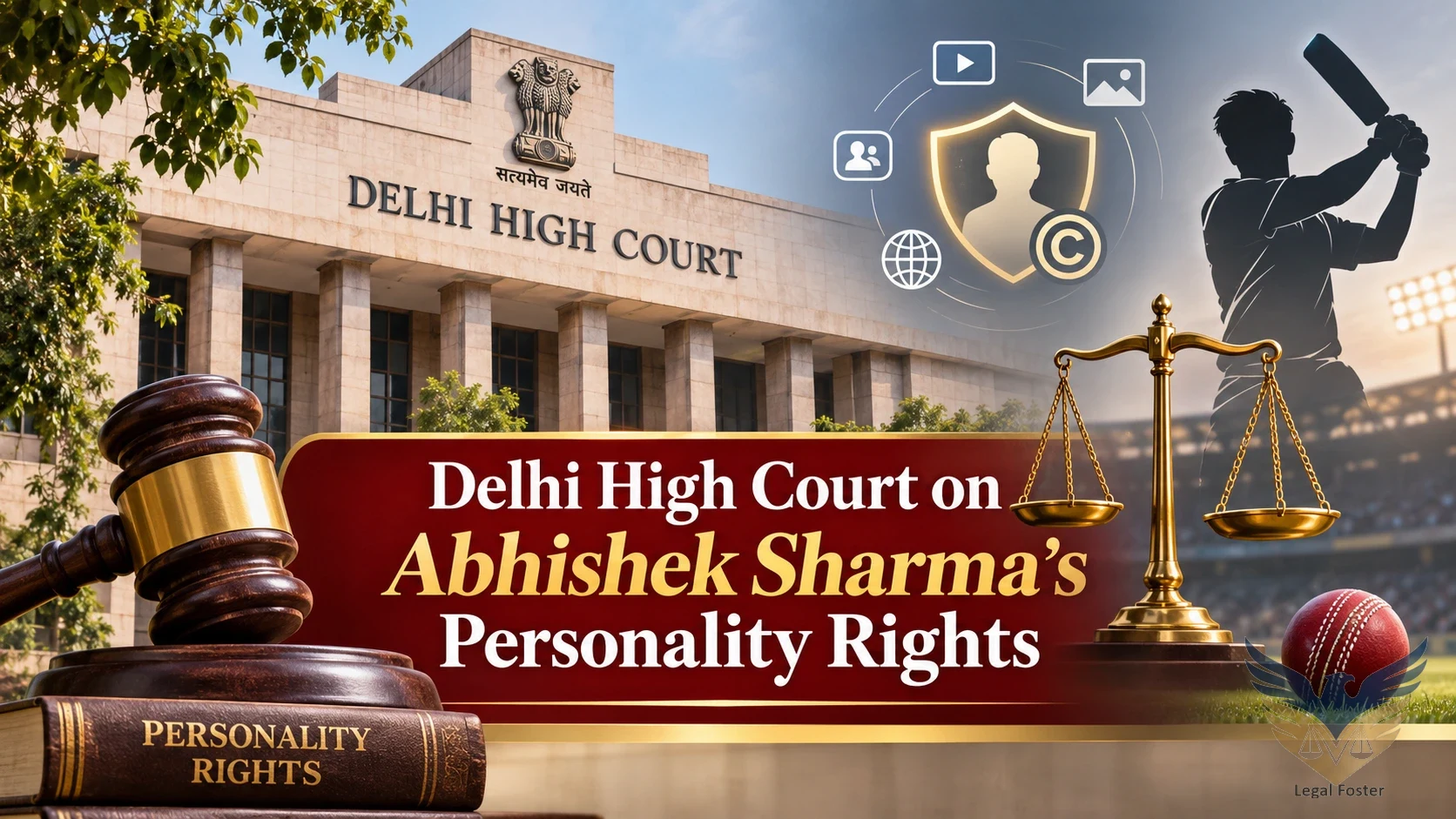
Delhi High Court Highlights Challenges in Deciding Personality Rights Cases in Abhishek Sharma’s Suit
The Court expressed reluctance to accept the notion of 'personality rights' as an overarching principle, bringing disparate heads of grievance under the same umbrella and granting relief in the form of an omnibus injunction.
In a recent set of judgments, the Delhi HC took note of certain difficulties that arise in the context of personality rights litigation, especially when a celebrity seeks disparate reliefs.
Justice P.K. Kaurav took note of these issues in a suit filed by Abhishek Sharma. As noted above, the Court expressed hesitation to accept "personality rights" as a collective principle.
"As held above, the Court does not subscribe to the idea of 'personality rights' as a collective concept, under which all such claims are gathered into one cause of action and met with an omnibus injunction."
As illustrated by the instant suit, the Court highlighted how the applicant brought together 5 separate grievances under one head, each giving rise to distinct legal considerations:
"A false rumour or a scandalous imputation concerns reputation. An obscene morph concerns privacy and dignity. A fabricated depiction of the plaintiff at an event which never took place may concern reputation and privacy and, if it is monetised, the commercial value of his identity. Merchandise raises questions of passing off and of the right of publicity."
The Court further noted that a complaint regarding injury to reputation would typically attract principles applicable to defamation. It will require due analysis to decide whether a complaint arising from appropriation of an individual's persona should attract the commercial principles applied to IP disputes before the IP Division, or whether there are sufficient alternative remedies in law.
On the specific points relating to obscene, AI-generated morphs and sale of unauthorised goods, the Court said they were currently being examined in separate proceedings.
Amongst other topics, the Court was also seized of arguments put forward on behalf of the defendants in relation to the so-called 'fandom defence'.
"In other words, the consumer of a cricketer's image (on a T-shirt, poster etc.) is likely to have purchased that article out of admiration for the player, and without attributing any express or implied licence or approval to the player. Accordingly, the player's image will not be deployed as a device to attach its connotations to another article, but will be the article itself."
Finally, the Court stated that it is insufficient for a person to establish that they are a celebrity in order to found a cause of action.
"That a person is a celebrity will not of itself give rise to a cause of action. However, celebrity status may be relevant in determining whether the individual possesses an identifiable commercial worth, and hence the extent of the damage suffered by the individual as a consequence of the wrong," it stated.
These comments were made in the Judgment delivered on 23rd November in the Sharma case. The petitioner's lawyers had argued that the impugned content had already been removed pursuant to a prior order, and sought dismissal of the current petition accordingly.
The Court upheld the Interim Order made on 9th July, restraining publication of any fake, obscene, morphed depictions of the cricketer, or sale of any related goods.
Notably, however, the Court took care to comment on the limited scope of this Order, given that the parties have not had an opportunity to argue their respective cases on the substantive issues raised in the petition.
"A decree in terms of the interim order is, thus, the outcome of the course which the proceedings have taken, and not of an adjudication of the questions which suits of this nature raise."
Accordingly, the Court declined to treat the Judgment in the matter as a determination of either the allegations advanced by the petitioner, or the various causes of action relied upon. Nor will it prevent the petitioner from taking any action that does not amount to an infringement of his rights.
In particular, the Court refused to recognize any 'omnibus' right over the petitioner's public persona:
"Nothing in the decree restrains news, review, criticism, commentary, satire, parody, caricature or fan expression which does not fall within the terms of the order dated 09.07.2026. It shall not be read as recognising any omnibus right in the persona of the plaintiff".
The Court permitted the petitioner to write to the relevant social media and online retail platforms to remove any content continuing to contravene the Interim Order, and provided a liberty to return to this Court in the event that the platform fails to comply.
The suit was instituted by Sharma praying for protection of his personality rights, and removal of certain content, including AI-generated imagery, appearing online. The petitioner contended that numerous instances of content on various social media platforms depicted him in a false and derogatory light, using AI-generated photographs and spurious copy. At a previous hearing in July, it was submitted on his behalf that in one instance, he was shown in a picture alongside his manager, who was described as his 'girlfriend'.
For the Petitioner: Mr Gaurav Bahl, Ms Anku Khanna, Ms Arundhati Dhar and Ms Bhawni Kashyap
For the Respondents:
- Flipkart:
- Mr Abhijeet Shrivastava, Mr Shashank Dwivedi, Mr Rahul Ray and Mr Anshuman Shrivastava
- Meta Platforms:
- Mr Varun Pathak, Mr Vishesh Sharma and Ms Nivedita Sudheer
- X Corp.:
- Mr Deepak Gogia, Mr Aadhar Nautiyal and Ms Shivangi Kohli
- Department of Telecommunications:
- CGSC Ms Nidhi Raman, GP Mr Manish Rawat, Mr Mohit Bokoliya, Mr Rishay Raj and Ms Nikita Singh
- Your Jersey:
- Mr Prajwal Tiwari, Mr Mayank and Mr Vidhu Awasthy