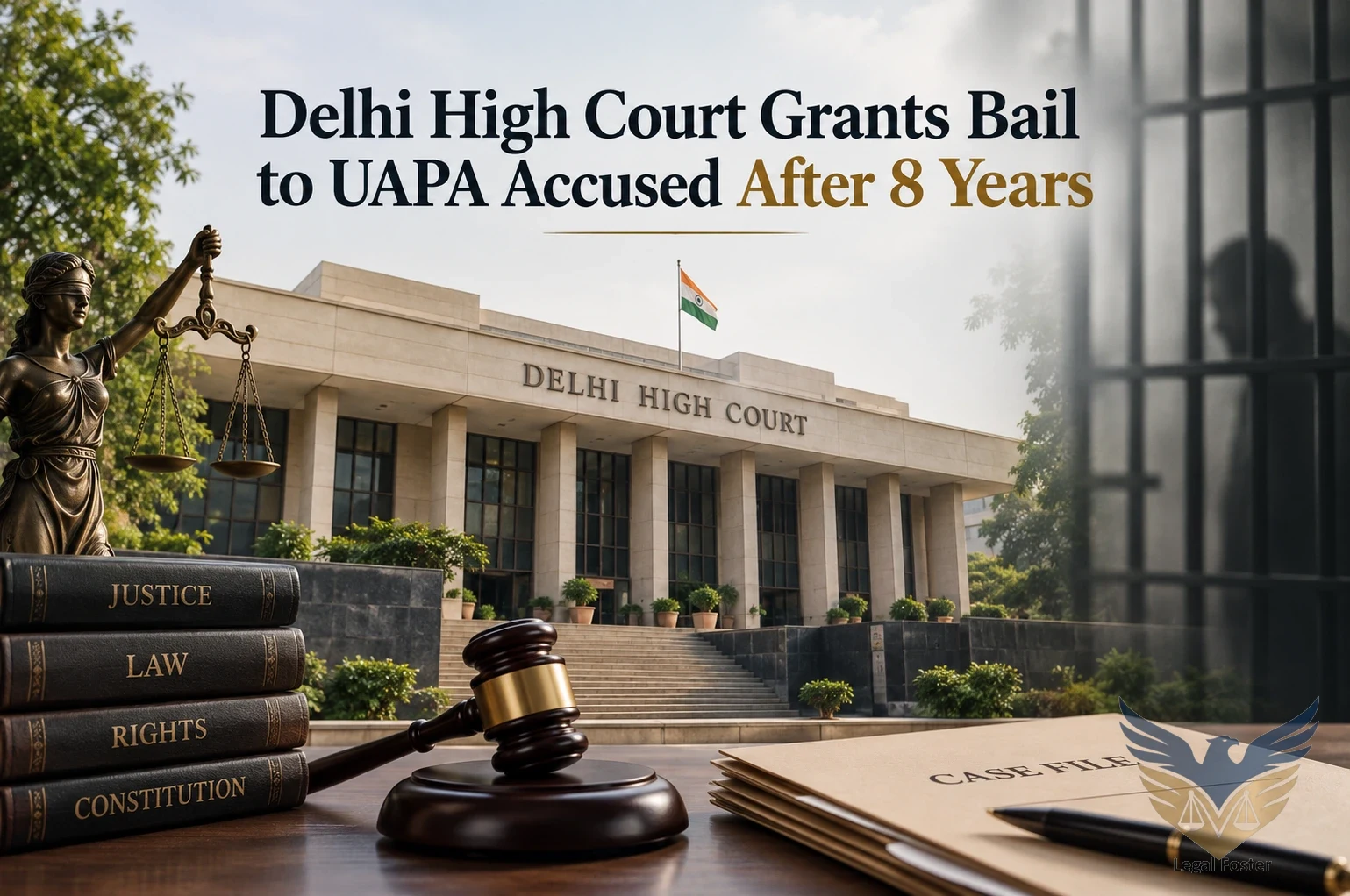
Delhi High Court Grants Bail to UAPA Accused After Eight Years in Custody
Among other things, the Court also ordered that the accused cannot share any anti- national material on Social Media or otherwise.
Delhi High Court Allows Bail To Accused Booked For Waging War Against Government Of India Since Trial Likely To Take Several More Years To Complete
One of the bail conditions imposed by the Court is that the accused cannot share any anti-national material on Social Media or otherwise.
The Delhi High Court on Monday allowed bail to a man who was accused of waging war against government of India. The Court observed that the man had been jailed as an undertrial for nearly eight years and that the trial against him was nowhere near its completion.
The Bench of Justice Navin Chawla and Justice Ravinder Dudeja passed bail to Mohammad Saqib who was booked in 2018 under the Unlawful Activities (Prevention) Act (UAPA), the Explosive Substances Act and the Indian Penal Code.
In 2018, Saqib was arrested in relation to the case. The National Investigation Agency (NIA) had alleged that he was part of a pro- Islamic State module called Harkat-ul-Harb-E-islam. It was further alleged that Saqib facilitated meetings of people with Jaish- e- Mohammed militants for training purposes and had even procured arms to wage war against the government.
The Sessions Judge, Special Judge Court-Patiala House Courts Complex, Patiala House Courts, rejected Saqib’ bail plea. Aggrieved, Saqib approached the Delhi High Court.
In his plea, Saqib claimed that he was only an auxiliary accused and was not involved in the core conspiracy of the terror plot.
The NIA opposed Saqib’s bail plea and submitted that “synonymous cannot be treated as a reason to grant bail to the appellant”. Further, it added that the delay in the conclusion of the trial cannot be considered a ground to grant bail.
The Court set aside the sessions court’s order and allowed Saqib bail.
Bail Conditions Imposed by the Court
The Court imposed several conditions on Saqib while granting him bail. The Court directed him not to travel outstation, i.e out of his native place in Hapur except to go to Delhi for attending his trial or to report at the NIA office. Saqib must visit the NIA’s office in Lucknow once every fortnight and report there.
He has to surrender his passport to the trial court as well. The Court said that Saqib can use only one mobile phone and/or a landline connection until the trial gets over. He cannot change his mobile number and address during this period. If he wants to change his contact details or place of residence, he must intimate the NIA and the trial court seven days in advance.
The Court also said that Saqib cannot “share or circulate any material that is anti-national in nature on social media or otherwise.”
Mohammad Saqib was represented by Advocate Sarim Naved.
Advocates Rahul Tyagi, Priya Rai, Avinash Kumar Singh, Priyansh Raj Singh and Amit Rohila represented the NIA.