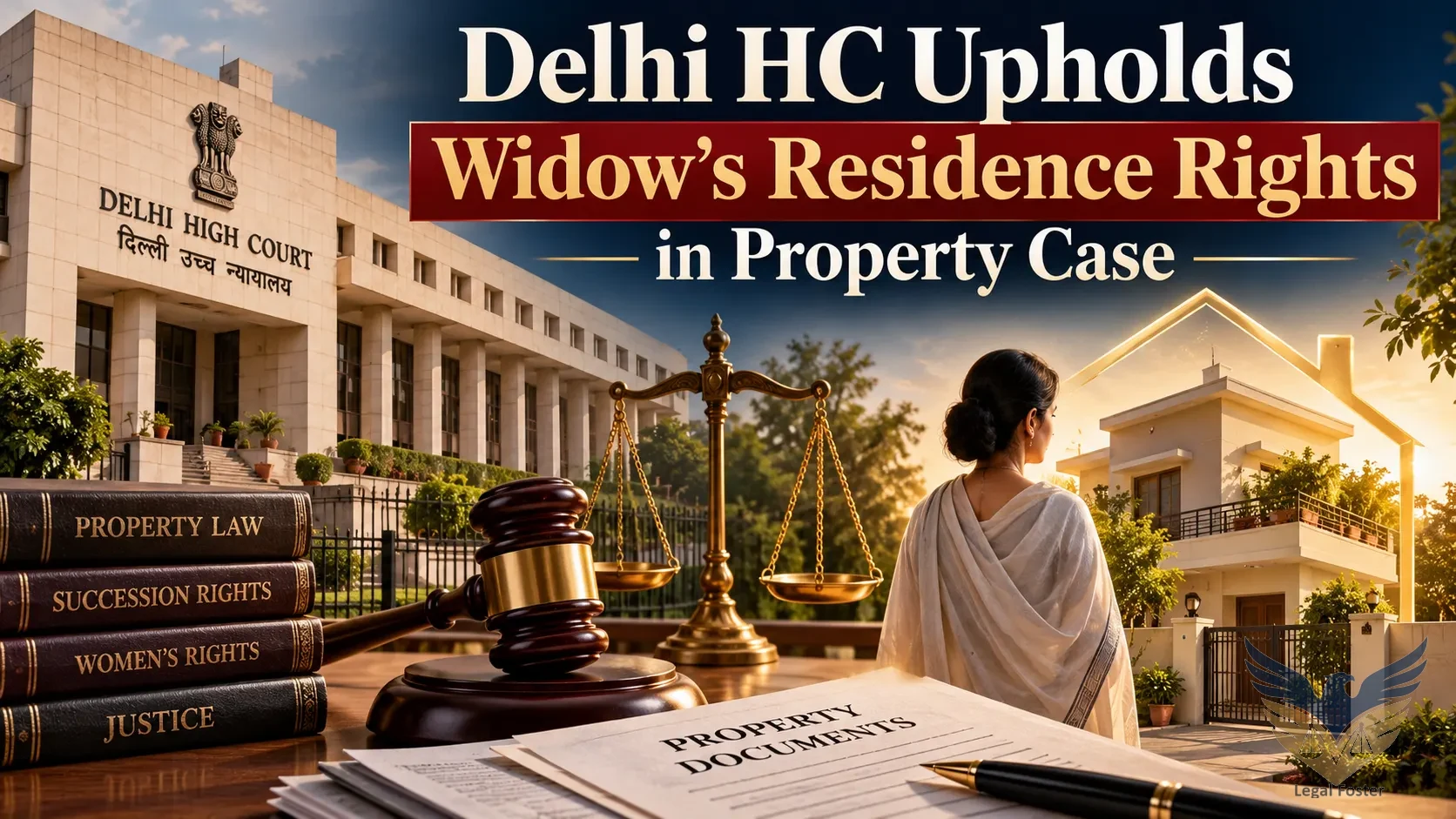
Delhi High Court Directs Son’s Family to Vacate Father’s Property, Upholds Widow’s Right to Residence
Introduction
Can father evict son’s family from his property? Can widowed daughter- in-law claim right to reside in matrimonial house after death of husband?
The Delhi High Court answered these questions in Raj Kumar @ Babbal (Deceased), Through Legal Representatives v. Sh. Attar Singh, Order dated 12 October 2026. Click here to read/download the Order.
The case involved a residential house located in Paschim Vihar, New Delhi where the 1st respondent (son) and his family were residing for many years. Due to conflicts, the petitioner-father approached court to recover possession of the property.
While allowing the claim for possession in favor of the father, the Court issued directions in favor of the widow daughter-in-law to safeguard her right of statutory residence.
Read on to find out how property rights and domestic issues affect women’s right to reside and claim maintenance under Indian law.
Case Details
| Particulars | Details |
|---|---|
| Case Name | Raj Kumar @ Babbal (Deceased), Through Legal Representatives v. Sh. Attar Singh |
| Court | Delhi High Court |
| Judgment Date | 12 October 2026 |
| Bench | Hon'ble Justice Neena Bansal Krishna |
| Case Number | RFA No. 778/2023 |
| CNR Number | DLHC010376462023 |
| Nature of Case | Regular First Appeal concerning possession, mesne profits and residential rights |
| Decision | Appeal partly allowed; possession decree upheld subject to alternative accommodation or rent |
Relevant Legal Provisions
The judgement dealt with -
- Section 96 and Order XLI, Code of Civil Procedure, 1908: First appeals-Regular
- Section 116, Indian Evidence Act, 18 72: Estoppel-Relevance of judgement when point as to title in dispute
- Sections 2(f), 2(s), 17, 19 and 26, Pro ction of Women from Domestic Violence Act, 2005: Explanation-O f domestic relationship-A meaning of residence-Injunction against act of domestic violence-Procedure when aggrieved person is unable to stay away from shared household-Inspection
- Sections 3(b), 19, 21 and 22, Hindu Adoptions and Maintenance Act, 19 56: Maintenance of dependant wife-Residence of wives-Right of residence in certain cases of Hindu widows
- Delhi Rent Control Act, 19 58: Pertaining to Claim of tenant disputed
What Were the Facts of the Case?
The case involved a property which was purchased by Attar Singh, located in Paschim Vihar Delhi.
Purchase and living with family 
As per the court record, Attar Singh purchased the property by virtue of documents dated 29 July 1988.
Attar Singh's sons, Raj Kumar and Rakesh Kumar resided with their family. They later started living separately post disputes.
Raj Kumar, his wife Manju Verma and daughters continued to stay at the disputed property.
Disagreements over occupation
Attar Singh contended that Raj Kumar was residing in the premises with his consent and had not acquired any rights in the premises either as an owner or tenant.
He further complained that Raj Kumar had been permitting sub lease of a portion of the premises for commercial purposes without his consent.
Raj Kumar denied these accusations and maintained that he was paying monthly rent to his father.
Attar Singh published a public notice in June 2006 disclaiming his son and daughter- in-law.
On 1 December 2012, he sent a legal notice revoking the alleged licence and demanding possession of the premises.
Civil proceedings and appeal
Raj Kumar defended the proceedings. But his defence was struck off in September 2014 for failing to pay the costs ordered by the court. He passed away on 25 July 2015. His widow and two daughters were later taken on record as his legal representatives. On 22 May 2023, the trial court passed a decree of possession in favour of Attar Singh. He was also awarded mesne profits of ₹10,000 per month starting from 1 January 2013. Raj Kumar's widow and daughters appealed against this order to the Delhi High Court.
What Legal Issues Did the Delhi High Court Consider?
The issues framed were:
- As to whether the plaintiff, Raj Kumar was holding over with the permission of the defendant or by virtue of an enforceable tenancy/right in the property.
- Whether the property was a shared household of the defendant wife within the Domestic Violence Act.
- Whether residence right of a widowed daughter in law extinguished by death of husband.
- Whether a father in law can oust himself out of possession by reason of his ownership.
- Whether alternative accommodation had to be offered and whether mesne profits were rightly awarded.
The key issue was to see if ownership overrode a statutory protection from homelessness.
What Arguments Were Presented?
Filed by the appellants 
Appellant Manju Verma along with her daughters filed this appeal against the decree passed by the trial court.
They argued that the property in question was her matrimonial home and shared household where she lived along with her husband and his family in a domestic relationship. She could seek relief under Sections 17 and 19 of the Domestic Violence Act, 2005. They also questioned the manner in which their right to defend was limited and trial court ignored their right of statutory residence.
A plea was also made that the property was purchased from the joint family funds.
Filed by the respondent 
Respondent Attar Singh, on the other hand contended that the house was his self-acquired property. His son and family members were residing there as tolerated persons and he had already asked them to leave.
It was also denied by him that the property was purchased out of joint family income. It was also contended that appellants had no right to remain on the premises and trial court had rightly awarded possession along with damages.
What Did the Delhi High Court Observe and Decide?
1. Does living in a father's property create ownership rights?
The Court considered the evidence regarding acquisition and possession.
The Court stated that there was no document to show that Raj Kumar had contributed to buy the property or that it was purchased out of the funds of joint family business.
Citing D. S. Lakshmaiah v. L. Balasubramanyam, (2003) 10 SCC 310, the Court held that the character of joint family property is not imbibed in a property merely because the family itself is joint.
The Court also noted down Raj Kumar's admission that the property belonged to his father and the applicability of Section 116 of Indian Evidence Act.
2. Can a daughter-in-law claim residence without ownership?
The High Court separated out proprietary title from residence rights under statute.
Pursuant to S.2(s) of DV Act, the dwelling can constitute a shared household notwithstanding the fact that neither is owned by the woman/husband.
Courts were guided by Satish Chander Ahuja v. Sneha Ahuja, (20 21) 1 SCC 414 & other judgments.
The family's residential history was reviewed and it was acknowledged by father that they stayed together.
3. Does a husband's death automatically end his widow's residence rights?
Answering this question, the Court said no.
"The Court said that it was referred to Prabha Tyagi v. Kamlesh Devi, (2022) 8 SCC 90 where issues pertaining to statutory right of a woman in domestic relationship to reside in shared household were dealt with.
"It further clarified that death of husband cannot extinguish the legal protection available to widowed daughter- in-law by itself.
"The Court went on to address the impact of the public notice issued by father in 2006.
"The Court stated that notice issued subsequently which mentions disowning of family members could not wipe off existence of domestic relationship which subsisted earlier."
4. What maintenance rights does a widowed daughter-in-law have?
The Court then considered Section 19 of Hindu Adoptions and Maintenance Act, 1956.
Such person is referred to a widowed daughter- in-law and that section lays down her right to maintenance subject to certain statutory conditions in relation to her own means, means of maintenance available to her otherwise and the means of the father-in-law out of the coparcenary property.
Section 3(b) elucidates maintenance to include the provision of residence.
The High Court cited Kanchana Rai v. Geeta Sharma, 20 26 INSC 54 on the topic of Maintenance and dependent widow.
Regarding the instant matter the Court noted that there was no material on record to prove that Manju Verma had any independent source of income or owned any property or had any estate left by her husband for her maintenance.
5. Can an owner still recover possession of a shared household?
Yes it does.
The Court observed that protection of shared-household can neveroutrule the absolute right of an owner of the property lawfully acquired by him.
DV Act, Section 17(2) expressly envisages eviction in accordance with law.
Such eviction can proceed through a civil suit for possession properly instituted.
Orders directing possession would thus be maintainable, however courts would have to take into account the statutory rights of residence before granting relief.
Delhi HC was evidently influenced by the principles enunciated by this Court in Ravneet Kaur v. Prithpal Singh Dhingra, 2022 SCC OnLine Del 594.
An attempt was made to ensure protection of ownership without depriving a poor widow of a roof over her head.
What Was the Final Judgment?
The Delhi High Court partially allowed the appeal and modified the impugned judgment dated 22 May 2023 as passed by the trial Court.
The operative part of the Decision passed three directions.
Direction 1 : Confirmation of Possession Decree
The High Court upheld Attar Singh‘s decree of recovery of possession.
Direction 2 : Furnishing of alternative accommodation or rent
Execution of the said decree would be stayed until such time as the respondent arranged alternative accommodation for Manju Verma in the same neighborhood or suitable accommodation comparable to her current accommodation along with her daughters and pending such arrangement is made, she deposited ₹15,000 per month as rent money.
The executing court would ensure compliance with the above direction before allowing execution of the possession decree.
Direction 3 : Damages Awarded by Trial Court Set Aside
The Delhi High Court set aside the award of ₹10,000 per month as damages/mesne profits. It was observed that evidence regarding the ready rent value of similar accommodations was not adduced. Further, the protection under the statute granted to the widow was also taken into consideration.
Note: No Ownership of the premises was given to the widow and her daughters.
Key Legal Principles Established
Some of the principles stated in this judgment are:
Ownership and residence are distinct concepts. Right to residence is not equal to ownership in a property.
Right to residence can be granted to a woman under the Act and it does not translate into ownership of the property.
Fact that a property is the residence of a family does not make it joint family property. The claim of joint family property has to be substantiated.
Merely because a woman is a widow, she cannot be said to have lost her right to residence. The existence of domestic relationship cannot be ignored.
Issue of notice for disposal from a family does not negate the operation of statute. The effect of such notice has to be considered.
Decree for possession cannot automatically be enforced. Necessary directions can be given to protect the right to residence of a woman under the Act.
Mesne profits have to be duly justified. Award of mesne profits on a per annum rent suggested by the appellant cannot be allowed.
What Is the Impact of This Judgment?
Legal Challenges for Homeowners and Parents:
Judgment allows owners to file legal actions to reclaim possession from relatives who have no individual title or tenancy rights in the property.
But the laws that grant special rights to women who live in a shared household cannot be overruled
Legal Challenges for Widowed Daughter-in-Laws
Court clarifies that death of husband does not automatically extinguish rights in the matrimonial home.
Poverty, Availability of alternative accommodation & Right to statutory maintenance are factors that can be considered by Courts before allowing eviction.
Lesson for Lawyers and Family Courts:
Property disputes between relatives would now have to be viewed through the lens of civil property laws as well as the law regarding protection of domestic relations.
Pleadings made by parties, proving ownership, claim of maintenance and availability of alternate accommodation can affect the kind of relief granted.
Why Does This Judgment Matter Today?
Landmark judgement: Family disputes often relate to parents and married sons and daughters-in-law who reside together without any tenancy agreement.
What happens when a marriage breaks down, a family member passes away or financial dependence persists?
Its significance is that it illustrates how someone's right to property can be balanced against preventing sudden homelessness.
It highlights that the right to possession and entitlements to exercise that right are not synonymous.
Frequently Asked Questions (FAQs)
Q1. About whom is the Delhi HC Orders Son’s Family To Vacate Father’s Property judgment?
Answer: Delhi HC Orders Son’s Family To Vacate Father’s Property judgment is about a dispute between a father and his deceased son’s widow and daughters. The father moved the court for possession of his property where his son’s widow and daughters were staying.
Q2. What order did the Delhi HC pass in this case?
Answer: The Delhi HC allowed the father’s appeal and affirmed his right to possession. However, before evicting the son’s widow and daughters from the property, the father must provide alternative accommodation to them or pay ₹15,000 as monthly rent to the son’s widow.
Q3. Can a father take back his married son’s possession from his own self-acquired property?
Answer: Yes. But the father will first need to establish that his adult married son has no right to compel him to permit his continued occupation of the father’s property. If the adult son has no legally enforceable right to reside on the parent’s property, the parent is entitled to recover possession of his property from the son.
Q4. Can daughter in law claim ownership rights over parents-in-law’s property?
Answer: Daughter in law cannot automatically acquire rights in the property of parents-in-law upon marriage. The daughter in law can get residence rights in her husband’s parental property, if it qualifies to be his shared household under the relevant statute.
Q5. Can a daughter in law live in a parental house after son’s death?
Answer: Yes. Provided the son was alive during her marriage and after marriage, she can get protection of her residence in her father-in-law’s house even after the death of her husband. But that will not mean that she can go and stay in one specific house belonging to someone indefinitely.
Q6. Why did Delhi HC direct to pay ₹15,000/- monthly rent to son’s widow?
Answer: Delhi HC observed that alternatively, the respondent No.1 (father) can be given time by this Court to arrange alternative accommodation for the respondent No.2 widow (daughter-in-law) either in the same locality or in the neighbourhood before she is evicted and made to vacate the premises in question.
Q7. Why did the Delhi HC strike off damages of ₹10,000/- per month?
Answer: Delhi HC allowed the appeal filed by the father and reduced the mesne profits awarded to ₹15,000/- per month by the trial court as it felt that there was no evidence on record to show the rental value of the suit property nor was there any evidence of similar premises.
Q8. Does posting newspaper advertisements disowning the son severs all legal relationships with him?
Answer: No. No legal relationship with son will be severed by posting a newspaper advertisement disowning him. The High Court while upholding the Tribunal’s order held that on account of newspaper advertisement which the father had published disowning his son, the relationship which existed between the son and the father during the lifetime of the son has not ceased to exist in respect of the widow.
Q9. Under which laws are widowed daughter in laws protected from eviction from her parent-in-law’s house?
Answer: Section 17 and Section 19 of Protection of Women from Domestic Violence Act, 2005, deals with residence in shared household. Also, widow daughter in law is entitled to maintenance, including reasonable accommodation from her father-in-law under Hindu Adoptions And Maintenance Act, 19 56
Q10. Will this judgment stop all evictions of daughter in laws from their parent-in-laws’ properties in India?
Answer: No. Daughter in laws cannot avoid eviction from their parent-in-laws property in all cases. The daughter in law will have to separately establish her right to reside in a specific house belonging to her parent-in-law. She cannot just take his property on the basis of this judgment.
Conclusion
Raj Kumar @ Babbal (Deceased), Through Legal Representatives v. Sh. Attar Singh Judgment, 12 October 20 26 Del. HC
High Court of Delhi
FaIR use 29 – Law relating to ownership rights and right of residential of widowed daughter-in-law to reside in a property
Brief Facts: The Delhi High Court has affirmed the father’s right to possession with consequential provision for making arrangement for residence of the widow daughter in law before execution of the writ.
Court also set aside the award of mesne profits.
Direction by Court reflects that Courts in India are called upon to balance different legal rights and grant relief in a manner that is not unlawful.
This judgment is significant insofar as it acknowledges that ownership of property is a right that ought to be protected by law. However, the right of a woman to reside in a place granted to her under the statute cannot be denied on the ground that she has no stake in ownership of such a place.