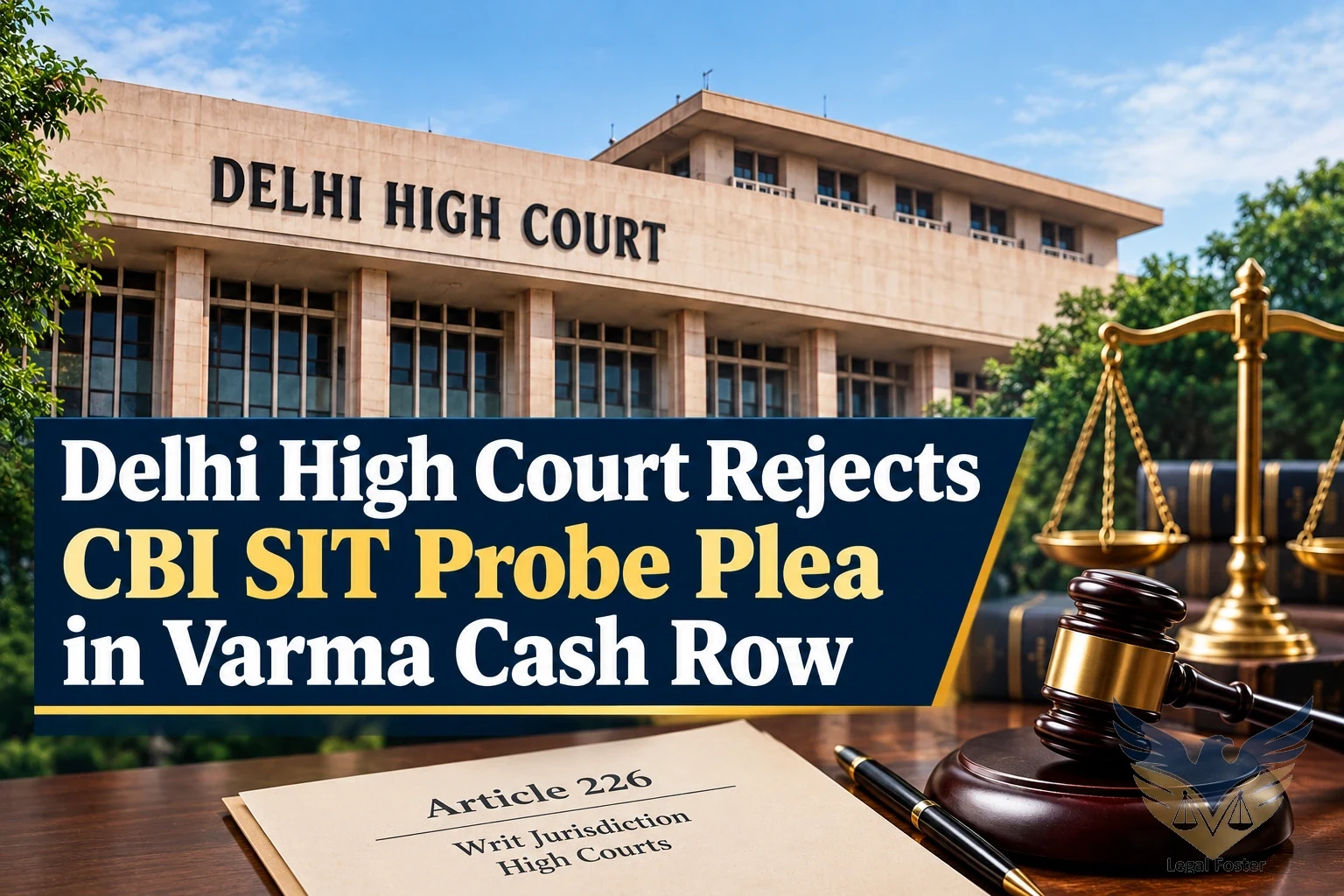
Delhi High Court Refuses CBI/SIT Probe Plea in Justice Yashwant Varma Cash Row
Introduction
On 21 September 2026 , the Delhi High Court dismissed an application seeking directions for registration of an FIR and investigation by CBI/SIT into alleged offences pertaining to recovery of currency notes from Justice Yashwant Varma’s residence when he was a sitting judge of the High Court. Justice Amit Bansal raised issues as to maintainability of the application, locus of the petitioner and crucially as to why reliefs which were available ordinarily before the police and the competent criminal court were not sought. The Court characterized the litigation at hearing as a “wild witch hunt” and refused to entertain the application praying for such extraordinary directions.
Importantly, this order is notable not because Delhi High Court sat in judgement whether allegations against Justice Varma were true or false (it did not), but rather what it means when a person has access to remedies under criminal law and refuses to exhaust them, preferring to approach this Court in exercise of its extraordinary writ jurisdiction.
What should also be carefully noted is that the order also needs to be read distinctly from earlier proceedings in the Supreme Court on the same saga.
Case Details
Relevant legal framework:
- Article 226 of the Constitution of India- High Courts- writ jurisdiction
- Ordinary criminal-law remedies- Approaching police and thereafter the concerned Magistrate in case the grievance relating to registration or investigation of an offence is not remedied.
- Judges (Inquiry) Act, 19 68- reference to the separate Statutory inquiry mentioned in the petition.
- Constitutional and institutional mechanism for inquiry into allegations against constitutional- court judges.
The Delhi High Court neither enquired into criminal liability nor pronounced upon any specific penal offence in its order dismissing the petition.
What Was the Background of the Justice Yashwant Varma Cash Row?
The origin of the controversy is said to lie in a fire that broke out in the intervening night of 14–15 March 2025 at a storeroom or outhouse/attached to Justice Yashwant Varma's former official residence at 30, Tughlak Crescent, New Delhi. Newspaper reports and material that was later placed before proceedings mentioned currency burnt or partially allegedly seen by those involved in firefighting efforts at the site. Questions were raised over the incident.
Follow-up internal proceedings into the matter were initiated. Justice Varma was transferred from the Delhi High Court to the Allahabad High Court. Work had also been ordered withdrawn from him whilst Justice of Delhi High Court during the controversy. Proceedings were also instituted separately in court and Parliament.
In August 2025, the Supreme Court dismissed Justice Varma's petition challenging the initiation of the in-house inquiry against him. The Supreme Court observed inter alia that the procedure adopted in initiating the in-house procedure against Justice Varma was neither illegal nor an unconstitutional "parallel scrutiny mechanism."
Justice Varma's petition challenged the initiation of the in-house inquiry on procedural grounds. The controversy later came up before Parliament initiating proceedings under law providing for inquiry into the conduct of judges. Referring to material relied upon in a petition filed in Delhi High Court in September 2026, a three-member statutory committee appointed under the Judges (Inquiry) Act, 1968 to inquire into the allegation held the three charges referred to it were proved.
However, it did not make a finding akin to that in criminal law that Justice Varma himself owned the money. The committee's report was submitted to Parliament on 12 August 2026. Justice Varma has consistently denied any wrongdoing.
Why Did Advocate Ghanshyam Upadhyay Approach the Court?
Advocate Ghanshyam Dayalu Upadhyay had prayed for registration of an FIR and independent investigation into issues such as alleged existence, sourcing of money, ownership, custody and then disappearance/removal of money allegedly found during searches at the house.
The plea also spoke about alleged non-preservation of evidence. we learn
Petitioner in his claim states that he had filed a complaint on 2 June 20 and approached SC when his FIR was not registered. Reportedly,
A Bench of Justices P. S. Narasimha and Alok Aradhe refused to entertain his plea for FIR registration and court supervised probe on 7 August 20.
After the statutory panel submitted its report, he is said to have filed another complaint on 17 August 20 and then approached Delhi HC.
What Legal Issues Were Before the Delhi High Court?
This Court had noted that the main questions before it were not a trial of allegations. They were procedural.
Can FIR & CBI or SIT investigation be ordered by the High Court suo motu?
The petitioner sought to invoke the inherent jurisdiction of the High Court to direct investigation by agencies specialised for the purpose.
The Court then posed the question as to why the petitioner sought to deprive himself of remedies ordinarily available before the police and the competent criminal court.
Did he have sufficient locus to make such a prayer?
The learned Additional Government Advocate also agitated the said objection on behalf of the respondent authorities.
Must extraordinary investigation be ordered only on the ground that allegations were against a former constitutional- court judge?
Petitioner tried seeking succour in unusual and serious nature of allegations.
But this Court did not find this sufficed, on its own, to deprive the petitioner of remedies available under ordinary laws.
What Did the Petitioner Argue?
Appearing for himself, Advocate Upadhyay described the issue as one of “rare nature”. Upadhyay’s main point was that a regular Magistrate would not be able to order the kind of investigation demanded, especially an investigation by the CBI or an SIT formed for the purpose.
He said the petition not only demanded investigation into the purported recovery of currency but also aspects related to its origin, custody, ownership, whereabouts and disappearance and alleged official’s failure to ensure preservation of evidence. Hence, he said petitioner deserved constitutional scrutiny and an independent probe.
What Did the Respondents Argue?
Central Government Standing Counsel Premtosh Kumar Mishra, appearing for the Union of India and the CBI, pointed out that the petitioner had previously approached the Supreme Court and that the earlier petition had been rejected.
The respondents also challenged the petitioner's locus.
More importantly, they submitted that alternative remedies remained available: the petitioner could approach the Delhi Police and thereafter seek appropriate relief before the competent Magistrate or criminal court.
This availability of ordinary remedies became central to the High Court's approach.
What Did the Delhi High Court Observe?
Justice Amit Bansal declined to entertain the petition.
This Court raised questions both as to locus and the petitioner's choice of writ jurisdiction over well-defined criminal-law remedies.
Don’t read too much into that comment.
The Court did not say that something improper did not happen in the original cash scandal when it declined to entertain this petition. The Court did not say that allegations, some of which have been investigated by other agencies, are untrue.
The question before this Court, based on the pleadings and materials presented to it, was whether this petitioner could immediately come to this Court to seek an extraordinary remedy from the High Court in the form of an FIR and a CBI/SIT probe when other remedies existed.
Keep that in mind if you read the judgement below.
What Was the Final Decision?
The Delhi High Court refused to issue the prayer made for registration of FIR or investigation by CBI/SIT.
Allowed the petitioner the liberty to approach any appropriate forum.
Here are the recent reports on how exactly the matter was disposed of:. One says that The Court dismissed/denied to entertain the petition after petitioner requested the Court to allow him to withdraw while another says that petitioner was allowed to withdraw his petition. The bottom line remains the same that Delhi High Court passed no order for FIR to be registered or investigation to be conducted by CBI or SIT.
Therefore, this judgement cannot be reported as Justice Varma being acquitted nor can it be reported as a finding on the merits of the cash findings against Justice Varma.
What Legal Principles Can Be Understood From the Decision?
The order is best understood as an application of established procedural principles rather than as a broad new precedent.
How Does the Earlier Supreme Court Decision Differ?
This can get confusing because Advocate Upadhyay had previously filed a petition in Supreme Court as well.
He filed a petition on 7 August 20 26 in Supreme Court asking for an FIR & a court monitored SIT investigation. The Bench involved was Justice P. S. NARASIMHA/ASHOK KUMAR MEENA & Justice Alok Aradhe. According to some sources the Supreme Court viewed his plea as an attempt to misuse its jurisdiction & mentioned the previous suits filed over the controversy.
The judgment dated 21 September 20 26 which I am referring to here, is from Delhi High Court & Justice Amit Bansal.
Hence the two matters shouldn't be conflated while doing case-law digests, metadata or reporting.
What Is the Practical Impact of the Delhi High Court Decision?
Lawyers dealing with petitions praying for court monitored investigations will find this judgment useful.
It is a lesson in how allegations against a public office, particularly one with high constitutional obligations, does not become an extraordinary remedy by default.
A petitioner praying for an FIR or investigation will need to be extra careful about aspects of maintainability, locus, res judicata based on previous proceedings and the remedies already available at the police and Magistrate stage.
For investigative agencies and public authorities, this order also makes it clear that an institutional investigation is a separate aspect from criminal investigation.
For lawyers who publish judgments, please take special note that the orders of the High Court refusing relief procedurally cannot be construed as adjudication of Justice Varma's criminal liability.
Why Does This Judgment Matter Today?
The order straddles issues of judicial accountability, criminal justice and constitutional remedies.
On the one hand, the legitimacy of the judicial system demands that accusations against judges be investigated fairly. On the other hand, allegations have to meet the test of admission set by the constitutional courts if their custodial intervention is sought.
Passed on September 20,26, the order represents a judicious balance…
it strikes between these claims.
The Delhi HC did not venture to pass any judgement on the veracity of the allegations of cash gifts.
Nor did it start any probe into that aspect. It merely examined whether the petition before it made a case for reopening investigations (with the order to file an FIR) by extraordinary means – that is, through court supervision mandating investigation by the CBI or an SIT instead of the statutory legal channels.
It is this focus on procedure that lends the order its overriding significance.
Frequently Asked Questions
Q1. About the discovery of cash in Justice Yashwant Varma’s office what was the order passed?
Answer: The order was passed in connection with a plea seeking registration of FIR and initiation of investigation by the CBI/SIT into alleged incidence of discovery of currency notes/hardoney at the official residence of Justice Yashwant Varma after fire there on March 20,25. The Delhi High Court did not allow this plea and denied extraordinary relief sought.
Q2. Which court passed this order?
Answer: The order discussed here was passed by Delhi High Court on 21 September 2026. The Hon’ble single Judge bench of Justice Amit Bansal was hearing the case. Earlier also a petition related to this issue was dismissed by Supreme Court on 7 August 2026.
Q3. Who approached Delhi High Court in this case?
Answer: The petition was filed by Advocate Ghanshyam Dayalu Upadhyay before Delhi High Court. He demanded FIR registration and independent investigation by CBI/Special Investigation Team about allegation of discovery of currency notes/hardoney whatever at the residential official premises of Justice Yashwant Varma.
Q4. The Court held Justice Yashwant Varma not guilty of any criminal act?
Answer: No. The Delhi High Court in this order did not conclude Justice Yashwant Varma’s criminal guilt/innocence in above said controversy. It only ruled upon the question whether the petitioner is entitled to such extraordinary relief of directing FIR registration and investigation by CBI/SIT in the writ petition filed before it.
Q5. Why Delhi High Court refused to direct CBI/SIT inquiry in this case?
Answer: The Delhi High Court firstly scrutinized the locus of the petitioner to file this writ petition and pointed out that the petitioner has remedy under ordinary laws first to approach to Police and then to the competent Criminal Court. Hence, the Court refused to exercise its extraordinary powers in the said matter.
Q6. What was said by Justice Amit Bansal about this petition?
Answer: During the hearing, Justice Amit Bansal stated that this proceeding is nothing but “wild witch hunt”. Please note that the Court refused to entertain the writ petition and so far the conclusion of this matter is concerned let us wait for the final judgment. Here the word wild witch hunt was used by the judge just because of the nature of petition.
Q7. On the same issue did Supreme Court reject any petition?
Answer: Yes. Earlier on 7 August 2026 the Supreme Court Bench of Justice P. S. Narasimha & Justice Alok Aradhe also refused the plea sought by Advocate Upadhyay for registration of FIR and court monitored investigation.
Q8. The decision involved Article 226. What does Article 226 say?
Answer: Article 226 of Indian Constitution confers wide powers in the shape of writ jurisdiction upon the High Courts. But in a case where the petitioner has an option to seek remedy under ordinary laws i.e. firstly to approach Police and later to the competent Criminal Court, High Court can choose not to exercise its extraordinary jurisdiction.
Q9. Is the order of Delhi High Court rejecting the order by various inquiry committee’s findings?
Answer: No. Delhi High Court by this order did not reject/interfere with the findings of any Committee because earlier inhouse/investigation and later committee appointed by Ministry of Justice heard this separate allegation against Justice Yashwant Varma. These committees findings are different and Delhi High Court here only took notice of the writ petition filed by Advocate Upadhyay for seeking registration of FIR and investigation by CBI/SIT.
Q10. What is the law learned from this order?
Answer: Law majorly learned from this order is that, mere seriousness of the allegation is not enough to entitle a person to seek investigation by CBI or SIT by invoking the writ jurisdiction of High Court. Courts can see into the locus of a person to file a petition, see if the petition is maintainable or there is alternative remedy available before passing such extraordinary order under Article 226.
Conclusion
The Delhi High Court judgment in the Justice Yashwant Varma cash- row CBI/SIT probe plea is at its heart a judgment on the appropriate exercise of extraordinary writ jurisdiction. Denying Advocate Ghanshyam Dayalu Upadhyay's plea for a High Court directed FIR and specialised investigation into the matter, Justice Amit Bansal raised issues of locus as well as existence of ordinary remedies available with the police and the competent criminal court to hear the matter.
The Court did not pronounce upon criminal liability, responsibility for the alleged cash nor did it pass upon the ultimate truth of the allegations made. Lawyers and litigants would do well to note that even in a case involving significant public interest, the presence of an alternate remedy under the law can be a determining factor if one attempts to approach higher courts for extraordinary constitutional relief.