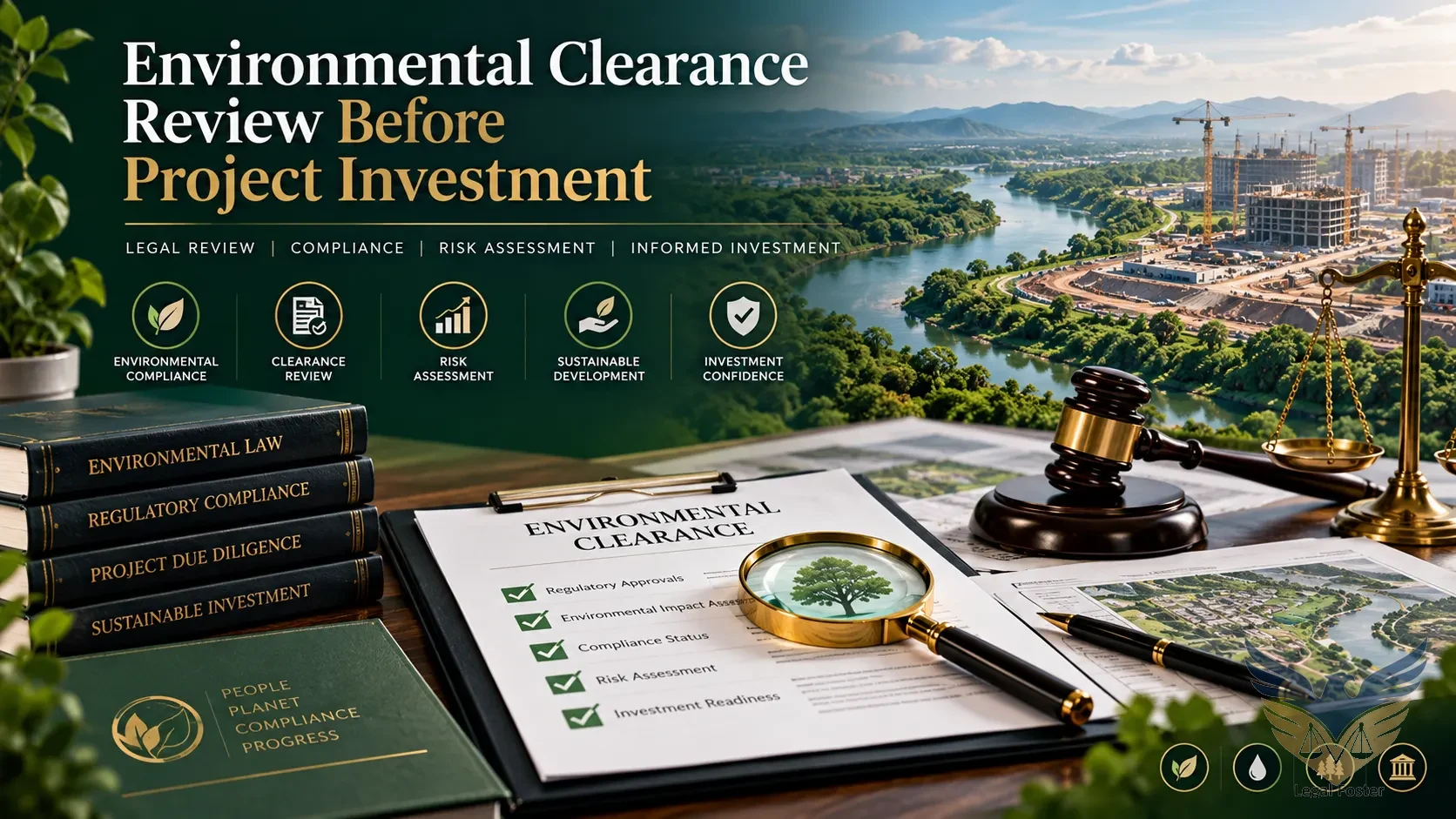
Why Should Investors Review Environmental Clearance Before Funding a Project?
While you would normally carry out diligence on financials, title to ownership, approvals for construction, title to land, zoning, market value,etc. before buying an investment property/project or lending money to a project/client. Diligence on environment compliance/status of Environmental Clearance (popularly known as EC) is one area that investors/buyers usually overlook.
That investment you are about to make could be earning you profits today on paper but come back to bite you years down the line through delays in obtaining approvals from regulatory agencies, notices/stoppage by regulators, conditions on your operations, paying penalties, litigating with regulators and local communities etc. and hamper your investment’s profitability.
Have Environment lawyers review the EC that is in place for a project you plan on investing into/funding before you buy/invest. Get a legal due diligence done to identify any potential compliances, gaps in approvals and what approvals are needed, current regulator concerns etc. prior to cutting that investment/funding cheque.
Environment due diligence helps you, businesses, lenders, investors, and purchasers understand
Whether the project has obtained all the permissions it needs to operate and whether those permissions allow you to do what you intend to do at the project/site (i.e. do the development activities you propose to carry out at the site align with the permissions obtained?)
India has a well defined process laid down under Environmental (Protection) Act, 1986 and the Environmental Impact Assessment Notification, 2006 and various regulations passed by Ministry of Environment, Forest and Climate Change (MoEFCC) and State Environment Impact Assessment Authorities (SEIAA) to grant environment clearance to industrial projects.
BK Singh Advocate / Lawyer / Firm Name (NGT Lawyers) help a number of clients AFTER they have received a notice/objection by the concerned regulator/agency or the project is stuck and not able to obtain approvals due to regulatory/localities concerns. Why wait for your funds to get stuck in a project that is facing regulatory hurdles. Consult us at the investment stage itself.
BK Singh assists businesses operating in Delhi NCR, Noida, Gurugram, Ghaziabad, Faridabad and other industrial/commercial belts in India understand their environmental compliances related to their project/property/plant. We review the ECs and assist our clients understand whether the permissions they obtained for the project are fit for your purpose at the project site.
Why Environmental Clearance Review Matters Before Project Investment in 2026?
Environmental due diligence has become increasingly important to developers, industrial units, infrastructure companies, lenders and private equity investors. Many projects are discovered downstream (when the money is already tied up in developments) that incomplete or lack proper environment approvals.
When purchasing a commercial asset or investing into a development, the buyer/investor should be aware if the subject project had any prior Environmental Clearance and if the approval/documents allow for the activity the buyer intends to conduct. Environmental Clearance is granted based on the level of environmental impact. Projects are often bound to meet specific conditions to ensure compliance with environmental regulations and stay in line with compliance obligations.
Projects get approved for “x” amount of floors, built up area or construction but proceed to build more after breaking ground. Industrial projects and activities may require to obtain additional environment clearances before even commencing operations. Variances such as these between what was approved/granted and what is actually being conducted can open the project/asset up to risk from regulations.
Environmental due diligence is becoming common practice when investing or lending into projects in major cities such as Delhi, Noida, Greater Noida, Gurugram, Mumbai, Bengaluru, Hyderabad, Chennai and Ahmedabad. As most construction projects, industrial development and infrastructure development are required to obtain regulatory clearances.
Investors/Lenders are looking at environmental risks because they do not want regulatory uncertainties affecting:
- Timely completion of the project
- Financing
- Valuation of the asset
- Operations
- Ability to transfer/ sell
- Future prospects
- etc.
There have been many cases filed at the environmental regulators and National Green Tribunal (NGT) because parties didn’t conduct an environmental approvals assessment prior to entering into an agreement/transaction.
Have BK Singh Advocate or our firm conduct your legal due diligence to uncover any potential issues with Environmental Clearance(s), compliance/status reports, required regulatory approvals, and any other environment obligations the project may have prior to moving forward with your transaction. (NGT Lawyers)
Quick Facts
Need for Environmental Clearance depends on category,size and location of project.
- The umbrella legislation for protection of environment in India is The Environment (Protection) Act, 1986.
- Projects that need Environmental Clearance are defined in EIA Notification, 2006.
- Terms of approval highlights conditions to be followed whilst implementing a project cleared under environmental laws.
- Don't forget the environment check before you invest/buy a project. There can be unseen future liabilities!
- The NGT has jurisdiction over all environmental issues arising out of or under the following laws
- Environmental due diligence is done to identify document gaps, if any, and likely compliance issues.
What Does Legal Review of Environmental Clearance Actually Mean?
An Environmental Clearance legal review determines if a project has received environmental approvals and if so, were they obtained legally. It also reviews whether the activity being undertaken is being done in compliance with any environmental conditions.
The review tries to determine how the approved plan translates into the actual development/activity on the ground.
For the buyer/investor it's more than just was an approval document issued. Does the approval insulate the investment from future environmental claims?
A thorough environmental legal review will include:
- Did the project undergo Environmental Clearance? Did they get approval from the appropriate party?
- Was an EIA done if necessary?
- Are they complying with all conditions of approval?
- Are there any pending notices/complaints/proceedings?
- Do the environmental approvals match up with purpose of purchase/funding?
A registered property or approved plan of development means there will be no environmental issues with your project. Falling into this trap will create headaches for you in the future. Each approval process is done under different statutes.
The fact that something is approved by a municipal agency, has building rights or you own the property does not automatically mean it will pass environmental muster.
Environmental Due Diligence gives you another layer of protection by evaluating environmental regulatory compliance.
Legal Framework Governing Environmental Clearance Before Buying or Funding a Project
Prior to committing funds into a venture where there maybe existing Environmental liabilities, it is always advisable to at least know Environmental laws under which Environmental Clearance is dealt with. In India, granting of environmental clearances isn’t done through a single approval document. There are numerous statuary provisions & regulating authorities, classification of projects, studies to be carried out to assess impacts, conditions to follow etc.
The Primary act under which Environmental Clearance is dealt with is The Environment (Protection) Act, 1986 which simply empowers the Central Government to take all such measures as it deems necessary to protect and improve the environment. The government over years has notified/issued certain rules to govern the regulation of projects under their respective purview of potential environmental impacts.
Some of the Notifications are as follows
Environmental Impact Assessment Notification, 2006 – Projects are categorized under this Notification to determine whether a project would require prior Environmental Clearance or not.
Depending on which category the project falls under, depending upon its size, nature and potential impacts it may affect. A project would typically need approval from the concerned Authority. Depending on the category & location of the project, approval shall be given by……………
- Ministry of Environment, Forest and Climate Change (MoEFCC)
- State Environment Impact Assessment Authority (SEIAA)
- State Expert Appraisal Committee (SEAC)
- Any other authorities from whom environmental clearance is required.
Buyers/investors/lenders should verify whether approvals were obtained from the proper authority and the terms of approval are being followed as per the project activities undertaken.
How Do Environmental Clearance Approvals Affect Buyers and Investors?
Environmental Clearance may directly affect the legality and bankability of projects. Projects with unresolved environmental issues can be restrained even if they appear otherwise fully permitted.
For example, a commercial project may have legally executable land titles and municipal construction permits but develop contravening agreed environmental terms or without receiving necessary approvals. Ask investors if:
- Obtained all approvals before starting project work Where Applicable
- Project is working within approval requirements
- Made changes to construction or operation without approval
- Keeping Up With Compliance Reports/Documents
Environmental risk can be a major factor when it comes to funding as banks and investors do not want their project to encounter any regulatory hurdles. Doing your due diligence before investing allows you to discover any legal road bumps before they become financial road bumps.
NGT Lawyers, BK Singh Advocate / Lawyer / Firm Name can assist individuals, businesses and investors with reviewing environmental compliance for projects and transactions.
What Role Does the National Green Tribunal Play in Environmental Disputes?
NGT means National Green Tribunal. National Green Tribunal was established under National Green Tribunal Act, 2010. It is a specialized wing to provide environmental justice by delivering expeditious remedy to the people.
NGT deals with matters relating to the environmental laws mentioned in Schedule of NGT Act. NGT deals with civil cases only and decides the disputes related to environment protection and conservation.
Projects can get caught up in NGT. If there are problems related to environment, NGT can hear those. Sometimes the NGT has the authority to adjudicate on these problems. Examples include:
- Environmental Clearances Legal Terms:
- Terms of Approval Under Compliance,
- Environment Related Issues,
- Environment Damage,
- Suits Alleges,Orders Passed by the Agency.
Pending or threatened environmental litigation and government enforcement actions can affect the intended use of the transaction value asset and what that asset is worth to potential buyers and lenders. Always be sure to inquire as to whether there are any pending environmental litigation, notices, objections or Orders from the Agency related to the transaction you are involved in. BK Singh Advocate / Lawyer (handling NGT cases) will perform a legal due diligence investigation on behalf of our clients to identify whether there are any pending environmental litigation or agency compliance issues.
Documents typically reviewed for Environmental Clearance Legal Due Diligence
This is in no way an exclusive list and will change depending on the transaction related facts, however the following are typically helpful documents to review when determining environmental clearance status.
Environmental Clearance:
Project Title/ Documents
Chain of Title (Ownership)
Statutory/ Compliance History
Litigation History
This will also depend on whether the subject matter is real estate, industry, infrastructure, mining, manufacturing or something else. Documents will vary.
When Should You Consult an Environmental Lawyer Before Investment?
If environmental matters can affect the value, legality or future viability of your project, you should seek legal advice.
Reasons to include a legal review by your purchaser/investor include:
- Large scale development or industrial activity
- Unclear or outstanding environmental approvals
- Limited information from the developer including evidence of compliance
- Projects that have received notices from government agencies
- Large financial exposures
- Suspected past environmental infractions.
Too often we hear from clients, "I should have talked to you before I bought into this project. Now I'm stuck with compliance problems." Often options become limited once contracts have been exchanged and money has changed hands.
A preventive law strategy by meeting with all parties before settlement can uncover future liabilities, missing documents and regulatory risks.
Consider a preventive legal due diligence review as your investment protection policy.
How NGT Lawyers Can Help With Environmental Clearance Review
Environmental law is complicated and often no clients know what questions to ask that would lead them to understand both what they need to know from a regulator’'s standpoint (Legal Requirements) as well as from a project implementation standpoint (Practical Considerations). Our NGT Lawyers can review your environmental study documents, highlight regulatory concerns and summarize the legal risks associated with your project.
Some of the environmental clearance related questions we have assisted clients with:
- What are the compliance issues with my project?
- Have all the necessary Environmental documents been approved by the regulator?
- What are the legal / regulatory risks with the project?
- Seeking advice on NGT related Environmental Disputes
- Whatever your legal concern is we can assist with Compliance related Legal advice.
Our clients are then able to make informed decisions about real estate, business or investments and have a clear understanding of the environmental risks before entering into a transaction. Just as in any legal review we can't guarantee a certain commercial outcome, but we can arm both sides of the transaction with the information needed to decide how to proceed.
For real estate and builder-related environmental clearance concerns, investors and purchasers can also review the Real Estate & Builder Environmental Clearance Lawyer service.
Frequently Asked Questions :
1. Why should I review Environment Clearance before investing/purchasing a project?
Ans: Reviewing Environmental Clearance allows buyers and investors to understand whether a project meets all applicable environment regulatory requirements prior to investing money in the project. An environmental due diligence can help identify approval gaps, look into compliance issues and pending proceedings if any and identify potential regulatory exposure related to the project.
BK Singh & Associates can review all environment approvals and advise you on possible legal hurdles related to the proposed transaction.
2. Is Environment Clearance mandatory for projects in India?
Ans: No, Environment Clearance is not mandatory for all projects in India. Based on factors such as category of project, size of the project, location of the project, type of activity carried out, etc., certain projects have been listed under the EIA Notification, 2006 (“EIA Notification”) which require prior approval from the competent authority.
Whether a project would require prior environmental approvals would be based on the specific facts related to the project. Lawyers can assist you with understanding if a project meets the criteria under the EIA Notification.
3. What documents should I review prior to investing in an environmentally regulated project?
Ans: Investors should review prior environmental approvals and examine the compliance status of all relevant documents including permissions from regulatory authorities, notices received, pending litigation (if any), etc.
Some projects may also have additional documents such as EIA reports, pollution control board approvals, drawings of the project, correspondence with authorities, etc. which can be reviewed as part of the due diligence.
BK Singh & Associates can help you review permissions and due diligence documents for compliance with applicable laws.
4. Can legal proceedings be initiated against a project after getting clearance from the Environment Ministry?
Ans: Yes. Project owners are required to ensure compliance with all applicable environmental laws and regulations and follow the conditions laid down in the approval order even after obtaining Environmental Clearance.
Non-compliance with the approval conditions and /or other environmental laws can lead to authority intervention and trigger regulatory proceedings/litigation.
5. What kind of cases does the National Green Tribunal deal with?
Ans: National Green Tribunal deals with civil cases arising out of –
Environmental Protection
Conservation of forests and other natural resources
Any other matter which the Central Government may by notification, specify as relating to
environment
The NGT hears all matters which are defined under “Environmental Laws” in the Schedule of the National Green Tribunal Act, 2010 (“NGT Act”).
Please get in touch with BK Singh & Associates for cases where the NGT has jurisdiction.
6. Should banks and financial institutions review Environment Clearance prior to lending funds to projects?
Ans: Reviewing environmental due diligence is one method to evaluate the potential risks involved in financing a project which falls under environmental laws and regulations. Based on the project, banks and financial institutions may also want to understand whether requisite regulatory approvals have been obtained and whether responsibilities related to compliance have been fulfilled prior to funding a project.
Having a lawyer review the permissions obtained can help identify legal issues before disbursing funds.
7. Can Environmental Clearance issues affect property buyers?
Ans: Most property buyers would not be affected by Environment Clearance issues. However, when purchasing property related to certain types of projects such as large developments, commercial projects or industrial operations which require regulatory approvals prior to commencement of construction/activity; this becomes an important factor to consider.
Property buyers should understand all approvals obtained by the developer/seller and ensure due diligence is conducted on the projects compliance status prior to buying the property.
8. What could be the implications if a project does not have all approvals?
Ans: If a project is missing any approvals, they could receive notices from authorities to cease use of the property or stop all activities until compliance is demonstrated. This could result in legal disputes with the authorities.
The implication would vary on a case by case basis depending on the facts related to the project, actions taken by the authorities and applicable laws.
9. How can a environmental lawyer help you?
Ans: An environmental lawyer can help you conduct due diligence on your proposed investment project, identify any potential gaps in compliance and regulatory risks you could be exposed to. We can also help you understand your legal remedies.
BK Singh & Associates have been handling environment due diligence and NGT cases for our clients. Please feel free to contact us and we can advise you after understanding the specific facts of your case.
10. Is Environment Due Diligence required only for Industrial projects?
Ans: Environment Due Diligence is required for any projects which fall under environmental laws and regulations. This would include certain real estate projects, infrastructure projects, commercial projects and industrial projects based on the specific facts of each project.
Final Thoughts:
Environment compliance is one among many things that anyone purchasing/ investing/ financing a project these days need to keep in mind. A seemingly good economic deal could have regulatory land mines if environment clearances and track record of compliance is not studied. Clearance of Environment aspects before purchasing/ investing/ financing a project helps one identify potential risk early on and understand regulatory obligations in a better manner. It is advisable that investors, companies, project developers and purchasers review environmental approvals, compliances and all pending aspects before agreeing to any major transaction. BK Singh Advocate / Firm Name (Advocateson NGT) helps clients with their environmental legal concerns related to projects, compliances and NGT cases.
You or your company can face complex environment compliance situations. Talking to an attorney will allow you to understand your specific situation, options and potential hurdles based on the merits of your case.