How Should You Respond to Consent Violation Allegations Legally?
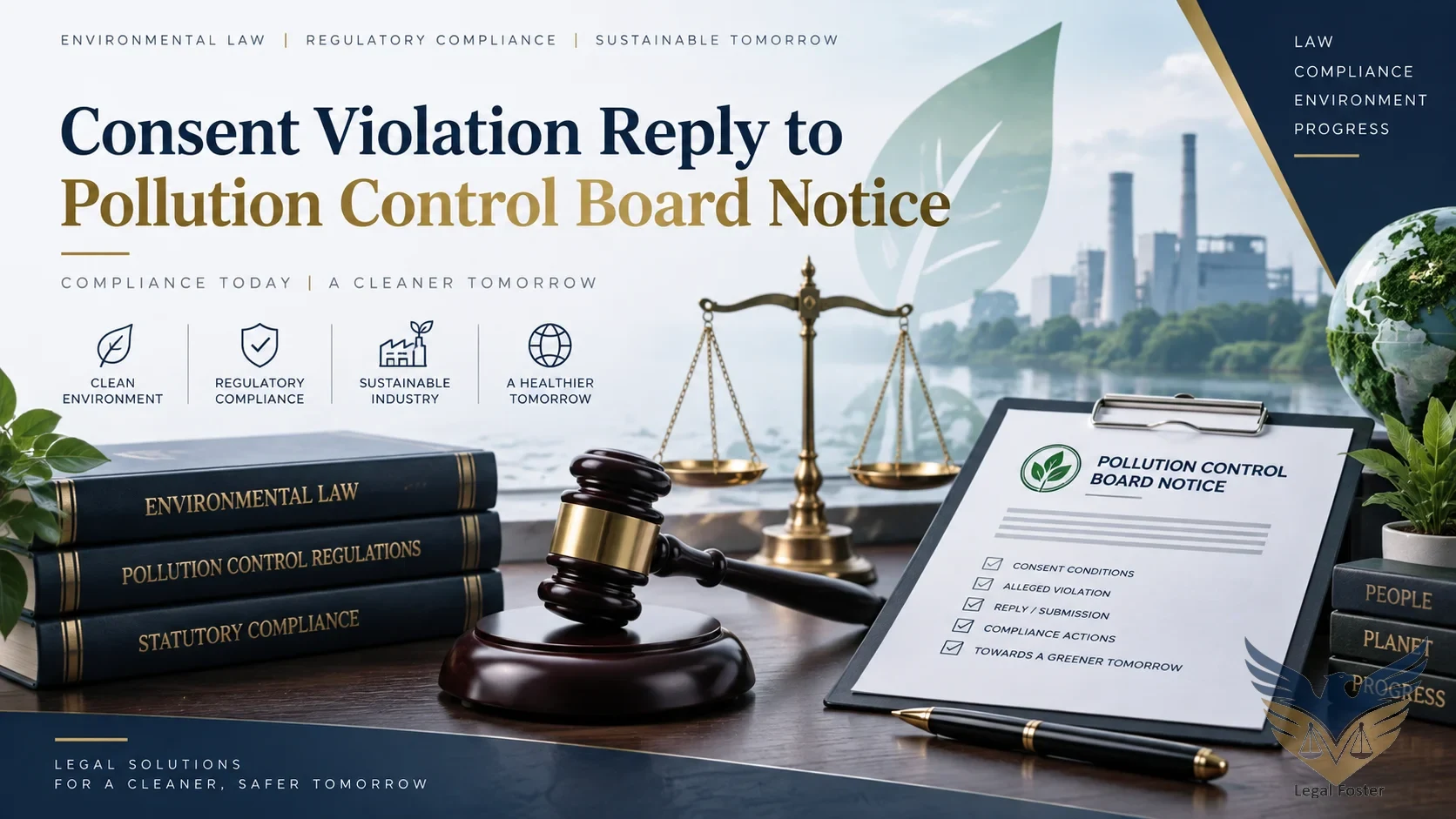
Never send back a "Form Letter" to a PCB notice. When a Polluting Unit, Infrastructure Project, Commercial Unit or any other Industry/Activity is under the jurisdiction of the Pollution Control Board of that state and receives a notice stating that you have violated one or many conditions of your Consent. Don't give that notice the bare minimum attention.
There are many reasons your Consent may have been served to you by your local Pollution Control Board. Consent could have lapsed. You may be producing over your allotted amounts or discharging pollutants. It could have been regarding your Pollution control devices. Hazardous Waste, Stack Tests, STP/ETP's. You may have failed to provide the required Monitoring Reports or followed one condition on your Order.
You may be in violation of that condition. Maybe not though, the Inspector may have seen something that you didn't think was wrong. Or you have rectified your situation. This matters.
A lawyers response to you violating a Consent Condition will go above just telling the PCB that your wrong. They will point out what you are accused of violating. Point out what that condition says and show them that your facts hold up. Proper documentation should be included with your response.
NGT Lawyers and Advocate BK Singh can assist you with responding to the PCB. We can help analyze your notice, consents, inspection report and your track record with the Board.
Sometimes you wish you could un-say what you just typed in that letter. But you have nothing to show that you are not violating the conditions set by the PCB.
Why Do Consent Violation Allegations Matter in India in 2026?
Environmental consent means much more than just a document. Depending on the activity, consent to operate is generally required under the Water (Prevention and Control of Pollution) Act, 1974 and the Air (Prevention and Control of Pollution) Act, 1981. Section 25 Water Act regulates new outlets and effluents. Section 21 Air Act prohibits setting up or operating certain specified industrial plants except after prior consent of the State Board.
Terms to which consent is granted can specify much more than just that a valid CTO must exist. They can control production capacity, amount of waste generated, treatment processes, method of disposal, air-pollution-control devices, stack height etc. monitoring and management of byproducts, and record-keeping. An allegation of non-compliance can result in denial or cancellation of consent, issuance of compliance orders by regulators, initiation of closure related actions, environ- mental compensation lawsuits, or appeals to an appellate forum or the National Green Tribunal as the case may be depending on the statute and order passed.
For example, for factories in Delhi NCR, Noida, Ghaziabad, Greater Noida, Gurugram, Faridabad and other industrial areas environmental regulations can affect project schedules, financing agreements, supply contracts and company image. BK Singh and his team at NGT Legal often address these issues by breaking down the situation into three simple questions. What does the consent to operate require? What actually happened at the facility? What evidence exists to show current compliance status?
Quick Facts
- Consent notice needs to be verified with corresponding CTE/CTO and all applicable conditions
- mentioned in it.
- Don’t plead guilty to offence before underlying records are analyzed.
- Check inspection records, lab records, photos and online monitoring for relevant date and operating parameters.
- Right disclosure of remedial actions taken after inspection rather than disclosing them as proof that a past non-compliance never occurred.
- Sec 33A Water Act & 31A of Air Act have been given significant consequential legislation-making powers.
- Appeals & NGT remedies depend on the order passed. Every S.C Notice will not become an NGT appeal.
- Water (Prevention and Control of Pollution) Amendment Act, 2024 has changed part of the statutory scheme which needs to be verified state-wise as the Amendment Act was made applicable to HP & Rajasthan & UT's only initially may be made applicable to other states by adopting it into their laws.
What Is a Consent Violation Allegation?
A Consent Violation Allegation is a Notice of Allegation issued by the Pollution Control Board or other government environmental agency stating that you or your facility has operated outside of the parameters of your environmental permit or operated without a permit. The allegation may be made as a result of a routine inspection, consent application renewal, investigation of a complaint, review of online monitoring data or review of records submitted by your facility.
Typical allegations are that you have:
- operated after Consent To Operate (CTO) expired;
- operated at a capacity larger than what is specified on your consent;
- disposed of more wastewater than your consent allows;
- bypassed or failed to operate an ETP or STP;
- emitted too many material from a stack;
- failed to install or operate required pollution- control equipment;
- stored/disposed of hazardous- waste improperly;
- failed to follow monitoring requirements;
- operated a new process, equipment or expansion activity that was not specifically listed on the consent.
Because you have been accused of violating a term or condition of your consent does not necessarily mean that you committed a serious legal or environmental crime. For instance, if a monitoring instrument happened to be down for a period of time that is different than knowingly discharging untreated effluent to the environment. Your response should be tailored to reflect such differences.
How Should You Read a Pollution Control Board Notice Before Replying?
Issue drafting is number two. Issue identification is number one. Read the notice and write a separate response to each allegation.
Ask yourself:
- What rule or consent condition is cited?
- What date or inspection is the allegation based on?
- What evidence did the regulator rely on?
- Was the consent still valid at the time?
- Was the activity alleged to have occurred actually occurring?
- Is there a lab report, sampling record or photo?
- Has the situation already been corrected?
- Is the allegation a statement of fact, technical interpretation, procedure or law?
A generic answer e.g. "we have always complied with environmental legislation" won't cut it if the regulator has cited specific numbers, equipment, production rates or consent conditions.
Once your answer is drafted by NGT Lawyers, each allegation should be turned into a numbered Issue and responded to with a citation to the record.
How Do You Prepare a Strong Legal Reply for Consent Violation Allegations?
The ideal Response to a Notice is one that follows a prescribed format.
1. Title each response correctly
Include Notice number, date, inspection date, unit name, site number and consent number.
Correctly.
If the Notice has numbers spelled wrong in the version you emailed around internally, do not reproduce those mistakes.
2. Include a brief factual background
What does the unit do? What consent does it operate under? Does the unit have a compliance system in place? Etc.
The Background should be factual.
Paragraphs about the history of your company will rarely, if ever, be helpful, unless there is something about how your company was founded that relates directly to your ability to comply with the environmental regulations you are being accused of breaching.
3. Answer each allegation specifically
If you received a Notice that lists 5 separate allegations, you should normally provide 5 responses.
The regulator should not be forced to search through pages of verbiage to try to figure out which response applies to which allegation.
4. Don’t mix denial and explanation
Each allegation is either:
- factually incorrect; or
- technically misconstrued; or
- partially true; or
- already corrected; or
- true, and is being explained with corrective action.
5. Attach records that support your written statements
If your response says “we are fully compliant with the conditions of our consent” you should have records that prove that statement.
If the issue is effluent, include laboratory reports or monitoring records.
If the issue is whether your CTO was still valid, attach a copy of the consent and any correspondence regarding renewals.
If the issue is installation of pollution- control equipment, point to invoices, commissioning records, photographs, technical certificates or O&M logs where applicable.
BK Singh and the NGT lawyers can help you organise your annexures in such a way that the factual statements made in your responses can be clearly mapped to specific exhibits.
6. Clearly detail any corrective action taken (or not)
If during the inspection it was observed that one component of an ETP was not working, and that component was subsequently replaced on Wednesday.
The response should clearly state:
- a) What was observed;
- b) Whether that fact is admitted; (or denied)
- c) Why, if known; (and preferably supported by a record)
- d) What action was taken to correct it;
- e) When that action was taken to correct it was completed; (and supported by a record)
If no corrective action is needed, say why. (and reference the records that support this statement)
Taking corrective action may help reduce your fine. It does not “wipe out” the fact that the incident occurred in the first place.
7. Request Appropriate Relief at the end
The Relief you request at the end of your response should fit the circumstances.
If your client disagrees with what was found during the inspection, they can request that allegation be dismissed/reconsidered.
Another client may want to point out that corrective action was taken and ask that they be given the opportunity for a personal hearing.
Do not ask the regulator to waive a requirement it cannot waive.
What Evidence Should Be Collected Before Sending the Reply?
- Millions have been lost on paperwork not adjectives.
- Documents That Matter Clean Technology Essentials
- keep copies of the current CTE and CTO;
- any previous consent orders;
- renewal applications and their confirmations;
- inspection report;
- show-cause/ compliance notice;
- correspondence with Pollution Control Board;
- lab reports;
- OCEMS or monitoring reports (whichever is applicable);
- operation log of ETP/STP, if maintained;
- production log, if maintained;
- electricity usage log, if maintained; water-usage log, if maintained;
- Manifests or other records of disposal of hazardous-waste, if applicable;
- Permissions obtained under other waste related rules which are applicable;.
- photos and videos;
- maintenance records and invoices for control equipment;
- technical studies; and
- Evidence of Corrective Action Undertaken.
How Should Inspection Reports and Sampling Records Be Checked?
It is important to cross check the inspection report with the consent,such as what was going on at the time of operation and location the sample was taken based on the operation methodology of the enforcing agency.
Ask yourself these questions
- What unit was operating at the time of inspection?
- What was the production level at the time of inspection?
- Where was the sample collected? Inlet? Outlet? Drain? Final Discharge location?
- What parameter exceeded?
- Which consent condition sets that parameter?
- Was that reading instantaneous or was it a reading from a lab sample?
- Were all machines that related to the process operating properly?
- Were any maintenance logs or breakdown reports available?
- Did the report properly identify the unit number and process that were inspected?
You are not looking for ways to be technically correct here. You are looking for the accusation to be contradicted by the facts in the report. An attorney such as Advocate BK Singh NGT Lawyers will focus on the grammar, the measurement and the actual condition versus attack your individual.
When Should You Consult an Environmental Lawyer?
The areas where legal review can prove valuable include:
- notice served alleging proposed closure/ suspension;
- refusal/challenge of CTO renewal;
- proposal of environmental compensation;
- more than one condition of consent is said to be violated;
- objection to sampling or lab results;
- inspection report with significant findings of fact;
- production beyond agreed capacity;
- expansion undertaken without modification to consent;
- hazardous waste is involved;
- matter is already pending before NGT or some other court;
younger managers are being called for personal hearing or
where significant business interests are involved.
BK Singh & NGT lawyers can review these matters and the entire regulatory file before you make your organization commit to a formal legal position.
An early review also ensures consistency in pleadings. For instance, you can't say one thing in an application for CTO renewal and something else in response to a show cause notice.
Can a Consent Violation Lead to Closure Proceedings?
Potentially yes. Every Environmental law provides extensive powers to Pollution Control Boards including powers to issue Statutory Directions -See Section 33A W ac t and Section 31A Air Act. The exact consequences will depend on the law, facts and seriousness of the alleged offence, stage of the proceeding, evidence and what consent conditions apply. What this means is that a company's response should deal with both the liability and current state of the environment. If the pollution control equipment has been fixed, secondary systems installed, operations been limited or a compliance plan implemented mitigation in the form of readily accepted facts can be extremely valuable. However, don't promise too much.
Can a Consent Violation Be Challenged Before the National Green Tribunal?
Just because certain orders passed by Environment Authorities are appealable before NGT, does not mean that all notices/orders/communications passed by Pollution Control Boards are appealable before Tribunal.
There are certain categories of appellate jurisdiction conferred on NGT under Section 16 of NGT Act 2010. For example –
- Water Act appellate orders are specifically mentioned.
- Orders passed under section 33A
- etc. Please see-
- Against whom the order has been passed;
- Under which section;
- Whether there is a statutory appeal first to some other authority;
- Whether the document you received is a showcause notice only;udi
- When was the order served; and
- What remedy you really want.
Forum Shopping leads to waste of precious time.
NGT Lawyers can suggest whether the challenged document is appealable before NGT or some other forum, if consulted. (Advocate BK Singh)
How NGT Lawyers Can Help With Consent Violation Matters
Environmental cases are mostly document driven, centered around law and technical facts.
Environtment cases. Advocates BK Singh and our Team of Environment Lawyers will assist you in reviewing the CTE/CTO conditions, notices from the Pollution Control Board, inspection reports, technical documents, suggested remedies and the legal remedies that may be available to you.
As stated on our website Practice Area page, we specialize in PCB notices, Air Water Act acts/issues, environmental compensation, consent applications and NGT cases.
- Services include, based on your needs:
- assessment of the notice;
- timeline of relevant documents;
- drafting of point wise reply;
- Legal analysis of consent conditions;
- prep for personal appearance;
assessment of technical evidence; and
drafting of appeal documents. We can also represent you in NGT.
The goal is not to promise you that the notice will be withdrawn.
A good Environment lawyer will help you understand what can be contested, what has to be complied with and what needs to be proven with evidence.
Frequently Asked Questions
1. When do I first contact you after I receive a consent violation notice?
Read the notice with CTE/CTO and list out every parameter/condition allegedly violated. Obtain copies of inspection records, monitoring results, lab reports and correspondence immediately. Have NGT Lawyers vet the record and arguments prior to submitting your formal reply.
2. Can I just deny everything in the notice?
Factual or legal allegations that are untrue can be denied. Merely denying everything will make your response look weaker. Each allegation should be responded to separately and supported by documentary evidence wherever possible.
3. What’s the difference between CTE and CTO?
Consent to Establish typically addresses establishment/commissioning of the regulated facility prior to commencement of operations. Consent to Operate regulates the operation of the facility upon terms stipulated by the respective Pollution Control Board. Please see the respective statutes and state rules for details.
4. Will an expired CTO result in enforcement action?
Running the unit without valid consent can subject you to action by the regulator. Depending on if/when a renewal was applied for, which statutes are involved and what terms were included in the prior consent, careful review needs to be made to ensure legal compliance. NGT Lawyers can help you evaluate your legal position.
5. If I take corrective action after they inspect me will that help my case?
Often times. If you can correct the violation and demonstrate current compliance, that can help your case. This does not mean that you are stating the violation did not exist on the date of the inspection, but it may help the regulatory body make their decision. Advocate BK Singh / NGT Lawyers can assist you in drafting your corrective action statement separately from responses to historical violations.
6. Do I need to submit lab reports along with my response?
If your violation notice refers to a specific effluent, emission or some other quantifiable environmental parameter, you will need to submit lab reports. Ensure that the dates on the lab reports and location of sampling match your arguments.
7. Can the Board close down my industry/legal proceeding due to consent violations?
State Environmental Boards can make directions to industries under the Environmental laws. These include powers under Section 33A of the Water Act and Section 31A of the Air Act. While Boards have directed closure in certain cases, they have not in others. Whether something is “lawful” will depend on the type of legal proceeding initiated and the facts of each case.
8. Can I file a petition in the NGT against a show-cause notice?
No. NGT appellate jurisdiction is limited by statute and only applies to certain types of orders. You will have to review the specific notice/order to determine whether NGT is the right forum to file your challenge.
9. The Inspection report has gotten some of the facts wrong. What do I do?
Indicate the statement you are referring to on the notice and attach contemporaneous documentary evidence proving it is incorrect. You should avoid making general allegations about the investigating officers if you do not have evidence to support those claims.
10. When should I first call Advocate BK Singh?
You should contact Advocate BK Singh if your notice: alleges serious consent violations which may result in closure; asks for environmental compensation; has disputed technical findings; is a CTO refusal/w withdrawal or could lead to NGT legal proceeding. NGT Lawyers and Advocate BK Singh will review your documents and relevant legal options before you file your response.
Final Thoughts
Legal response to allegations of consent violation should be factual, reasonable and supported by records. Clear statements stick to the point. They aren’t emotional. They explain what the consent required. They explain what occurred. They explain what the monitoring actually showed. They clearly communicate whether the allegation is true or not true. They explain what corrective actions are being taken towards compliance currently with records that demonstrate it.
Most importantly, make sure different departments are not giving different answers to the same events. Records of compliance, technical records, management records and legal responses should all be cross-checked.
We can go over serious notices from the Pollution Control Board. NGT Lawyers and Advocate BK Singh can help you understand your consent requirements, records, legal response, hearings and environmental-law solutions.
Author Bio
Advocate BK Singh practices before the National Green Tribunal, Pollution Control Boards in environmental-law and regulatory matters pertaining to Water Act, Air Act and other environmental laws. Some of the legal services involve reviewing regulatory notices, consent conditions, compliance documents, handling environmental prosecutions and advising on litigation strategy based on the facts of each specific matter. If you are a company, project proponent or individual who has received an environmental notice, please reach out to Advocate BK Singh at NGT Lawyers for a legal review of your specific situation. No outcome can be guaranteed in any environmental proceeding and the remedies available would depend on the statute, facts and stage of the proceeding.