When Can NGT Take Action Against Businesses for Environmental Violations in India?
Your accidental compliance miss can become an environmental offense. Running a factory without environmental clearance or setting up a project without adhering to pollution control norms or failing to follow environmental best practices of your business can attract complaints, notices and NGT action.
You wouldn’t want an environmental offense on your business record. Environmental laws may seem overwhelming for business owners until that notice lands on your doorstep. It’s not just penalties that concern businesses.
Factories can shut down because of reputational damage, project delays, loss of business and revenue and increased regulatory scrutiny.
In most cases, NGT action for environmental violation is taken when there is damage or a threat of damage to the environment, failure to follow environmental laws, violation of statutory consent or violation of a condition of consent. The National Green Tribunal hears all matters related to the protection of the environment and can hear all civil cases that are associated with these laws as mentioned in the NGT Act.
If you own a business in Delhi NCR, Noida, Gurugram, Ghaziabad or if you own a business in Mumbai or Bengaluru, Chennai, Hyderabad, Ahmedabad, Pune, Kolkata and other commercial cities that operate industrial or infrastructure-related activities, you need a deeper insight into environmental compliance and be prepared.
“The major reason environmental disputes turn ugly is because businesses focus on getting the task done and take paperwork such as permissions, inspection or compliance reports for granted, until the dispute has reached crisis level,” says BK Singh Advocate.
By simply being aware of where things can go wrong, you can take steps to prevent your business from being impacted. Review contracts, operations and authorization with a legal professional who can flag potential issues with environmental clearances, notices received, agreements and operating records with agencies.
Why Can Environmental Violations Become a Serious Business Concern in India?
Environmental compliance – linked to Business Continuity “If you have investments, manpower, customers and signed agreements you would still not be able to function. If someone objects to the environmental compliance of your facility or activity be it an enforcement agency or an affected party your daily operations can grind to a halt”
Environmental clearances involve multiple approvals – “Environment clearances are not a one-time affair. You need to seek various approvals for pollution control, environment clearance, solid waste management, water consumption, emission norms, handling hazardous waste, Regional Pollution Control Board(RPCC) clearance and local body requirements”
BK Singh Advocate explains “One point that has been observed is companies don’t take care of timely compliances reports. Their thinking is seeing one authorities have cleared this operation they are good to go. But what about the other enviroment clearances that are pending”.
If you own/operate any kind of business operation in industrial estates, manufacturing facilities, construction projects, mining and allied operations, infrastructure projects, commercial projects you need to manage Environmental Risk as part of your Legal Risks.
Why Does NGT Action Matter for Businesses in 2026?
Environmental disputes can occur in many different circumstances. Although you may be inspected by the regulator, you may also receive a complaint from an affected community/ resident group/ environmental organisation/individual claiming that your activities/environment are being damaged by your operations.
The National Green Tribunal Matter legal service is one forum in which environmental disputes can be heard. Cases filed in the Tribunal can relate to damage to the environment, regulatory compliance issues, restoration and compensation (where provided for by law).
Receipt of an environmental complaint should not be viewed as a confession of guilt by the company. Facts, evidence, the applicable law, your actual compliance status and the decision of the forum hearing the dispute will ultimately determine liability.
However ignoring notices served on you and failing to preserve documents can lead to further difficulties. By taking legal advice at an early stage, your company can understand the allegations being made and what documents will be required to properly defend any claim.
Quick Facts About NGT Action Against Businesses
- The National Green Tribunal was established under the National Green Tribunal Act, 2010.
- The NGT adjudicates environmental disputes arising out of and in relation to the enactments specified in Schedule I of the NGT Act.
- Companies may be parties to NGT proceedings for alleged violations of environmental laws and/or causing environmental damage.
- Environmental licenses and records of compliance may be important evidence produced in NGT proceedings.
- NGT proceedings focus on facts, relevant provisions and any supporting/pertinent documents.
- Receive legal advice on any administrative notices/statements or tribunal proceedings.
- Environmental problems can affect your business reputation and operations as well as your ability to secure future licenses.
What Does NGT Action for Environmental Violations Mean?
NGT proceedings translate to litigation before the National Green Tribunal over allegations of activities that adversely impact environmental protection. This can cover pollution problems, damage to natural resources, violation of conditions of environmental clearance etc.
In any number of ways, an organization can be a party to NGT litigation. An industrial unit may be alleged to be improperly disposing of waste into say a river. An infrastructure work may be facing challenge for violation of terms of an environmental clearance. A firm may be accused of not complying with pollution control norms.
It should be noted that NGT is not a place to air all kinds of commercial grievances. The NGT jurisdiction is limited to environmental protection and related issues based on allied environmental legislation.
As Advocate BK Singh writes, it is important for an organization to understand the difference between a regulatory inspection, a notice from the pollution control board, an environmental NGO complaint and NGT litigation.
Which Laws Govern Environmental Violations Before NGT?
Environmental cases can involve multiple statutes depending on the issues presented. Some of the possible causes of action against your business include:
- the activity conducted
- where it is conducted
- the impact on the environment
- the nature of the allegations
The following statutes are examples of laws that may be involved in an environmental dispute:
The NGT was established under this Act to adjudicate on environmental disputes. NGT has powers of relief, compensation and any other directions it deems fit under this Act.
This Act specifically enables the government to take measures to protect and improve the environment. If your business is affected by any notification, standards or other environmental requirements made under this Act, you may have a cause of action.
If your industry works with wastewater, discharge or water quality you may have concerns with this statute.
Similarly, if your business emits any pollutants you could be subject to action by the regulators under this law.
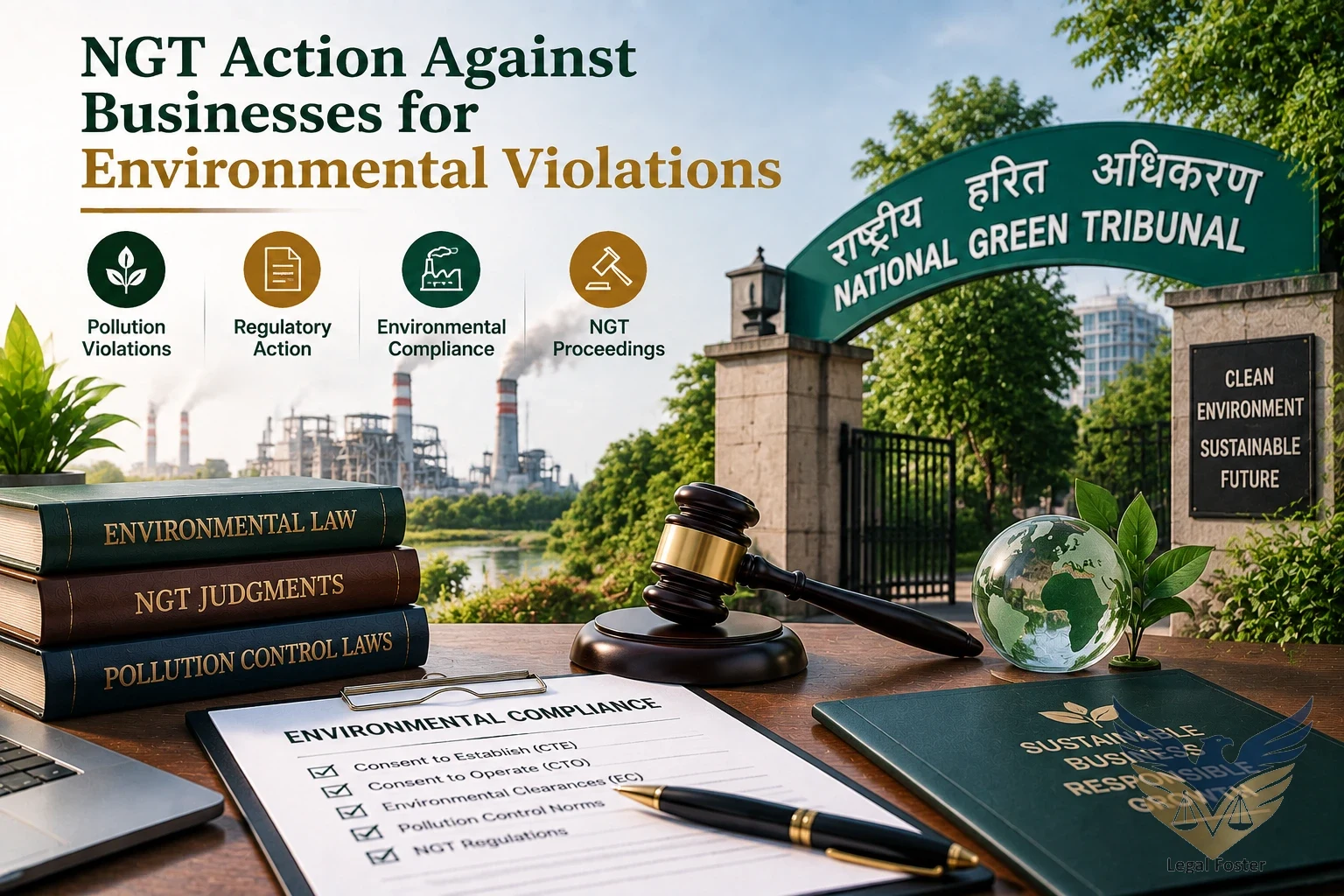
Obtaining Clearances such as Consent to Establish (CTE) and Consent to Operate (CTO) from the respective State Pollution Control Boards are important compliance tasks for businesses.
Before you take any further action with an environmental complaint against your business, make sure you know exactly what allegation you are responding to, which authority you are responding to, what documents they have and what legal forum they are pursuing.
What Types of Businesses Can Face NGT Proceedings?
Anything you do for your business, if there’s a slightest chance it can affect the environment and laws associated with it are not followed properly, will be questioned. NGT complaints don’t just involve big players of the industry. You can file a complaint against small and medium businesses if they’re found harming or affecting resources like air, water, land, environment assets and so on.
Building units, construction companies, Real estate, mining, infrastructure and EPC companies, waste treatment, garbage collection companies, chemical industries, businesses dealing with hazardous substances have more environment-based compliances to follow.
You may end up in NGT if:
- You are operating without the proper clearances from the environment department.
- Your business is violating rules mentioned on your EC.
- If your business releases effluents untreated.
- If your business is causing air pollution.
- If your business is not disposing off the industrial waste properly.
- If there are any violations under orders passed by the PCB.
- If your business affects the environment which are public properties.
As mentioned by BK Singh Advocate, “Most environment conflicts turn ugly because a business is only focussed on meeting their production targets. They forget the renewal date, where to keep documents like compliant record,frequent inspection reports, what does your approval mentions and under what conditions”.
Stay compliant and let compliance be your future armour.
How Does a Business Come Before the National Green Tribunal?
NGT proceedings can be started against a business in multiple ways. Generally speaking, you would expect a matter to be brought to the Tribunal in the form of an application by some aggrieved person, organization or other party who is eligible to make an application to the NGT.
The application would make allegations regarding non-compliance with an environmental law, illegality in the action taken by a particular authority or direction of remediation or compensation.
Typically the NGT would look at:
- Nature and extent of the alleged damage caused to the environment.
- History of compliance by the business.
- Permissions /clearances obtained by the business.
- Documents submitted by regulators.
- Scientific /technical data.
Companies should understand that notice from NGT is a legal proceeding. If you receive a notice from NGT take note. Do not ignore the NGT by not picking up documents from the court, returning notices unattended or providing incomplete information as these have the potential to negatively impact your company. BK Singh Advocate helps businesses understand the nature of the legal dispute, review the facts presented on record and advise on how best to respond with a strategy tailored to the unique facts of each matter.
What Risks Can a Business Face Due to Environmental Violations?
Legal & commercial consequences of Environmental Notices
Just like any legal notice, Environmental notices can have several legal and commercial consequences on your business. This depends on the allegation, regulator’s findings and the directions issued by regulator/Tribunal.
Impact on business
The direction issued to you can order you to stop your operations as usual, until you take certain action to comply with requirements or until regulator takes action. Delays to your project/activity can have cash flow implications for your business.
Financial implications
Any Environmental Enforcement action can result in costs for you to improve your compliance measures, carry out restoration, defend any claim for compensation, pay legal fees or carry out remedial actions.
Publicity
Any non-compliance with environmental laws can harm your business reputation and impact your shareholders, investors, customers and future business relations.
Consent for future projects
You may find it difficult to get future approvals/consent for expansion from regulators, if you have unresolved environmental problems.
Why you should act quickly on Environmental Notices
BK Singh Advocate advises that you get all Environmental Notices assessed by a lawyer quickly. Many times the severity of the problem is understood at an early stage itself and unnecessary panic can be avoided.
What Documents Should a Business Maintain for NGT Defence?
Documents again will play an important role in environmental disputes. The standing that the party could have before NGT would very often depend on the documentary evidence of compliance exercised, permissions taken and remedial measure performed.
Following are some of the main documents :-
- Category Examples
- Environmental Permissions Environmental Clearance, approval letters, renewal etc.
- Records maintained with Pollution Control Board CTE, CTO, Inspection reports, reports/documents submitted as part of compliance report etc.
- Plant Operation Records Month wise/account wise details of production/waste generated/emission monitoring system reports etc.
- Technical records / studies Environmental studies, environmental audits, Technical opinion received etc.
- Correspondence with Regulatory Authorities Notices received, replies sent, representation etc.
- Project/Plant Business Records Agreements/contracts/project/ tender documents, permission / approved to operate etc.
The above mentioned documents is not exhaustive and would vary from case to case depending on the nature of dispute. A case involving a construction activity would have documents very different from a manufacturing industry and a waste recycling facility.
When Should a Business Consult an Environmental Lawyer?
WHEN YOUR BUSINESS GETS AN ENVIRONMENT NOTICE, COMPLAINT, INSPECTION LETTER or NGT NOTICE
Businesses may want to consult an attorney if their business receives an environmental notice, complaint, inspection letter or NGT notice.
You should have these documents reviewed as soon as possible if:
- PCB issues orders or notice
- Conditions of EC are being questioned or violated
- Your project gets objected by affected person/opponent
- You receive a notice from/about NGT
- Expansion of your project is at risk
- Your operations are being carried out in sensitive areas
Waiting until the proceeding is in its end stage can cause you to lose valuable time to understand the allegations against you and compile necessary records.
BK Singh Advocate and our team of lawyers assist businesses with environmental compliances, issues and proceedings involving environmental agencies.
How Can Corporate Law Firm Help Businesses Facing Environmental Legal Issues?
Environmental disputes often turn out to be commercially sensitive. CORPORATE LAW FIRM analyzes these matters by understanding how your business operates, what are your permissions/ regulatory status quo, contracts, concerns and your legal exposure.
BK Singh Advocate would evaluate your position before you take any legal action. He would study the environmental approvals/permits you have received, any notices/compliance/violation letters received from any government agency.
Legal assistance may include:
- Assistance to understand the Legal Notice/NGT/PC/DIR Consent Order you have received.
- Advising you on NGT/ NCDRC cases and interpreting laws that would apply to your case.
- Studying your existing permits and your own record
- Representation before appropriate forums.
Assisting you navigate through your business concerns with environmental disputes.
We have helped clients who have operations across Delhi NCR, Noida, Gurugram, Ghaziabad. Mumbai, Bengaluru, Chennai, Hyderabad, Pune, Ahmedabad and other states having places of business in India.
Environmental disputes can often impact your commercial activity. We help businesses understand their options. We will not take up your matter unless you specifically instruct us to. We will evaluate your position from a legal standpoint and help you understand your options. We do not take sides. Environmental disputes are often a matter of facts, documentation and law.
Frequently Asked Questions
1. When can a company/business face NGT action?
If your business is accused of something related to damage to the environment, violation of environmental laws, violation of permissions issued to them or non-compliance to regulatory requirements; you may face NGT action. Ultimately it would depend on evidence, facts, laws applicable and findings of the Tribunal.
2. Can small scale business be sued at NGT?
Yes. NGT matters could be related to small or medium business concerns too. Depending on the type of activity small and medium businesses indulge in, NGT action could be initiated against them if environmental concerns are raised.
3. What does National Green Tribunal do?
National Green Tribunal hears environmental disputes and can award relief, compensation and other directions.
4. Can a business fight an environmental allegation at NGT?
Yes. Every business has a right to defend themselves and submit all the material they have before NGT. Please share the facts and we can advise you on the legal issues based on the matter and evidence.
5. My business received an environmental notice. What next?
Read the notice carefully. Gather all the records you have pertaining to the matter, understand what is being alleged and get in touch with us or any other legal counsel to determine a response in accordance with law.
6. Can an environmental issue stop my business from operating?
Yes. If the environmental concerns are serious enough, it could affect your operation depending on the facts. If authorities or the forum hear the case decide to stop your operation till the matter is resolved.
7. What documents should I keep for Environmental disputes?
Any environmental clearances you have obtained, Industrial permission from the Pollution Control Board, any Compliance reports you have submitted, Records of inspections done by technical staff, Any communication you've had with regulators. These are some documents that you should keep.
8. Do I have to pay fines if someone files an environmental complaint against me?
No. Just because a complaint has been filed against you, doesn't mean you're liable for what's being mentioned in the complaint. You will only have to pay fines if an investigation is conducted, evidence is found against you and according to the applicable laws.
9. How can Corporate Law Firm help me with NGT related matters?
Corporate Law Firm can help you with any environment related concerns for your business. You can contact BK Singh Advocate, analyze the facts and documents and we can guide you on the appropriate course of action.
10. Why should I consult a lawyer when an environmental dispute arises?
It is always better to take legal advice at the earliest. You’ll understand the issue at hand, gather all your documents and know how to proceed/respond according to the law.
Final Thoughts
Environmental compliance is quickly becoming standard business practice in India. Received an NGT complaint or an environmental notice against your company? Don't stick your head in the sand.
Environmental disputes involve technical data, regulatory requirements and legal argument. A review of your permits, compliance history and the claims against you will help you understand your situation.
BK Singh Advocate at Corporate Law Firm can assist you and your business in understanding environmental legal issues and recommend the appropriate legal action based on the unique facts in your situation.
Its critical that you seek advice in a timely manner as environmental enforcement can affect your operations, your reputation and your future business.