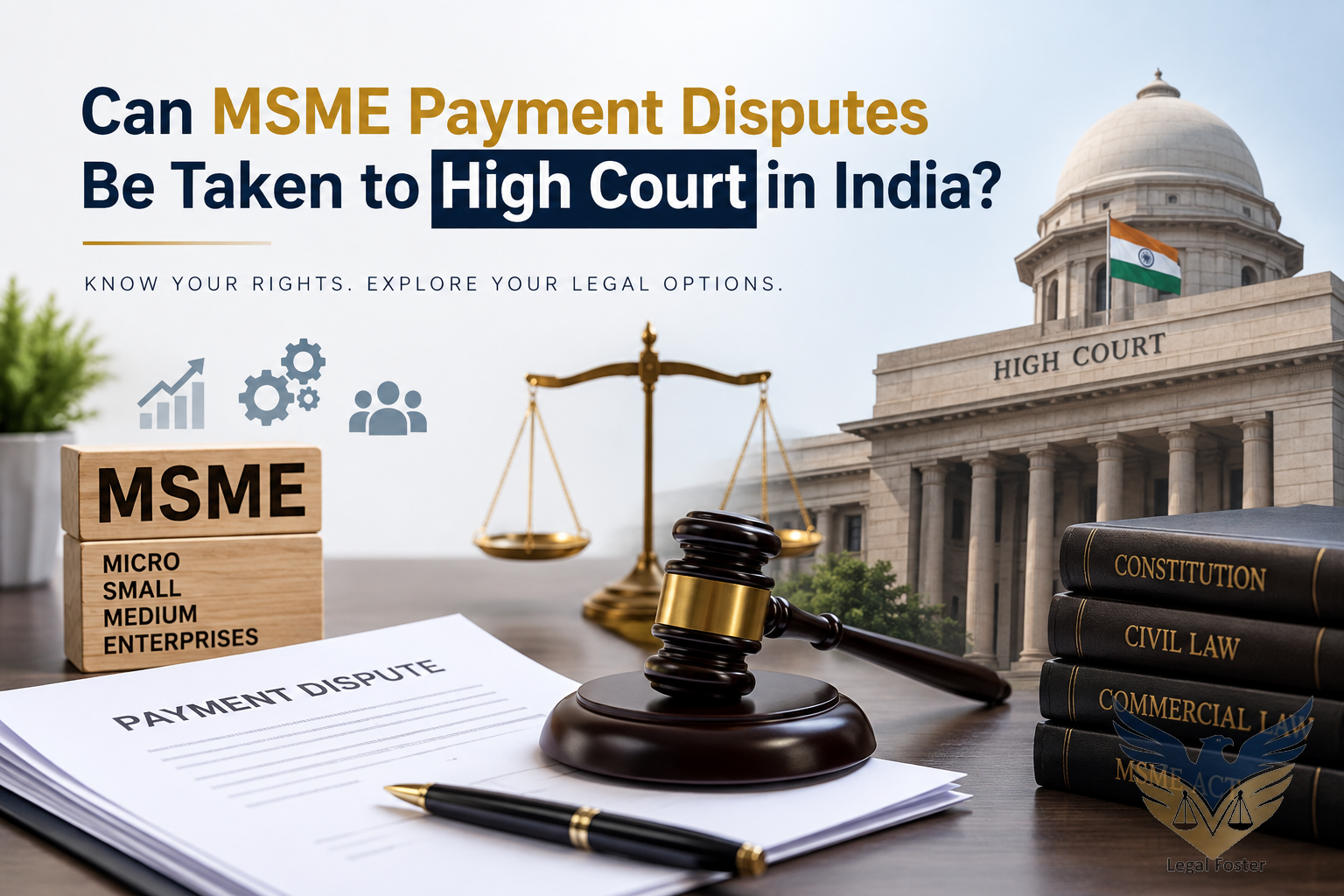
When Can an MSME Payment Dispute Be Taken to the High Court?
An MSME sells some machinery worth a few lakhs rupees to a large corporate. The buyer takes the equipment. Invoices are raised. Weeks pass. Months go by. Suddenly you realize…..nothing has been paid.
In another situation entirely, a micro business provides professional services to a corporate buyer based in Delhi. You have emails proving work was completed but now your buyer simply tells you the invoice is “under process”. Cash ceases to flow and heads roll. Your employees don’t care if you can’ not pay their salaries on time because your largest account just hasn’t paid. Neither do your GST liabilities, landlord, or suppliers.
So how long do business owners sit before wondering can I sue my customer immediately in the High Court for non-payment?
The short answer is: no, not usually, as a first step. If you are a qualifying micro or small supplier, you have a specific remedy under law for late payments. Chapter V of the Micro, Small and Medium Enterprises Development Act, 2006 details the obligations of the buyer to make payment, statutory interest, and recovery of the amounts due to you under sections 15, 16, and 17. Section 18 allows you to file a complaint with the Micro and Small Enterprises Facilitation Council, more commonly known as the MSEFC.
This is not to say that the High Court is stripped of its powers under Articles 226 and 227 of the Constitution of India to adjudicate any dispute which may touch upon MSMEs. It does mean the courts are not your first stop merely because a buyer hasn’t paid you. Further, the courts will generally expect parties to first utilize legislation designed for a specific purpose, where it exists. This is particularly true where there are factual disputes on issues such as contractual performance, invoices raised, delivery and acceptance of goods, set-offs or counterclaims.
Knowing where (& how) to file your commercial dispute is critical. Filing in the wrong court can halt your case even if you have a clear-cut demand for payment. Just because the courts can hear a matter, doesn’t mean they should. Buyers can also challenge MSEFC orders in court if they wrongfully believe the Commercial Courts Act or the Arbitration and Conciliation Act provide a parallel forum for dispute resolution.
The commercial and MSME law team of BK Singh Advocate at MSME Lawyers can help you determine whether a matter lies before the MSEFC, civil courts/commercial courts, arbitration or (in very specific situations) the High Court.
Why Does the High Court Question Matter to MSMEs in 2026?
Rarely does delayed payment become “just” a legal issue for an MSME. Delayed payment quickly becomes a question of the survival of one’s business.
Take the example of a manufacturer located in Noida who may have prepaid for raw material and labour. He will wait patiently for his buyer to pay up his dues. Consider a services supplier based out of Gurugram who may depend on two or three key corporate buyers for a lion’s share of his business. Non-payment from them could put him in jeopardy. An MSME supplier from Ghaziabad, Faridabad, Delhi, Mumbai, Pune, Ahmedabad or Bengaluru may have large outstanding receivables from clients and still be servicing GST, employee salaries, office rent, loan EMIs and vendors.
It is no surprise then that the delayed- payment law under MSMED Act gives special protections to qualifying suppliers.
Section 15 of MSMED Act lays down that in respect of any goods supplied or services rendered, payment thereof shall be made on or before the date agreed. Further, where there is a written agreement, the period so agreed shall not exceed forty- five days from the date of acceptance of goods or services or deemed acceptance in writing.
Section 16 really gives some teeth to Section 15. Interest shall be payable by the buyer failing to make payment as required under Section 15 at a rate which shall be three times the bank rate notified by RBI for any specified period by the Reserve Bank of India with monthly rests subject to the conditions provided in the statue.
Section 17 allows for deemed liability for the amount due along with interest under Section 16. Filing for one’s dues under Sections 16 and 17 may become more commercially relevant for many suppliers vs. issuing an ordinary demand for the value of their invoice. Simply put, the MSEFC route can offer stronger protections.
And while the MSMED Act was drafted to provide legal protections to MSMEs, not every business with an MSME certificate has the same remedy available to them in every dispute. Their registration status as an MSME, the date of supply, who is making the claim, whether there is a contract between parties, what goods/services were supplied, and any number of other facts surrounding a claim can alter your legal rights. BK Singh Advocate at MSME Lawyers can help you figure that out so your business doesn’t waste time going after the wrong remedy/forum.
Quick Facts: MSME Payment Disputes and High Courts
- Section 15 : Time of payment to eligible supplier.
- Normal terms of business cannot stipulate a period of payment in writing of more than 45 days from acceptance or deemed acceptance under section 15.
- Section 16 : Statutory compounded interest on overdue qualifying payment.
- Section 18: Reference to Micro and Small Enterprises Facilitation Council of amount falling due under section 17.
- Proceedings before MSEFC may be continued from conciliation to arbitration in case of failure to reach a settlement under the statutory scheme.
- Revision to High Court under writ jurisdiction cannot be invoked instead of statutory mechanism to challenge an MSME award.
- Section 19: Deposit to be made by buyer disputing decree, award or order referred to. Buyer who challenges the decree, award or order as mentioned in section 19 must pay statutory deposit of 75% as subject to mandate and interpretation of that section.
Can an MSME File a Payment Recovery Case Directly in High Court?
Under normal circumstances, a prudent MSME won’t want to approach the High Court as a first forum simply because a buyer hasn’t paid some invoices.
Section 18 of the MSMED Act directs us to a specialized tribunal called MSEFC for adjudicating timeous-payment disputes. Jurisdiction of Council is determined by amount sought under Section 17 as well as the supplier’s statutory eligibility.
Writ jurisdiction before the High Court is an entirely different animal.
Articles 226 & 227 allow for constitutional and supervisory relief. However, writ jurisdiction is exercised at the discretion of the court. It is not designed to act as a fallback option for all routine disputes simply because a litigant doesn’t want to wait for the statutory process to run its course or because one party wants to avoid certain consequences that flow from the exercise of a statutory remedy.
We continue to see 20-26 matters filed in High Court against MSEFC references and proceedings being challenged on jurisdiction, registration, contractual nature/legal validity of reference etc. Maintainability is looked at very closely. Courts are not inclined to treat a writ petition like they would any other run- of-the- mill appeal filed against an MSMED Act proceeding.
The practical question really becomes something different than –
“Can I file in the High Court?”
Rather, a more prudent question to ask may be –
“If I file in High Court, what am I exactly challenging and does law already provide me an effective remedy under statute?” The answer here could change your forum choice entirely.
Who Can Use the MSEFC Delayed-Payment Mechanism?
One of the most mis-conceptualized terms has to be that of an “MSME”.
Although the MSMED Act references micro, small and medium enterprises for certain purposes, the delayed- payment mechanism under Chapter V references micro and small enterprises.
Section 2(n) defines “supplier” for these purposes by reference to a micro or small enterprise (which complies with the statutory requirements). That definition then goes on to exclude certain specified bodies.
Don’t fall into the trap of thinking that if you commercially describe your business as an MSME you fall within Chapter V.
You could be subject to queries as to:
- whether the claimant is a supplier as per the statutory definition;
- whether the relevant registration was validly in force at the relevant time (legally speaking);
- the nature of the underlying supply;
- whether the invoices relate to the registered activity;
- whether the transaction is one which Chapter V even applies to.
Courts have seen litigation on registration and jurisdiction questions regarding 206 MSEFC claims.
This is why BK Singh Advocate @ MSME Lawyers may wish to look at your Udyam or previous registration along with purchase orders and invoices before framing of Section 18 reference.
What Documents Matter in an MSME Payment Dispute?
Sometimes just the existence of contemporaneous paperwork can be more valuable than the amount at stake. Your supplier might well be owed money but still lose an otherwise straightforward dispute on a technicality due to lack of paperwork.
TYPES OF RECORDS YOU SHOULD RETAIN
MSME Registration Documents
Keep a copy of the relevant Udyam Registration or previous statutorily mandated registration that you had at the time.
Date of registration itself can become contentious.
Don’t just pull out an up to date certificate at face value. Take time to check that the certificate corresponds with the relevant date of transaction and requirement during that period.
Purchase Orders and Work Orders
Help to confirm
scope of supply; price; payment terms including window for payment; conditions for acceptance; allowable deductions; dispute resolution etc.
A verbal or emailed quotation – if not signed – will not always contain the full contractual terms.
Invoices
Hopeully these correspond with purchase orders and records of delivery.
As a general rule sellers should keep a record of date of invoice, invoice number, GST#, value of invoice and proof of dispatch.
Proof of Delivery & Acceptance
Retain delivery challans, e-way bills, transporter documents, goods- received notes, warehouse notes or emails acknowledging receipt of goods.
Proof that the services were accepted can include a formal completion certificate, email approving / accepting the work carried out, reports provided, timesheets, achievement of milestones or ultimately the buyer using the services provided.
Correspondence Around Payment
Email will very often be key evidence.
Messages that state “we will release payment next week” or “ we have approved your invoice and are awaiting approval from ….” can become part of the overall narrative.
Don’t screenshot a Whats App chat and keep it on an employees phone. Print it out properly.
Ledgers and Account Statements
An up-to-date ledger can be useful to highlight individual invoices raised, payments made (and not made), any credit notes issued and any outstanding balance.
Bank statements can also be used to show that part payments were indeed received.
Debit Notes / Quality Issues
Don’t throw anything away that may be used against you.
An email from the Buyer rejecting the goods, disputing quality or issuing a debit note could become key evidence in any dispute. Everyone wants their side of the story to be heard. Lawyers will want all the documents, not just the ones you think support your claim.
Demand Letters and Prior Settlement Negotiations
Preserve any demand notice (or response), offer to compromise, acknowledgment or correspondence during settlement via Mediation.
BK Singh Advocate can analyze this evidence to firstly help determine what the real legal issues are and then advise whether to commence MSEFC adjudication, arbitration, File Commercial Court Suit or explore rare High Court remedies.
What if the Buyer Says the Goods Were Defective?
MSME status does not magically vanish disputed facts.
the goods didn’t conform to specification; or the services weren’t complete; or the delivery was late; or liquidated damages are triggered; or warranty obligations remain unpaid; or an amount was invoiced that was never accepted.
The supplier claims all of those defenses were manufactured after the payment became overdue.
When disputes are about facts like this, they should be decided on the facts.
Strong payment protections in the MSMED Act don’t alter the fundamental rule that not every invoice an MSME supplier claims it issued should automatically be paid without allowing for adjudication of valid contract defenses.
That’s why direct suits in the High Court are often not the right way to resolve disputes that turn on evidence.
When Should an MSME Consult a Lawyer?
Ideally you should consult an Advocate well before your receivable turns several years overdue.
Some specific reasons why NOW is a good time include:
- buyer stopped responding after receiving goods/services;
- there have been multiple promises to pay;
- large debit notes were created AFTER the receivable was demanded;
- buyer denying the purchase order exists;
- timing of MSME registration is in dispute;
- buyer is located in another State;
- contract has an arbitration clause;
- you've already sent a reference under Section 18;
- MSEFC has issued a reference to arbitration;
- award has been issued;
- the other party has appealed to High Court.
The sooner you speak to someone the more options you will have. Once awards are passed and battles are fought over limitation and jurisdiction your options dwindle. BK Singh Advocate of MSME Lawyers will review your entire dispute as we would a commercial document, starting with more than just the past due invoice.
How Can MSME Lawyers Assist With Payment Disputes?
MSME Lawyers can help you with delayed payment disputes, MSEFC proceedings, buyer vs supplier disputes, contractual claims or any other form of commercial dispute.
What goods/services were supplied? Who supplied them? When were they accepted? What does the purchase order say? Was your business registered? Were there objections made at the time? Has a part-payment been made? Which court has jurisdiction?
Once these questions are answered, BK Singh Advocate at MSME Lawyers can tell you whether your dispute falls squarely under the delayed- payment ambit of Sections 15 to 18 of the MSMED Act or would require some other remedy to be invoked.
If MSEFC proceedings have already been initiated, MSME Lawyers can assist you by reviewing the notices sent/received, claim document, reply /statement filed, invoices, correspondence, pending jurisdictional objections etc.
If you are a buyer/supplier considering approaching the High Court, BK Singh Advocate at MSME Lawyers can tell you whether the matter involves a genuine writ issue, whether there is some other statute that can help you and what procedural issues would arise from the current stage of the proceedings.
If an award has been passed (even if it is in your favour) then the legal analysis is different yet again. Now we need to look at the Arbitration and Conciliation Act in terms of Section 19 of the MSMED Act.
Frequently Asked Questions
1. Can an MSME file a writ petition in High Court directly for recovery of payment?
Ans. A cause of action for delayed payment should ordinarily arise under the statutory framework provided under Chapter V of MSMED Act and should not be initiated directly as a writ petition in High Court. Section 18 allows for reference with respect to amounts payable under Section 17 to MSEFC. However High Court writ jurisdiction can be exercised in extraordinary constitutional or jurisdictional scenarios. Consult BK Singh Advocate at MSME Lawyers for analyzing which forum would be suited for your dispute.
2. What is the maximum allowable time limit for payment as per MSMED Act?
Ans. Section 15 of MSMED Act specifies that if any time of payment is agreed to in writing it shall not exceed forty- five (45) days from the date of acceptance or deemed acceptance. In absence of any agreement, the ‘appointed day’ under the statutory scheme would refer.
3. What rate of interest can be claimed by MSME from a buyer for late payment?
Ans. Section 16 provides for a formula to allow for calculation of interest on compound basis with monthly rests at a rate of interest thrice the bank rate notified by RBI where the prescribed conditions are met. The interest amount that can be claimed can be assessed from the statutory date applicable and records of the transaction.
4. Can a buyer approach High Court against MSEFC award through writ petition?
Ans. Generally a buyer should not be filing a writ petition instead of following the statutory remedy of challenging an award. Section 34 of Arbitration and Conciliation Act would apply to an award passed by MSEFC, read with Section 19 of MSMED Act. Courts have construed the writ jurisdiction very narrowly where it has been used as a tool to bypass that process.
5. Is it compulsory to deposit 75% of awarded amount if someone intends to challenge an MSME award?
Ans. Section 19 does provide for a condition that 75% of the awarded amount should be deposited at the time of making an application to set aside a decree, award or order if the person who makes that application is not the supplier. The applicability of that Section would be determined depending on the type of proceeding that is being initiated. BK Singh Advocate at MSME Lawyers can go through the facts before initiating any proceedings to challenge the award.
6. Can MSME register a complaint against a buyer belonging to different State?
Ans. Section 18 provides for a jurisdiction clause which allows the Council or respective ADR center to admit a dispute if the supplier is located within the jurisdiction of the Council or the respective ADR Centre and the buyer at any place in India, provided all statutory conditions are met.
7. Can every MSME approach MSEFC for recovery of payment?
Ans. No, firstly the delayed- payment provisions of MSMED Act would require you to be a “supplier” as defined under the statute. Section 2(n) refers mainly to a qualifying micro and small enterprise and to the bodies specified in the defined brackets next to it. One cannot assume that since you are a medium enterprise you would also qualify for the purpose of Chapter V proceedings.
8. Can I file writ petition in High Court if MSEFC is ‘without jurisdiction’?
Ans. A substantial defect with regard to jurisdiction can be challenged before the appropriate court. However writ jurisdiction is also being exercised at the discretion of courts and the fact that an alternate remedy is available under the statute is still a relevant consideration. High Courts have recently been seen to only entertain such objections on strict legal and factual basis.
9. Can I proceed under Section 18 if there is an arbitration clause in my contract?
Ans. Not always. Since the mechanism provided under Section 18 and Chapter V of MSMED Act in general is special in nature and overrides most other laws in case of eligibility. Section 18 would still depend on whether you qualify as a supplier under MSMED Act for that particular transaction and what is the nature of dispute. BK Singh Advocate at MSME Lawyers can help you understand your contract and guide you better with respect to MSMED Act.
10. What documents should an MSME maintain for claiming payment?
Ans. Few of the important documents that you should maintain are MSME/ Udyam certificate of registration, purchase order, invoices, proof of delivery /proof of service completion,timesheets, correspondence records, acknowledgement from buyer, account ledgers, bank statements, debit notes, legal notices etc. An MSME claim for dues is only as strong as the paperwork that you have maintained.
Final Thoughts
Can MSME payment disputes be filed in High Court? Well, if you find yourself in exceptional circumstances then a High Court may well have something to say about your matter. But you should not view it as an obvious first choice for debt recovery just because you are an MSME chasing some invoices.
Firstly, there is a specialised delayed-payment regime for qualifying micro and small suppliers under the MSMED Act. Sections 15 to 17 deal with liability to pay and statutory interest. Section 18 deals with the MSEFC reference scheme. The Arbitration and Conciliation Act and Section 19 kick in after an award has been made where there is a dispute.
That’s why it’s critical for businesses to understand the correct route to take prior to commencing litigation. An otherwise valid commercial claim can be struck out due to a jurisdictional mistake.
If you are an MSME based in Delhi, New Delhi, Noida, Greater Noida, Ghaziabad, Gurugram, Faridabad, Meerut, Hapur, Lucknow, Kanpur, Prayagraj, Mumbai, Pune, Bengaluru, Hyderabad, Chennai, Ahmedabad, Kolkata or anywhere else in India and need help with delayed- payment claims, MSEFC references, arbitration or related High Court matters you can contact BK Singh Advocate at MSME Lawyers.