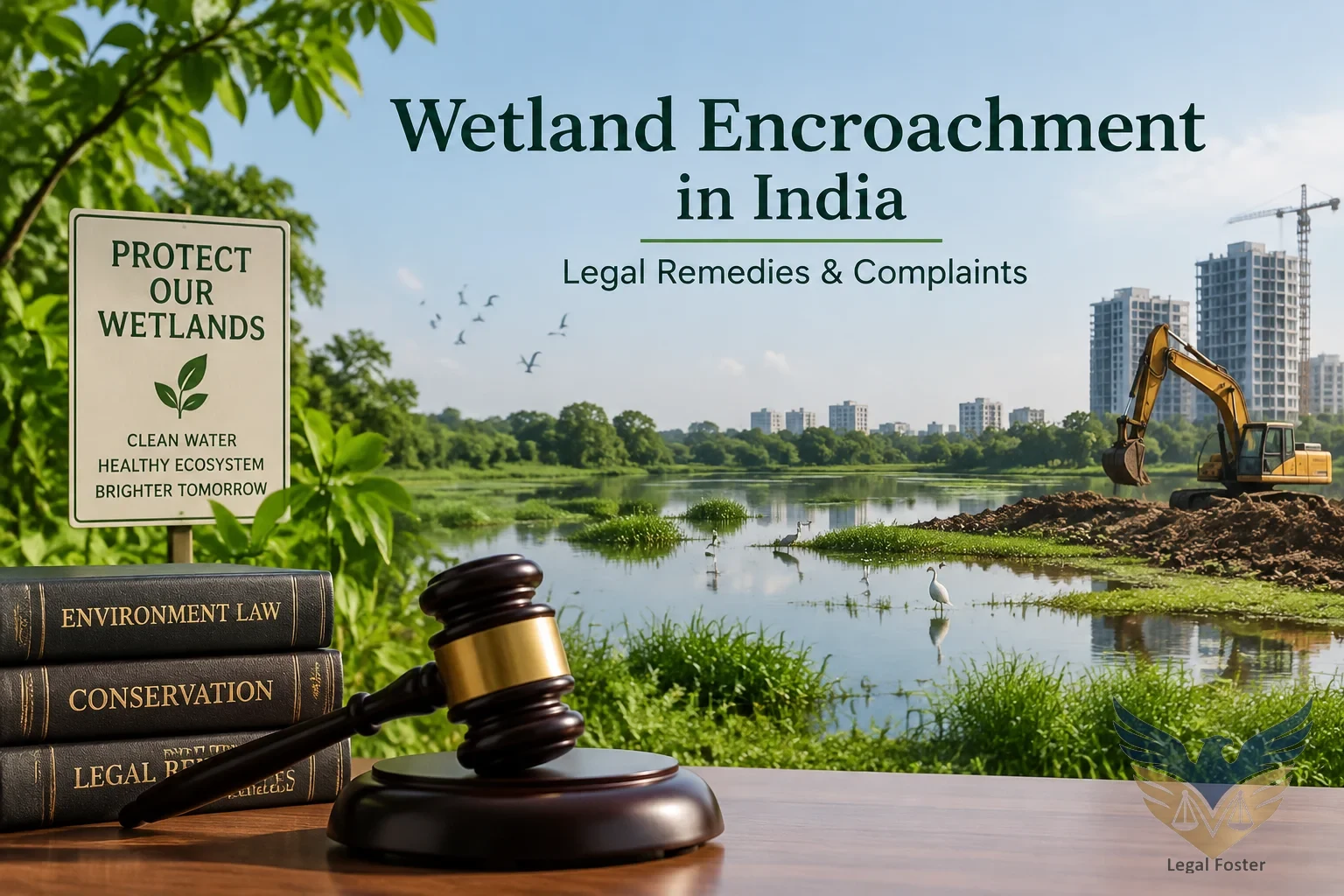
When viewed from across the fence, wetlands can appear vacant and underutilised swathes of soggy land begging to be developed. Thinking that may get you into hot water — legally and environmentally speaking. Fill it up, move a boundary marker, dump construction waste, divert inflowing or outflowing water or repurpose the land for something other than a wetland and you could be triggering a compliance buzz saw. Whether that buzz saw sounds, and who flicks it on, depends on whether the wetland in question has been notified, and what its status is.
If you’ ve spotted wetland encroachment, the first question you probably ask is one of the most basic: Where can I file a complaint? And what happens after that? To whom does enforcement belong? The answers depend on where the wetland is situated, what legal protections it has, what kind of violation you’ ve witnessed, what evidence you have to back up your claims, and who has jurisdiction over that space.
India currently uses the Wetlands (Conservation and Management) Rules, 2017 as its central regulatory mechanism for notified wetlands. On its website, MoEFCC says these rules were framed under the authority of the Environment (Protection) Act, 1986.
If you live in Delhi NCR ( Delhi, Noida, Greater Noida, Ghaziabad, Gurugram, Faridabad etc.) there are several government bodies citizens can approach in addition to the Forest Department since environmental violations fall under the jurisdiction of multiple authorities: local urban development bodies, municipalities, pollution-control boards, the revenue department and, if criteria are met, the National Green Tribunal.
With so many options, it’ s important to know where to file a wetland complaint. Filing your complaint with the wrong\_.990, asking the wrong government body to investigate can render your efforts useless.
Why Does Wetland Encroachment Matter in 2026?
A wetland can provide unseen services from ground level. They can be recharging groundwater, harboring biodiversity or storing flood water. Impacts of filling or developing land can extend beyond the visual footprint of a wetland.
Neighbors can discover themselves with altered drainage, water-logging or reduced ground water capacity. Businesses can discover themselves with an environmentally sensitive property they may or may not be aware of creating liability and documentation problems.
This issue is particularly timely in the rapidly developing areas of Delhi NCR where development pressures, land value appreciation and changing land use may result in conflicts over whether or not a particular land parcel falls within a wetland, impact zone or some other protected/enforceable area. A legal consultation can answer the first question: What's the legal status of that parcel of land? before anyone thinks they are encroaching upon it.
What Exactly Counts as Wetland Encroachment?
Wetland encroachment usually means illegal or unauthorized entry on, conversion of or use of wetland. The exact offense will depend on whether the wetland is notified and what act is taking place.
Conversion for non-wetland uses, and virtually all forms of encroachment are prohibited within notified wetlands under the Wetlands Rules. Dumping of solid- waste, certain effluent discharges (without treatment), certain industrial uses, and certain permanent structures are specifically regulated under the Rules as they apply to wetlands.
The first problem on the ground is identification.
A person can look at a filled pond and think it is a protected wetland. Someone else can produce revenue records that show it is something else. There could be another set of documents that show the land is within a notified wetland boundary. Just because there are three sets of records does not make each set correct.
Environmental Lawyers can help the complainant understand what records are available to see what legal action is appropriate.
Which Laws Apply to Wetland Encroachment?
Its cardinal regulation is the Wetlands (Conservation and Management) Rules, 2017 enacted under the Environment (Protection) Act, 1986. Please note that under the Ministry’s wetland regulations only Rule 4 is mentioned as being the Rule that deals with conservation and prohibited activities in notified wetlands.
The legal scenario will also involve other environmental, zoning, municipal,pollution- control or development acts/regulations depending upon the facts of what has actually happened. Say if construction waste has been dumped into a wetland, the legal position may be different than if construction has taken place over the wetland.
If sewage or industrial effluent is getting pumped into the wetland,pollution laws come into play.Also the role of the relevant Pollution Control Board will have to be seen. The NGT is a specialized environmental court instituted under the National Green Tribunal Act, 20<<>>(NGTA).What exactly says on its website? It has jurisdiction to hear matters on Environmental Protection and Conservation of forests and other natural resources including Environmental Legal Rights and Relief and compensation for damage to environment. Environmental Lawyers will thus be able to decipher if the dispute has an NGT angle to it or if some other administrative/legal remedy needs to be explored first.
Who Can Seek Help for Wetland Encroachment?
The owner of the wetland needn’t be the party who has an environmental interest to protect. A citizen might notice that a waterbody is being filled in. An Apartment complex may be affected by changes to drainage. A society might be affected by dumping / construction. An owner may discover development around their property has diverted/built over a natural watercourse.
Which legal course of action is appropriate will depend on the specific facts.
Residents, local communities, property owners, societies, business and organisations can get in touch with Environmental Lawyers to understand their legal options before taking any further action.
If you are unclear whether the land in question is classified as a wetland under law, then this should be determined. It makes it difficult to prove a grievance if it is based solely on your assertion that the land falls under a certain category.
What Is the General Process for a Wetland Encroachment Complaint?
Lets stick to the facts of the case at hand and NOT jump to conclusions.
What are the facts?
Location/land records/availability of notified wetland/ photographs/ maps/satellite imagery/development around/ nature of the said activity etc will help you understand where to start at.
Environmental Lawyers will help you string these facts together into a cognizable issue rather than making a vague statement such as ” Someone has encroached on the pond.”
OK. We have the facts. Now what?
Now you have to figure out which forum /authority can address the issue you just framed. Depending on the facts, the forum could be State/Union Territory Wetlands Authority, local body, development authority, pollution- control board or any other statutory authority.
The Wetlands Rules for instance establishes State/Union Territory Wetlands Authorities and sets forth the regulatory mechanism for notified wetlands.
Can I file a case in Court?
Yes, the case could make its way to court.
The NGT states that it has the power to adjudicate civil cases where (a substantial question relating to the environment is raised) and (the matter is otherwise falls within the statutory jurisdiction of the Tribunal). Furthermore, the NGT states that any person can approach the Tribunal with an environmental complaint thereby putting the said environmental damage before the Tribunal.
Yes. Different situations require different legal remedy and Environmental Lawyers will be able to guide you on the appropriate legal course of action instead of treating every complaint as identical.
What Documents and Evidence Should Be Kept?
Typically a well founded environmental complaint is backed up by an objective factual basis.
Some useful documents include:
- Photographs/video of the alleged encroachment.
- Exact location & identifiable points of reference. Tax receipts/records or land documents that the complainant is aware of.
- Copies of relevant notices / Maps/Public documents.
- Photos of any filling or construction or line marking.
- Name and information of the persons / groups involved in the activity to the greatest extent known.
- Copies of any previous complaints and replies from authorities.
- Any communication with the Municipality, Development or environmental department(s) regarding the issue.
- Documents that show changes to Drainage or waterways if available. An Environmental Lawyer can review these documents and advise what specific documents have legal standing before drafting a complaint or representation.
How Quickly Should a Wetland Complaint Be Made?
Environmental problems can become harder to fix after the environment is changed. If the dirt has been dumped, buildings erected or drained, or swamps filled it may be harder to show what the conditions were before. Plus delay can allow more development right up to the disputed area.
On the other hand, there is not always a hard time limit to obtain an environmental outcome. Statute of limitations, venue based limitations and what type of remedy you want may differ depending on where your case is filed.
As stated on its website, NGT has rules which allow for the expeditious resolution of environmental cases. However, this is based on the specific facts in your case and the procedure that occurs after filing. This is why Environmental Lawyers advise their clients to contact an attorney as soon as they know there is an issue, instead of waiting until the whole swamp is drained.
When Should You Consult Environmental Lawyers?
When you are faced with a situation where: There is a pond/marsh/lake/wetland area being filled in. Construction is being done over a water body. Soil/Construction debris is being dumped into a wetland/stream etc. Natural flow of water has been obstructed. You have seen a notification about wetlands which applies to your neighbour property and they haven’t complied with its directive. Previous complaints/civil discussions have not helped. A government body/authority has served a notice on them for the disputed activity. You aren’t sure whether the matter should be directed at a local body, Environmental body or NGT. You would like help understanding documents/legal correspondence prior to sending in a formal complaint.
At this stage Environmental Lawyers become extremely useful. It’s not simply a matter of drafting a complaint. Can the facts, documents and legal standings support the action you want to take?
Why Hire Environmental Lawyers and Advocate BK Singh?
Choosing to retain counsel for an environmental law issue is more than who can write a document for you. Wetlands can involve environmental law, real property records, government agencies AND specialized environmental courts all in the same issue. Environmental Lawyers offers legal services that start with identifying your environmental issue, evaluating the evidence you've collected, determining where to properly file your claim and explaining your legal remedies to you.
Every client has the right to know. What is my legal issue? What evidence do I have that supports my claim? What government agency has authority over my issue? What are my possible legal outcomes? Before you decide to proceed. BK Singh can assist clients in Delhi NCR and throughout India with their environmental-law questions, even if that question includes assessing possible NGT forums.
Visit BK Singh Environmental Lawyers to learn more about how the law firm can help with your environmental law concerns.
What Can Environmental Lawyers Help You With?
BK Singh will assist you in following Legal analysis :
- Matters relating to complaint against infringement into wetlands..
- Illegal development over wetlands..
- Dumping/pollution/greed related problems..
- Any water-body/environment related matter..
- Representation before the concerned forum/authority.
- Scrutiny of records/environmental evidence..
- Environment/ NGT proceedings which can be legally sustained..
- Litigation for restoration etc., depending upon facts..
- Sending of notices/ receipt of non-compliance of notices..
- Any environment related matter affecting people/land owners etc.
Exact service would be as per the facts. BK Singh can review whatever documents you have and would suggest you whether the issue can be resolved by filing an administrative complaint or needs to be represented before regulators or requires environmental litigation or some other remedy.
Frequently Asked Questions
What is wetland encroachment?
Encroachment into a wetland can mean many things, however in most contexts it would mean where a wetland has been occupied, filled, converted or used for a purpose that is otherwise prohibited by law. Since every wetland notified has its own set of conditions, some activities are restricted under the Wetlands (Conservation and Management) Rules, 2017 that aren’t considered “wetland uses”. However, the legal standing would be different depending on the status of the wetland, its boundaries, activity performed and any backing records.
Who can I complain to about wetland encroachment?
As indicated by the question above, it depends on the type of encroachment and where it has taken place. Some complaints would be made to the State or Union Territory Wetlands Authority, others would be directed at a local authority or development authority, pollution-control board or an environmental civil court / forum. Our Environmental Lawyers will have to review the facts and any documentation you have to understand what legal options are available to you.
Can I complain to NGT about wetland encroachment?
The National Green Tribunal (“NGT”) may be an option to file a complaint for certain types of wetland disputes. If you fulfill the statutory requirements, your issue would be heard by the NGT. The remedy available would be based on the environmental problem, what laws cover the activity being carried out, what evidence can be produced and what relief you require from the Tribunal. Our Environmental Lawyers can go through your situation and determine if you have an NGT-based legal remedy for your issue.
Is construction on a wetland illegal?
Similar to the previous question, it depends on the legal status of the land that has been constructed upon. If the land qualifies as a “wetland”, has been notified under the relevant statutes and what type of construction has occurred on it. Certain activities are not permissible to be carried out on a notified wetland as per the Wetlands Rules. Our Environmental Lawyers will need to review the relevant records, understand site information and the notification to determine if the construction activity in question is a violation of environmental laws.
Can a Wetland be restored after encroachment?
Maybe. There are certain cases where it may be possible to have a wetland restored to its original condition if it has been encroached upon or damaged. There is no guarantee, and a lot of factors would be involved to determine if the wetland can be restored. Depending on the extent of damage to the environment, status of the wetland, evidence you have and what legal remedies can be filed for. Our Environmental Lawyers can review your unique facts and determine if there is any possibility to have the wetland restored.
What documents are required for filing wetland encroachment complaint?
As with other environmental complaints, any photographs, videos and location information will be helpful. Other documents like land records, old maps of the area, notifications and proof of construction activity will help establish what kind of environment violation has occurred. If any previous complaints have been filed about the site in question, those records would also be beneficial. Our Environmental Lawyers will go through whatever information you have and recommend what type of documents would strengthen your case.
Can a person file a complaint about wetland getting encroached near his house?
Yes, if there is a legitimate concern for the environment near your house due to encroachment of a wetland you can file a complaint. Just because a wetland may be near your land, it doesn’t automatically mean that the cause of action would include your land. As with any environmental issue, it will depend on the facts and if an environmental violation has occurred that falls under the jurisdiction of a particular authority or forum. Our Environmental Lawyers will review whatever information you provide to determine if there are grounds to pursue legal action.
What should I do if no action is taken by the authority on my complaint of wetland encroachment?
If you have submitted a written complaint to any authority about wetland encroachment and feel that they haven’t properly handled your situation, you may be able to take further legal action. Once again, depending on what authority you’ve contacted and what exactly your complaint was, you may be able to have our Lawyers represent you in taking further legal action or file proceedings in the relevant forum if that is an option available to you. Our Environmental Lawyers will go over your complaint and the reply you’ve received to determine what you can do moving forward.
Can wetland encroachment near my house affect my property?
Yes. Since wetlands can help in draining water and store water, if a wetland near your house has been encroached upon or altered, it could affect how your property drains or stores water. There may be other problems that affect your ability to develop your property or related documents. Our Environmental Lawyers can go through the environment violation and understand your property and land records to figure out if there are any legal impacts for your property.
Why should I choose Advocate BK Singh for wetland encroachment complaints?
At Advocate BK Singh, we understand the complexity of environmental laws in India. Not only do they require technical knowledge about land records, but there can also be multiple authorities and environmental forums with jurisdiction over different issues. Advocate BK Singh and our team of Environmental Lawyers will review your documents and become familiar with the environmental issue you have mentioned to suggest what legal course you can take to help with your concerns. Since every case is different, please understand that the advice you receive from our Lawyers will be based on the specific set of circumstances around your legal matter.
Final Thoughts
Your wetland encroachment problem may have issues beyond a dispute about a piece of property. Involved may be environmental conservation, clarifying the status of property, government agencies, development and more technical legal solutions.
Should you know of filling, construction, dumping or some other activity affecting a suspected wetland area, avoid assuming the facts based on hearsay or reporting to local authorities with no follow-up. Secure any evidence that currently exists if possible and try to clearly establish the legal status of the land.
Attorneys that specialize in the Environment can help you go over documentation, clarify the environmental legal concerns and assess what options may be available to you. Advocate BK Singh provides Environmental Law consultation to clients who need knowledgeable professionals to discuss wetlands and environmental issues with.