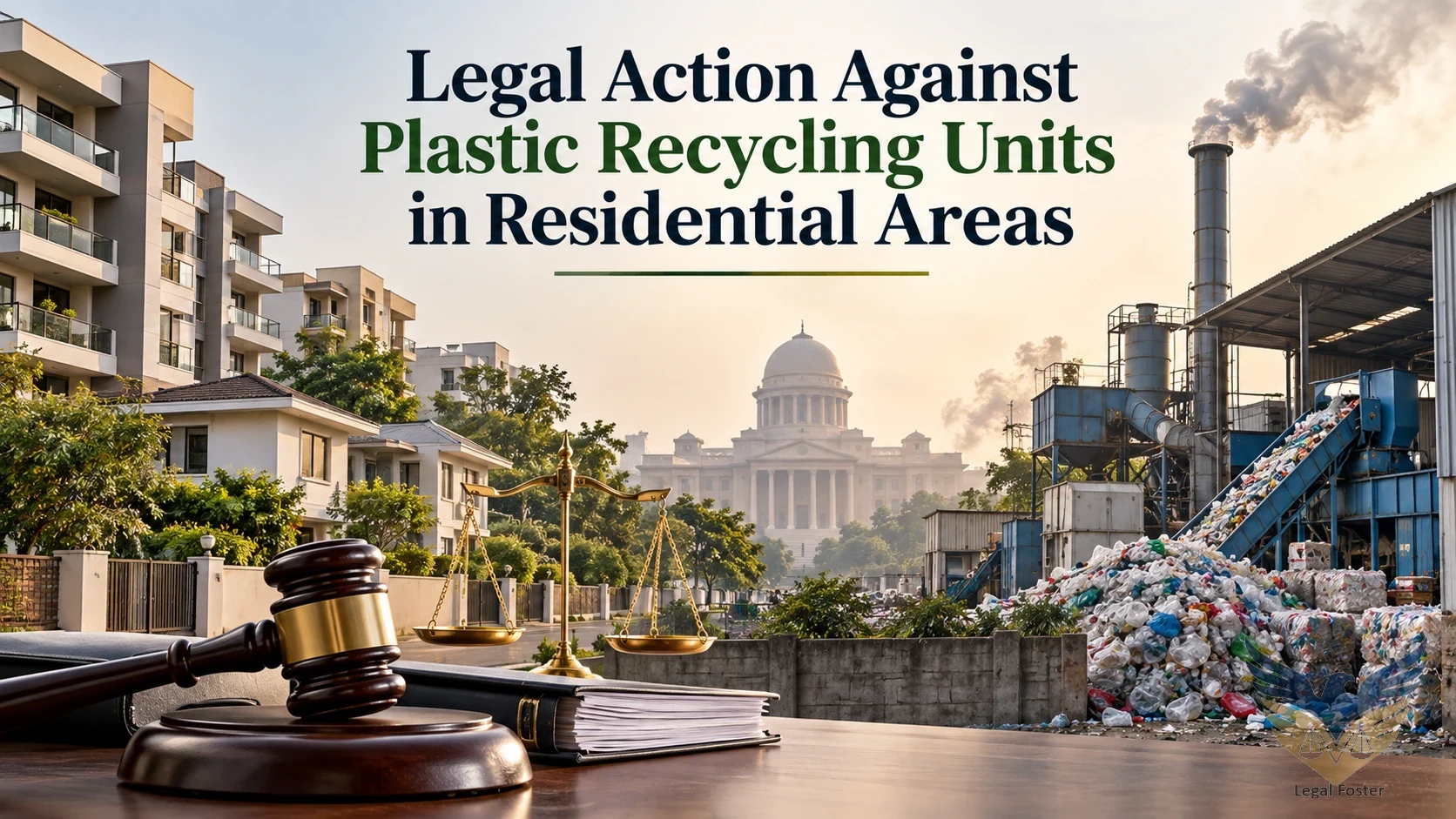
Legal Action Against Plastic Recycling Units Operating in Residential Areas in India
Are you aware of a plastic recycling unit in or around your society? Do your neighbors suffer from smoke, odor, noise pollution, flying plastic pellets, traffic or dangerous stockpiles of material? Plastics Recycler Nuisance in Residential Society: Legal Options You Can Take
Do you have legal options if there is a plastics recycler in your residential society? Yes and no. The short answer is that there are environmental laws, pollution-control standards, waste-management regulations, local approvals plus potentially action in the National Green Tribunal or State Level Environment Appellate Forum, depending on the facts.
As a resident of the society you may quickly realize that something isn’t right. Figuring out what law applies, what documents you should have and who to go to may be another matter.
Just because a facility recycles materials does not mean it is illegal or violating the law. After all, recycling is a good thing and it involves plastic waste. But if the unit isn’t authorized, compliant with environmental standards, or meeting its statutory obligations, then operating in a residential area can be part of the problem.
India has environmental laws that specifically mention plastic waste. These include the Plastic Waste Management Rules, 2016 which applies to plastic waste generators, local authorities and persons who undertake manufacturing, processing or recycling of plastic.
“The owner must have known better than to start such a plastics nuisance in a residential area.” If only it were always that simple. While starting a plastics recycling unit in a residential area may not have been in his or her best interest, it’s likely that the owner obtained registrations and approvals from relevant authorities.
Determining what laws apply, which standards must be met and who to contact can be difficult for non-lawyers. That’s where Environment Lawyers come in. We can help our clients understand the nature of their legal grievance, sort through what documentation you have and determine what legal option is best suited for you.
Contact us today to take the next appropriate step, legally.
Why Can a Plastic Recycling Unit in a Residential Area Become a Legal Concern in 2026?
Residential Landlord/Tenant Issue – Plastic Recycling Unit near Residence
Does having a Plastic Recycling Unit near Residence upset you? It should….may or may not. The concern for having a plastic recycling facility near a residence is based upon the reasons for pollution, mishandling of plastic-waste, creating unsafe storage facilities, unreasonable noise standards, emissions, flying debris and or any other environmental hazard. Is it lawful to have a plastic recycling unit near residences? That is completely fact dependent and will vary from situation to situation based on what the unit is actually doing out there and whether or not they are following their permitting requirements.
Say you live in Delhi NCR (Delhi, Noida, Greater Noida, Ghaziabad, Faridabad, Gurugram) there are many branches of regulation that could go into effect when filing a complaint to their environmental regulatory agency. The same can be said for many mixed industrial/residential communities and Urbanized cities throughout India.
You could have issues involving The Environment (Protection) Act, 1986, Plastic Waste Management Rules and the applicable pollution-control regulations and etc. addressing your concerns. The Environment (Protection) Act talks about Environmental pollution, Directions, Inspection, Industries etc. “ Section 5. Power to issue directions. – The Central Government may issue such directions, including directions for the closure, prohibition or regulation of any industry, operation or process, as appear to be necessary or expedient for the purpose of this Act.” India Code
The concern for a resident is simple. As a resident when do I get to enjoy life in my home without nuisances from environmental hazards?
Lets dig into where you need to have your lawyers look into things as soon as possible.
Quick Facts
- Recycling of plastic comes under the ambit of Plastic- waste rules.
- Registration & compliances differ based on the recycling activities.
- Pollution- control board has something to say in matters of environment compliances.
- Environment (Protection) Act, 1986 provides legal framework to control environment & pollution related issues.
- Environment related complaints consist of documents, pics, correspondences, location/address etc.
- Cause of action can be determined based on facts, relief sought and the law applicable.
- It is in the best interest of the clients to consult Environmental Lawyers & Advocate BK Singh to ascertain the forum before initiating a legal proceeding.
What Exactly Is the Legal Issue With a Plastic Recycling Unit Near Homes?
Because a plastic recycling facility is located near homes it does not necessarily mean the facility is involved in illegal activity. Rather, what would be occurring would be some activity or aspect of the facility's operation that violates environmental / pollution control / waste management / land-use / regulatory compliance.
This could be an ongoing problem with smoke/emissions, odour, stored plastic scrap, open burning of waste material, noise, wastewater, dust, heavy equipment entering / exiting the property or the stockpiling of discarded material.
More importantly we need to ask what does the unit actually do? And what permissions or registrations would that activity require?
Environmental Lawyers can assist our clients in determining the difference between a general neighbour nuisance issue and something that has an identifiable environmental-law issues. This is crucial as the legal remedy should correspond with the actual problems.
All too often homeowners wait until things have progressed too far. Not only does this cause more stress but also an initial consultation with Advocate BK Singh could identify what evidence you should be collecting and what regulatory matters you should be addressing.
Which Laws Apply to Plastic Recycling Units in Residential Areas?
A few laws mentioned below may apply depending on the facts:
Environment (Protection) Act, 1986 is one of the main environmental laws. It enables the central government to take measures to protect and improve the quality of the environment and matters connected thereto, and prevents the pollution of the environment. The said act contains provisions relating to directions, inspection, sampling and prohibition and regulation of certain activities.
More specifically, Plastic Waste Management Rules, 2016 , as amended from time-to-time (the “Rules”) shall apply which deal with plastic waste management. The rules also explicitly mention stakeholders involved in plastic waste management such as waste generators, local bodies, manufacturers of plastic, processors of plastic, etc. and activities relating to plastic.
Registration and Regulatory Compliance is another law that may be relevant to recycling units. As per data available on CPCB ’s website, Plastic Manufacturing units and recycling units are required to register under the concerned State Pollution Control Board or Pollution Control Committee respectively as per the framework mentioned above.
Also, the respective State Pollution Control Board or Pollution Control Committee shall be an important regulator depending on where the operations of the unit are located. For example, Delhi Pollution Control Committee has on its website mentioned the laws as well rules related to pollution- control applicable in Delhi which includes the Plastic Waste Management Rules, Solid Waste Management Rules etc.
The specific facts can be analyzed by Environmental Lawyers vis-a-vis the above mentioned framework instead of putting all recycling units in one generalized bucket.
Can Residents Take Legal Action Against a Plastic Recycling Unit?
Yes. If there is genuine environmental abuse,pollution,event or non-compliance issue, residents certainly have legal or regulatory recourse. However, it would depend on the facts or evidence available, any permissions that apply and the nature of relief required.
For instance, it would be helpful for a resident to understand if a pollution issue exists, whether it pertains to waste management issues, regulatory non-compliance issues,luxury land-use issues / complaints,nuisance,unsafe activity or a combination of several issues.
Upon analysing these factors, there may be room to make representations to the concerned authority, file a regulatory complaint, request an inspection/remedial related resolution or in some cases initiate legal proceedings before a Court of law or appropriate Environmental Tribunal/ FORUM.
India has a National Green Tribunal (NGT) which is a specialized forum created for the purpose of speedy disposal of cases relating to environmental protection and the conservation of forests which involve a substantial question of law or fact.
Section 22(1) of the National Green Tribunal Act, 20 10 reads as “applications for relief and compensation for harm to environment, also allows any person who may be aggrieved or adversely affected by any order made or action taken to prefer an appeal to the Tribunal.”
However, this does not mean that every neighbourhood conflict has to be settled at NGT. Identifying the appropriate forum is a legal decision. An Environmental Lawyer can advise the concerned citizens whether the facts of the situation merit an environmental lawsuit or there might be alternate recourse available.
What Documents and Evidence Should You Keep?
Concise information can make a weak environmental complaint a very strong one.
Retain any evidence you currently have e.g.
- Photographs/video footage of the activity/noise/pollution
- Location of the premises
- Dates/time if it is a recurring problem
- Copies of previous complaints
- Responses received from council/unit
- Notices/relevant correspondence
- Photographs of litter/build up/storage
- Noise logs if applicable
- Addresses of other affected properties
- Council inspection reports/contact you have already received.
Do not invent evidence or provide inaccurate statements about things that have not happened.
Environmental Lawyers will be able to review what you have and guide you on what will be relevant for legal proceedings.
How Quickly Should You Consult a Lawyer?
Environmental complaints shouldnt always sit for months before being filed, if the alleged activity is continuous.
Depends on what the activity is, what Statute of Limitations/filing requirement there is, if there were previous complaints filed, what regulatory action has been started and what you want as a remedy. Also an environmental violation can continue to generate evidence of a violation. Waiting to see if the situation corrects itself can be one course of action but can have unintended consequences.
Meeting with Advocate BK Singh early on will allow a citizen to see if something needs to be put into writing immediately, if regulatory action is needed or if some other legal action is necessary.
There isnt a master timeline for all types of plastic recycling lawsuits. You must look at what Limitation period and procedural requirements you have based on what legal action you would like to initiate.
When Should You Consult Environmental Lawyers?
When:
- There is a plastic recycling unit installed near your house/office which is causing repetitive pollution/envirnomental nuisance.
- You suspect that the said unit may not have taken any environment clearances/registration.
- You have approached the concerned department but have not received any positive response.
- A residential society/community would like to know the legal recourse that they can take.
- You have received a notice or letter from the concerned department/plant regarding the plastic recycling activity.
- It involves continuous pollution/waste dumping/smoke/smell or any other environmental nuisance.
- You aren’t sure if the matter can be approached at the pollution- control board/local body or NGT or some other forum.
- Multiple residents are facing the issue and want to approach the matter in a legally organized manner.
Environmental Lawyers and Advocate BK Singh will evaluate your situation and guide you on the most appropriate legal course of action you can take before deciding to file any specific litigation.
Why Hire Environmental Lawyers and Advocate BK Singh?
Why hire a specialist when you can just file another complaint, you may ask? Here’s why. An environmental grievance is very rarely based on a single photo or incident no matter how nasty. The legal issue may concern what activity is actually taking place, under what laws it is regulated, what its environmental impact is, which authority has jurisdiction and what remedy is available under law. Advocates has experience and can offer guidance at the very assessment stage. We will try to understand your problem, pick out which environmental law applies and advise on the correct legal avenue to pursue. This can be especially helpful for clients located in Delhi NCR where local understanding of the regulatory landscape can make a big difference. We can advise on similar issues for businesses and individuals in other Indian cities and states depending on the facts and the jurisdiction.
You should not have to know all the environmental laws before meeting with us. Just tell us what is going on and give us the information you have.
We will help you figure out what needs legal attention and what doesn’t.
Facing problems with a plastic recycling unit located in/residential area? Meet Advocate BK Singh and discuss your case. We can provide a case specific analysis of your legal and regulatory options.
Frequently Asked Questions
Only because a recycling unit happens to be located next to residences, does not automatically make its presence illegal. Depending on land-use regulations, environmental approvals obtained, pollution-control compliance status or existing regulations on plastic-waste and other standards that may apply, the activity may or may not be permitted. Citizens who believe that unlawful activity is taking place, or that the environment is being harmed, can have these issues investigated. Environmental Lawyers can review the facts as you know them and identify what legal issues must be addressed.
Ensure that you have evidence of the issue occurring, documented and keep copies of any written complaints or communication already submitted. Depending on the nature of the pollution issue your concern may be directed to, the avenue for regulation or legal enforcement will vary. Advocate BK Singh can provide an initial consultation to clarify if the situation warrants writing to a regulator on your behalf, supplying further evidence to an enforcement body or recommending another legal remedy is available.
If the plastic waste located near your residence is being collected or processed improperly and you believe that this activity is against regulations, or the environment could be impacted negatively then you may consider lodging a complaint. Certain laws will apply based on the type of waste being handled and what occurs at the premises. An Environmental Lawyer can help you figure out exactly what occurs at the concerned location and what information you should submit to the relevant authority.
Yes. These Rules are part of a legislative framework which controls how waste plastics are managed in India. Some recycling units and processors fall under the ambit of these Rules which mean they would require to register and follow compliances under this legislation. Environmental Lawyers can help you figure out if your recycling unit falls under the ambit of these Rules based on the activity that you actually perform at your location rather than assuming all recycling units process plastic waste in the same manner.
The NGT hears cases which relate to the National Green Tribunal Act, 20 10 and matters which fall under environmental laws listed in that legislation. You may be able to file a case for relief and damages against the responsible party if your situation falls under the categories outlined in that act. Although your issue may involve environmental damage, it may still fall outside of NGT's jurisdiction. Advocate BK Singh can review your intended complaint and explain whether NGT is the appropriate place to file your petition.
Citizens should not assume that asking an authority to shut-down a non-compliant business will result in immediate action. First you must figure out what your goals are and what kind of relief can actually be granted by a regulatory body or court of law. If there are environmental laws which have been broken, various remedies may be available through conviction of the offending party. Environmental Lawyers can help you understand what actions can be taken based on the laws which apply to the activity in question.
Documentation that a problem is occurring repeatedly can be useful. Pictures or video, location/address of the polluting property, copies of any previous complaints you have made to authorities, any correspondence or notice you have provided to the polluter, records of how many times/week the problem occurs can help establish your claim. Provided your evidence is genuine, an environmental lawyer can assist you with what legal options are available. Environmental Lawyers will need accurate information in order to recommend a course of action.
Yes. Since a housing society qualifies as a "person" who is aggrieved under the National Green Tribunal Act, your society may file a case in NGT if members of the society are affected by pollution/environmental violation. In certain cases NGO's and other societies may also have standing to file a case. Advocate BK Singh can assess your potential case and direct you accordingly.
This may vary depending on which authority you have filed your complaint with and whether your complaint is still pending. You may consider following up with the authority by sending a letter to the higher-ups but only after we have reviewed your case. Environmental Lawyers can review what you have done so far and recommend whether you should write another letter or begin a lawsuit to prompt action.
Researching environmental laws and trying to figure out which applies to your situation can take up a lot of your time. If you hire a lawyer, he will examine the details of your case and determine which laws apply. An Environmental lawyer will organize your documents for your case and assist you in making decisions by advising you on what you can and cannot do legally. Environmental Lawyers take the burden off your shoulders and deal with the legal aspects while you focus on other things. Advocate BK Singh offers legal representation for issues that involve the environment.
Final Thoughts
Don’t make decisions based on myths and speculation. If you have a plastic recycling plant operating in your neighborhood, assess the facts. Is the activity legal under all applicable environmental and other laws? If so, is there actual environmental damage? If so, what is the proper legal remedy? It all depends on the facts of the situation.
You or your family, co-op / society or building should not have to become environmental lawyers to determine all of the facts.
If your home, community association, building or neighborhood is affected by suspected plastic recycling or solid waste wrongdoing, we can help you understand the issues. By contacting Environmental Lawyers you will be able to understand the legal issues and options available to you.
Once you know the facts it is much easier to know what, if anything, should be done about them from a legal standpoint. Call Environmental Lawyers / Advocate BK Singh for your legal analysis based on your unique environmental situation.