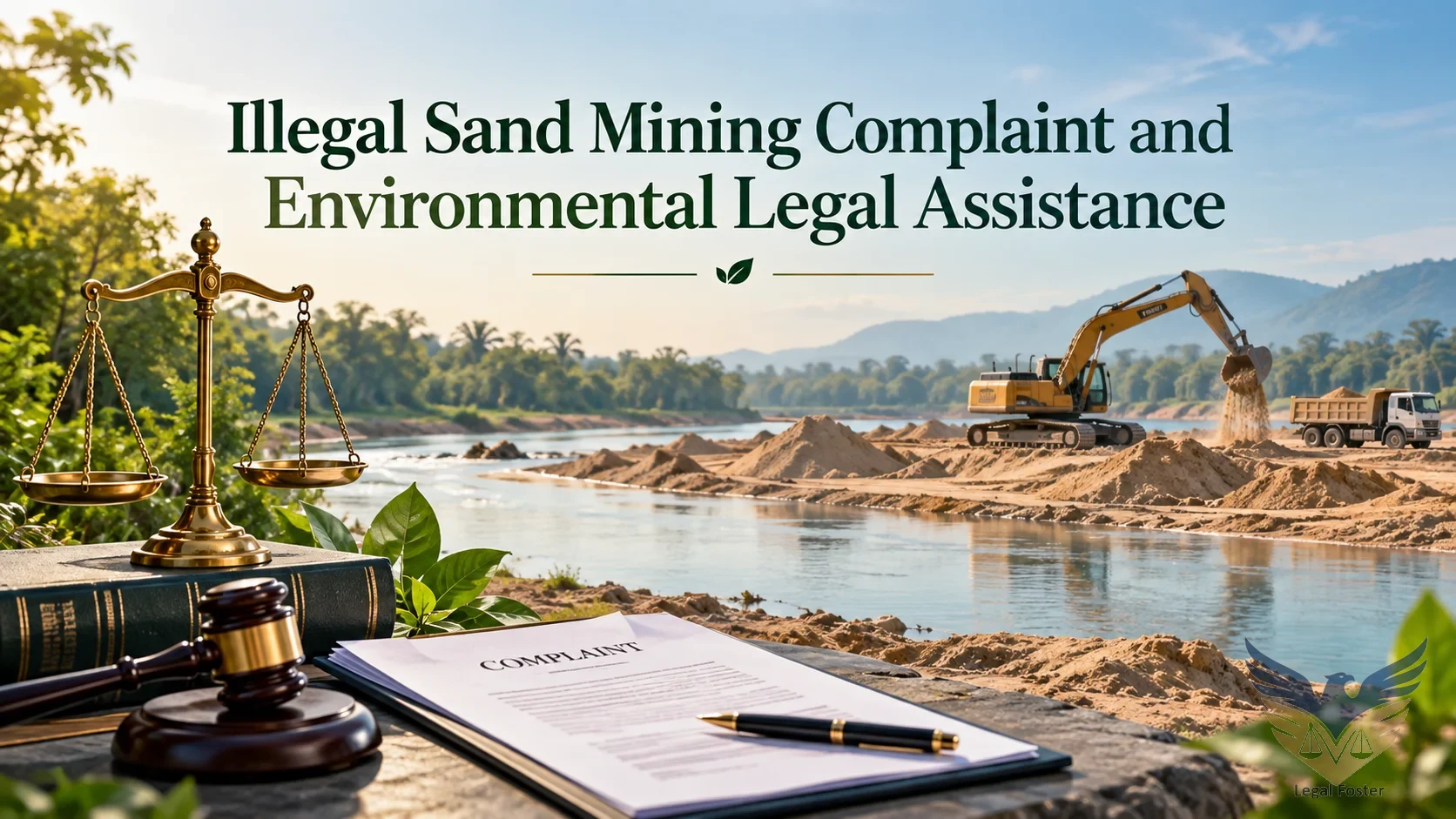
Illegal Sand Mining: How Can Environmental Complaints Be Filed and Addressed?
Illegal sand mining is not limited to extraction of sand present on the banks of a river bed. Illegal or inconscientious mining can affect river ecology, groundwater recharge, agricultural land, roads, nearby villages and the flow of water itself. The average man noticing suspicious activity may have far simpler questions – where should he file a complaint, what evidence will matter and when does he call a lawyer?
If you are a citizen, land owner, farmer, member of a community organisation or run a business located in Delhi NCR or anywhere else in India and you are considering filing an environmental complaint against someone, take a moment to think about how you file that complaint. Although a picture or video may suffice to show what “went wrong”, a legally valid complaint will usually require a more detailed account of where something is occurring, what specifically is occurring, how the environment is affected and who has been notified about the occurrence.
Advocate B.K. Singh assists clients who seek professional advice on environmental matters pertaining to alleged illegal mining activity, environmental destruction and lack of regulatory action. The objective is not to incite citizens to file frivolous lawsuits. Instead we aim to ensure our clients know and understand his legal rights, compile his claim properly and choose the correct legal forum.
Why can illegal sand mining become an environmental issue in 2026?
Illegal sand mining could involve breaches of mining regulations. Depending upon the facts of each case environment clearance, mining leases, transportation/ storage of minerals, river ecology and environment could also get implicated.
Here’s how: Mining activity is regulated under the Mines and Minerals (Development and Regulation) Act, 1957 (MMDR Act) . State Governments have been granted authority with respect to minor minerals and rules concerning prevention of illegal mining as well transportation/storage.
Furthermore, depending on where the sand mining activity is taking place, clearance requirements under the environmental clearance route would also get implicated. Proceedings before the NGT have expressly recognized that sand/ RBM mining is regulated under MMDR provisions and environmental clearance would be required under the relevant EIA Notification.
This means the practical question before the complainant is not simply, “Is sand being removed?” It is legally authorised? Are safeguards being followed?
What should you know before making an environmental complaint?
An environmental complaint regarding suspected illegal sand mining should be based on ascertainable facts and not presumptions. Whereabouts of mining activity, details of what you observed, approximate date/time, photo/video evidence, visible environmental impact and copy of any previous complaint if any will aid in determining the facts of the situation. Thorough documentation will make an environmental complaint by far easier. Advocate B. K Singh will analyze what you've got and will be able to advise you if the situation seems primarily regulatory, environmental, mining-specific or suitable for some broad legal action.
What does the law say about illegal sand mining?
Mining and regulation of minerals is primarily controlled under the statute called MMDR Act. The MMDR Act under section 4 defines “mining operations” as the operation to be carried out under this Act and subject to rules to be made under this Act. Mining operations relating to minor minerals can be directed by the State Governments to make rules under section 15 of MMDR Act. Section 21 of MMDR Act talks about the penalty to be imposed for certain offences against this MMDR Act. State Governments have the power to make rules for prevention of unlawful mining or transport of or storing minerals under section 23C of MMDR Act.
As sand is classified as a ‘minor mineral’ in most instances, the rules framed at the state-level and the enforcement of these rules thereunder become extremely relevant. This is why the specific legal status quo in each situation would vary based on the State, region, and nature of mining operations being conducted. Furthermore, environmental regulations would also be applicable in the event of mining. There have been numerous NGT orders on river sand mining reinforcing the applicability of EIA Notification and securing clearances under environmental laws.
This is why environmental grievances related to mining need to be looked into deeply rather than being shrugged off as null.
Who may need a lawyer for an illegal sand mining complaint?
You may require legal assistance if you are:
- An occupant with a residence affected by mining activity on rivers, canals or any water bodies
- A farmer concerned about mining activity affecting/agricultural land and/or water resources
- An owner with land being subjected to environment degradation due to extraction activities nearby
- A society/group of residents aggrieved by repeated /continuous mining activity
- Someone who has already made a complaint to the authorities but would still like advice on legal recourse
- An individual/business/organization with environmental concerns about mining
Advocate B.K. Singh can assess your situation as a complainant and help you figure out what information would be legally helpful before deciding upon any course of action.
Why should you hire Advocate B.K. Singh for an illegal sand mining matter?
The problem is often not recognizing that something doesn’t look right. The difficulty lies in wording your complaint in a way that ties the activity to laws and environmental concerns.
Lawyer B.K Singh starts with identifying the facts. This will include reviewing any photos or video you may have taken documents any correspondence material as well as location and details of the affected environment.
Your lawyer will also be able to explain whether you have a routine mining-rule complaint or a situation that has larger environmental impact. This can determine what agency or legal venue will have jurisdiction. Advocate B.K Singh provides Delhi NCR, Uttar Pradesh, Haryana and other parts of India clients with experienced legal counsel that evaluates your situation thoroughly and doesn’t promise you the world.
What happens when you approach Advocate B.K. Singh?
Step 1: Know the Complaint. Oftentimes the facts and any accompanying documents will reveal what type of mining is supposedly taking place and what the environmental concern is. If there have been any previous representations/complaints to government agencies, those records can reveal what has happened in the past.
Step 2: Know Your Legal and Regulatory Path. Once you understand the facts, you can determine what your legal remedies and regulatory pathway will be. This may include contact with the appropriate mining authorities, environmental authorities or filing a proceeding in front of an appropriate court.
Remember to keep things professional through documentation, respectful representations and legal counsel rather than needless escalation.
What documents and evidence should you keep ready?
You do not need to have a lengthy legal file prepared when you call to request your very first meeting. Here are some examples of useful information:
- Photos or video of the alleged mining activity
- Exact location or the ability to be located there
- Date and approximate times activity took place
- Descriptions of vehicles, equipment or extraction methods, if safely observed
- Photos of environmental or real property damage
- Copies of previous complaints you have filed
- Responses or notices you have received from government agencies.
- Deeds or titles, if the complainant is the property owner of the property in question. NEVER PUT YOURSELF IN DANGER when trying to obtain information. Your lawyer should never ask you to confront those who are possibly breaking the law.
How can Advocate B.K. Singh help with your complaint?
Hiring an environmental attorney can help shine some attention on an issue that may have otherwise been settled with pictures, complaints and discussions with various agencies. Advocate B.K. Singh will evaluate what you have, what law applies and recommend action based on the specific facts of your case. If you have already made complaints to government agencies and aren't happy with the response, previous dealings with the government will be considered as part of the legal analysis. In short, we want you to be aware of your legal rights before deciding how to proceed.
When should you consult Advocate B.K. Singh?
You might want to consider hiring an attorney if the offense you are reporting is current, if you believe the violation is causing significant damage to the environment, or if previous reports have not addressed the issue. Additionally, if you are unsure where the violation should be reported, you may want to contact an attorney.
Another benefit of speaking with an attorney is if you have a lot of information you are not sure how to share.
Advocate B.K. Singh will explain your legal options in terms everyone can understand and guide you through what information will help with your particular complaint.
Frequently Asked Questions
What is illegal sand mining?
Illegal sand mining can mean different things depending on the circumstances. As a general rule it involves extraction, transportation or storage of sand in contravention of mining laws, rules and permissions or other applicable legal requirements. Exact position would depend upon the location in question, any permissions available to the mining activity and applicable State-specific laws/rules.
Where can I complain about illegal sand mining?
Appropriate authority to receive your complaint depends on the State, location of the illegal sand mining activity and exact nature of the alleged violation. This could include mining authorities, or other empowered environmental authorities. A lawyer can help determine the appropriate channel based on facts of your situation.
Can illegal sand mining become an environmental issue?
Yes. In addition to pure mining-law concerns, taking sand can also involve environmental concerns especially when riverbeds, groundwater, farming areas or other surrounding ecosystems are impacted.
Is environmental clearance necessary for sand mining?
Yes. EIA framework would be applicable for sand/RBM mining in many locations, so environmental clearance requirements would apply. NGT has passed orders involving river sand mining which have specifically discussed environmental clearance requirements.
Does MMDR Act cover illegal sand mining?
The Mines and Minerals (Development and Regulation) Act, 1957 (“MMDR Act”) is one important law which applies to mining & minerals. Section 15 also allows State Governments to make rules with respect to “any matter not inconsistent with this Act relating to minor minerals”. Section 23C deals specifically with prevention of illegal mining, transportation or storage.
Can I consult a lawyer if I only have photos/videos?
Yes, you can consult a lawyer if you have photos/videos. Both can be used as part of the factual records supporting any claim. Whether they are useful will depend on whether they can be connected to a location/date/activity and supported by other facts.
I already complained to the local authorities. Now what?
If you already complained to the local authorities, please make sure to retain copies of your original complaint, acknowledgement receipt, any correspondence with the authorities and any response you received. Advocate B.K Singh can review this history and advise regarding legal options you may have based on response (if any) and specific facts.
Will a lawyer be able to stop the illegal mining?
No lawyer can guarantee that illegal mining will be stopped. As with any legal matter, the results will depend on the facts of each case. Whether legal action can be initiated depends on facts/evidence, applicable statutory provisions, potential action from authorities and ultimately a decision by a court or other forum having jurisdiction over this matter.
Can I consult a lawyer if the sand mining is not happening on my land?
If the sand mining is taking place outside of your property, you may still have legal options depending on environmental concerns caused by mining and what legal route is used to file a complaint. The better question is whether there is some actionable/legal grievance held by the person filing the complaint and whether facts support the initiation of any legal proceedings.
Why hire an environmental lawyer for mining complaints?
Issues involving environmental laws can involve multiple regulators and different agencies. Advocate B.K Singh can work with you to understand the legal position you are in based on the location of mining activity. We can help you organise any information you have and assess what legal options are available without promising unrealistic results.
Should I hire a lawyer for Illegal Sand Mining?
Environmental Lawyers offer legal assistance to our clients regarding environmental matters. If suspected illegal mining is affecting your land, water resources or other common resources around your community, we can help.
Advocate B.K Singh can speak to you about the facts and assess what next legal step should be taken. This service is for individuals, property owners, communities and other persons who require legal assistance tailored to their situation instead of relying on generic online information. Contact us to learn more about illegal sand mining and whether you should consult a lawyer.
Final Thoughts
Sand mining may be both an environmental problem or a mining regulations problem. It depends on where the mining occurs, if permissions were granted, whether it is causing environmental damage and what proof you have - not to mention what actions (if any) the regulatory agencies have already taken.
You should NOT have to know the intricacies of environmental and mining law before contacting a professional. Advocate B.K. Singh can review what you know and inform you of your position and options so that you can decide what actions you would like to pursue.
The correct advice at the correct time can turn an uncertain environmental issue into a verified potential legal issue involving illegal sand mining.