How Can MSMEs Take Legal Action Against Payment Gateways for Withholding Their Funds?
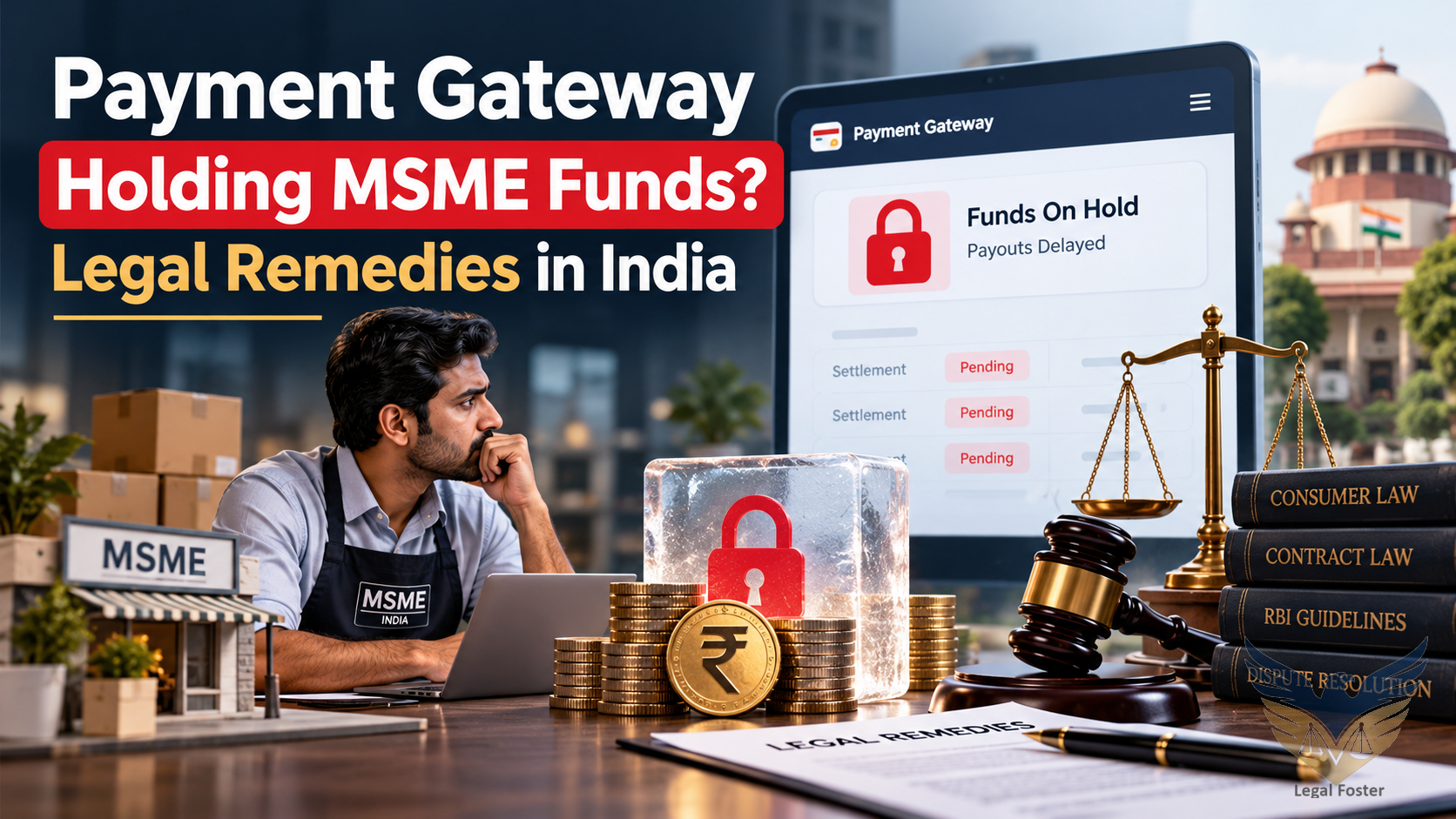
Payment gateway holding funds may cause significant cash flow issues for MSMEs. Business owners may not be able to pay wages, order stock, or fulfil existing financial obligations if a payment aggregator freezes settlements, delays merchant payout, or reserves collected payments without explanation.
Let’s say you own an online store in Delhi. Customers pay for orders. You ship the products, and transactions are marked completed on your payment dashboard. The payment gateway, however, refuses to release collected funds to your business bank account.
Weeks go by. Customer care sends automated replies. Your team is waiting on paycheques. Suppliers want to get paid. Your working capital is depleting.
Businesses across India can encounter this issue. Whether you are a manufacturer, e-commerce seller, digital services provider, startup founder, or any other MSME.
This isn’t to say that every payment hold is unlawful. In some cases, payment aggregators rightfully restrict settlements due to suspected fraud, compliance requirements, customer chargebacks, unusual activities, or merchant agreement violations. But even in those circumstances, each situation should be reviewed according to the governing agreement, legal obligations, and regulatory guidance.
MSME Lawyers offers payment dispute reviews with legal insight from Advocate BK Singh. Businesses can learn how to review payment settlement concerns and identify actionable legal remedies.
In this article, we cover why payment gateways hold business funds, Indian laws that apply, how merchants can request settlement, and when filing a complaint orlawsuitmay be necessary.
Payment Gateway Holding Funds: Why MSMEs Should Be Concerned in 2026
Cash flow is vital to small businesses. Most MSMEs can’t afford to wait several weeks or months to get paid for services rendered or goods sold. If payment terms from suppliers are strict, the inability to settle payments can be problematic even if a business is otherwise profitable.
Suppose a payment settlement from an online order takes longer than expected. In that case, the delay can have serious consequences for operating expenses.
Consider an instance where a manufacturer based in Noida sells inventory through an e-commerce platform. It’s peak season, and consumers are spending on festive shopping. Customers place large orders through a payment gateway. The merchant fulfils orders and ships items to customers. Once transactions are complete, the payment aggregator places the merchant account on verification hold and reserves the funds.
It doesn’t matter if this ecommerce seller stays profitable during this interval. They may still need to pay employees, delivery services, suppliers, and EMIs.
This hypothetical situation can happen to businesses in Ghaziabad, Gurugram, Mumbai, Bengaluru, Hyderabad, Ahmedabad, or any major commercial city in India.
Online businesses must work with third-party payment facilitators. When disagreements arise over payment reserves, transaction monitoring, chargebacks, or merchant account suspensions, the legal agreement and technical contract language should always be reviewed.
Business owners should understand why funds are being held and what dispute process is available to them before considering escalation.
Speaking with a lawyer can clarify if the reason for withholding funds is justified by a contractual obligation, compliance issue, or unreasonable delay in settlement.
Important Laws
- Payment and Settlement Systems Act, 2007.
- RBI (Payment Aggregators) Directions, 2025.
- The parties’ Merchant Agreement.
- Consumer Protection Act, 2019 (for consumer claims).
- REsponseibility editableBIf editalso has the power to receive complaints under the RBI Integrated Ombudsman Scheme, 2026.
- District or High Court ondepending on the claim value and applicable jurisdiction.
- MSMED Act, 2006. (only applicable in enforcable/recovered if the transaction qualifies as a “delayed payment” under Sections 15–18)
- Evidence such as transaction logs, settlement records, the merchant agreement, and written correspondence.
Understanding Fund Holds
Essentially, when a payment gateway holds funds from an order, it means that money received from customer transactions is not being released to you for the expected period.
Both terms are sometimes used interchangeably, but payment gateway and payment aggregator are different entities.
Payment gateways usually provide payment technology for merchants to accept payment instructions. Payment aggregators act as intermediaries between businesses and payment processors to collect payments and settle them to merchants. The payment processor, acquiring bank, or another entity may be directly responsible for settlement.
Knowing the difference can help you identify who is responsible.
Reasons For Blocking Payment to Merchants
Here are some reasons why a payment provider might block or delay settlement:
- Incomplete merchant KYC / business verification process
- Suspicious or fraudulent transactions.
- High chargeback rates, refunds, or complaints.
- Business activities that don’t match up with the transactions being processed.
- Products or services that violate regulatory laws.
- Breach of the merchant agreement.
- Loss reserve, holdback, or rolling reserve.
- Legal investigation by a government body.
For example, high-risk merchants that suddenly start accepting transactions far greater than their usual business volume might receive additional scrutiny.
Payment providers can place a temporary verification hold if justified by the agreement and governing law. However, an unexpected delay or restriction that isn’t properly explained may be contested.
Contact Advocate BK Singh to review the contract and all correspondence if your business believes a payment hold is unjustified.
Required Documents for Challenging Payment Gateway Fund Hold
Here are documents that will help build your case:
- Merchant onboarding document and terms that apply.
- Udyam registration certificate and/or business incorporation certificate, if applicable.
- KYC documents provided and any verification responses.
- Transaction IDs and proof of successful payment from customers.
- Statement of settlement showing outstanding funds due to you.
- Invoices issued to customers, delivery notes, and refund paperwork.
- Bank statements highlighting missing payments from the aggregator.
- Notice of chargebacks and any correspondence related to reserve requirements.
- Emails, customer support tickets, and replies.
- Accounting records to support any losses claimed.
A written timeline from the business owner is also helpful. Briefly describe when you received payments, when you expected settlement, and when the hold was placed by your payment processor.
Do not modify any transaction reports or delete any emails from customers.
Organising your evidence will be much easier with legal assistance. MSME Lawyers can guide you through this process and determine which documents apply to your contractual demand, regulatory complaint, or recovery claim.
When To Seek Legal Advice on Payment Gateway Holds
Many settlement delays can be solved by submitting additional KYC information or transaction details to the payment provider. A lawyer should be consulted if:
- Several thousand dollars remain in escrow without a reasonable explanation.
- The payment provider changes their explanation multiple times.
- You disagree with the payment provider’s interpretation of their reserve clause.
- Your merchant account has been suspended without a clear path to settlement.
- Unknown charges are deducted from your account balance. Business owners are also hesitant to provide reconciliation.
- The payment provider claims your business is compliant with applicable laws.
- Your account is terminated for suspected fraud.
Contact Advocate BK Singh if any of the above situations apply to you. A lawyer can be contacted before filing a lawsuit.
Legal assistance is always beneficial if you want to understand your legal rights. With Advocate BK Singh, you can go over the facts and discuss the legality of your claim.
Frequently Asked Questions
1. Is it legal for a payment gateway to hold funds of MSME?
Yes, a payment service provider can potentially have a legal basis to restrict settlement pursuant to contract, risk-management grounds, or under regulatory directives. The legality of any particular hold will depend on the reason for the hold, how long it is placed for, what agreement it is under, and other facts of the situation.
2. Can MSME send money back claim from payment gateway?
You should first send in a written complaint to understand why the funds have been restricted and obtain a reconciliation of settlement. If necessary, the next steps could include sending a legal notice, filing a complaint with regulators, initiating arbitration under the contract, or filing a civil lawsuit. MSME Lawyers can review your options.
3. Can MSME file a complaint to RBI for blocked settlement amount?
A complainant merchant may be able to file a complaint under the relevant RBI complaint mechanism if the defendant is a regulated entity covered by the scheme and the complaint meets the thresholds to be admissible. Not all private party contract disputes will fall under the purview of the Ombudsman schemes.
4. Can MSME Samadhaan help in recovering settlement from payment gateway?
Not necessarily. MSME Samadhaan and MSEFC complaints are intended to address qualifying late payments due from buyers to suppliers who are micro and small enterprises. A payment aggregator may not meet that supplier-buyer relationship if it only served as a settlement pass-through.
5. Can we send a legal notice to payment aggregator?
Yes. A legal notice can demand explanation, account reconciliation, payment of any amount due (if legitimately owed), or any other relief you think is appropriate. You can consult Advocate BK Singh for what evidence to provide and what legal causes of action to include.
6. What will happen if my merchant account is closed by payment gateway?
Account closure does not necessarily dictate who has rights to disputed unpaid funds. You would also need to analyze what settlement obligations remain with the service provider (if any), any lawful deductions, reserve accounts, and other restrictions on activity after account termination.
7. Can MSMEs sue for compensation on delayed settlements from merchant?
Yes, in certain circumstances where there is an identifiable legal cause of action and evidence to support your claim. Generally speaking, a merchant will want to demonstrate liability for breach, an amount of loss that is recoverable, and causation related to the specific damages being claimed.
8. How many days does it take to unlock blocked merchant funds?
There is no set period of time that every hold is required to be released. It will vary based on the terms of settlement, investigation into the transaction, regulatory instructions, and notices required during a dispute. MSME Lawyers can review the relevant contract to evaluate timelines.
9. Can payment gateway block money due to refunds issued by customers?
A payment aggregator can withhold or clawback funds pursuant to the contract and conditions laid out for chargebacks. You can ask the business for transaction details and dispute any withholdings if they do not have a contractual or legal justification.
10. Do I need to consult a lawyer before filing a recovery suit?
Consulting with a lawyer can be beneficial if the stakes are high, the demand has not been responded to, or there are multiple parties to hold liable. Advocate BK Singh can advise on subject matter jurisdiction, what evidence will be needed, enforceability of arbitration clauses, and if a lawsuit is proportional to your claim.
Final Thoughts
Retention of funds by a payment gateway in suspense/escrow account is a significant commercial issue where settlement is unduly delayed impacting merchant business & contractual obligations.
Merchant should identify the party responsible for settlement, review merchant agreement/terms of use, retain transaction evidence and demand a written explanation. Resort to contractual remedies, RBI complaints mechanism, negotiations, or legal proceedings depending on the facts if the hold is unwarranted.
Startup/MSMEs can get their payment settlement disputes reviewed & next legal steps determined with the assistance of MSME Lawyers. (Advice prepared with inputs from Advocate BK Singh)