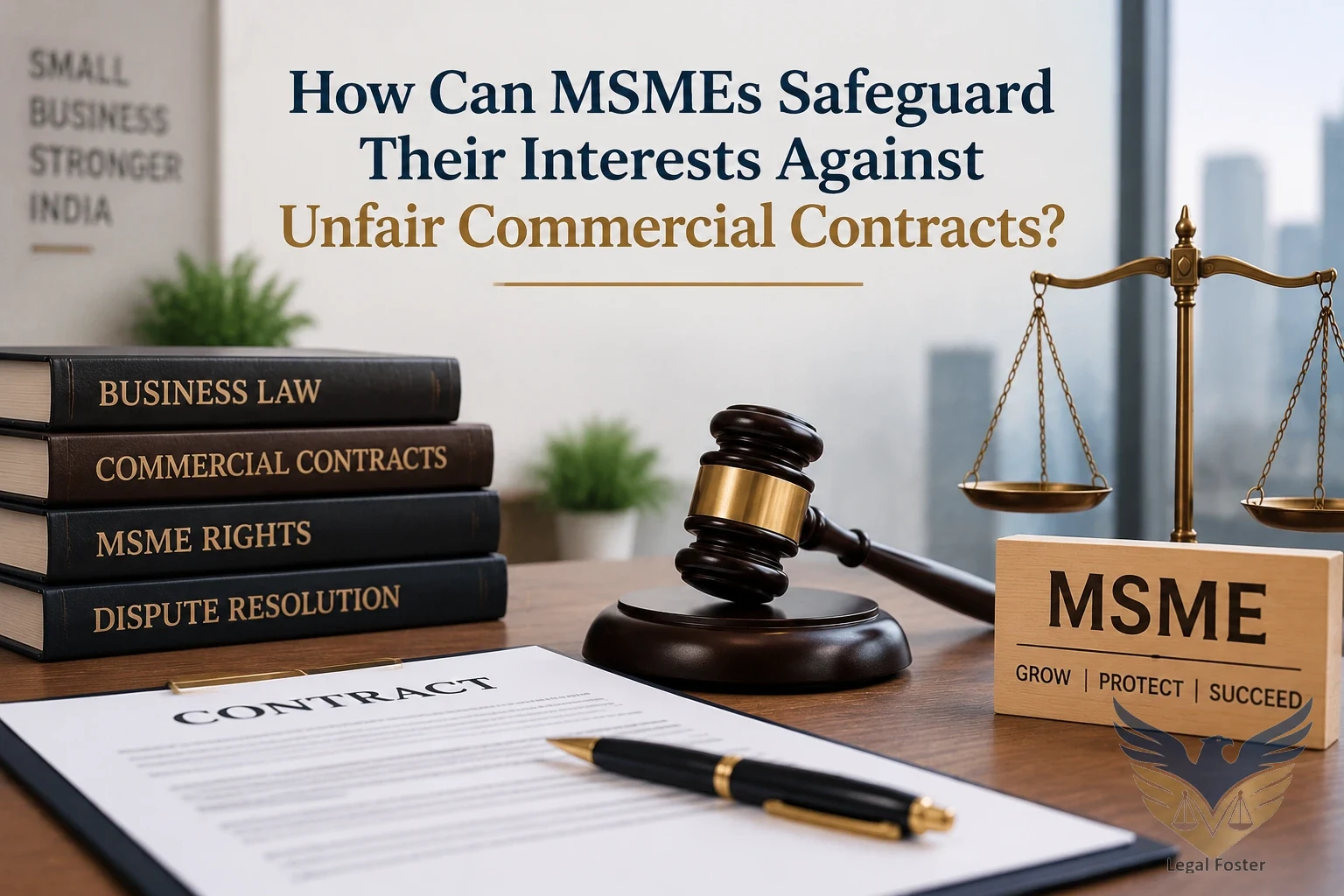
How Can MSMEs Safeguard Their Interests Against Unfair Commercial Contracts?
A single ill negotiated commercial contract can tie down the working capital of an MSME for months, if not years. Vendor agreements/service contracts/purchase orders are executed by businesses every single day in India without the parties understanding that unclear terms pertaining to payment terms/interest on late payments/arbitration can cause serious problems like cash- crunch/arbitration notices/MSEFC action being raised against them in future.
I have come across numerous small manufacturers/traders/Startuppers at Corporate Law Firm who surrendered their bargaining position simply because they accepted "standard" terms and conditions that were unfairly tilted against them in favour of large buyers. Thankfully, there are certain legal provisions which can empower MSMEs to prevent these situations from arising right from the very first signature.
Why Contract Risk Matters for MSMEs in 2026
India’ small businesses (MSME sector) operates on thin margins and tight credit. A bad contract can slowly kill your business by eroding your margins, exposing you to statutory interest under MSMED Act or land you in enforcement hell in MSEFC/DRT/Civil Courts.
Standard form vendor agreements are being pushed on vendors increasingly, especially in metros / big cities - Delhi/ Gurugram/ Noida / Mumbai / Bengaluru etc. Large and small businesses are using standardized vendor agreements which are drafted by big sophisticated buyers.
MSMEs sign these agreements without understanding that they could be waiving their rights, agreeing to unfair indemnities, subjecting themselves to jurisdictions which make enforcement of claims expensive, etc.
Craving for working capital, entrepreneurs accept whatever conditions are necessary to close the deal. They sign on that order form without realizing the implications if there are late payment/ quality disputes. That’s my cue. BK Singh Advocate walks in to save you. But by then the damage has happened. Don’t wait until the storm has already landed. Be prepared.
Quick Facts MSME Contract Protection
If you're not paid on time, you lose out on hefty penalties or cannot take action to recover the dues. Same happens if contracts contain ambiguous terms and you are unable to enforce your claims.
Ensure you have BK Singh Advocate review the Contract before it's too late and you find yourself embroiled in a dispute.
Don't fall into the trap of believing that every "Standard" contract out there is not tailored for MSMEs. Customize it.
Understanding the Core Legal Issue
A bad commercial contract isn’t unlawful or criminal. It’s typically unbalanced, ambiguous or procedurally hazardous. Watch for undefined delivery schedules, one-sided variation clauses, unreasonable penalty clauses, unspecified standards of quality and dispute resolution that favours the other party.
Don’t fall into the MSME trap of reading contracts after you’ve signed them. Especially if you are cashflow hungry and just want to onboard that sale today.
Many clients do this because they assume all commercial contracts are ‘legal’ and equally enforceable. They’re not. If it comes to Court / Tribunal they’ll look at the language used, conduct of the parties and whether the terms were freely negotiated or imposed.
The Legal Framework Governing MSME Contracts
MSME contracts in India would generally be governed by Indian Contract Act, 1872 and the parties would have rights and obligations as per the general laws of offer, acceptance, consideration and enforceability etc.
The Micro, Small and Medium Enterprises Development (MSMED) Act, 2006 would apply if the other party is also an MSME or if the dispute is regarding delay in payments. The rights and obligations regarding payments, interest on delayed payments and MSEFC proceedings etc.
would be specifically provided under Sections 15 to 18 of MSMED Act, 2006. If the contract has an arbitration clause, the provisions of Arbitration and Conciliation Act, 1996 would apply. It would be important to know beforehand as to which forum would have jurisdiction MSEFC or civil court or arbitral tribunal or consumer forum before getting into a dispute clause.
Clients are sometimes not aware that by submitting to a foreign jurisdiction or costly seat of arbitration they are actually taking away their right to justice. BK Singh Advocate has seen numerous disputes where contract itself becomes the biggest obstacle in recovery.
Documents and Evidence Checklist
- Agreed and signed contract /purchase order with clear terms mentioned
- Email conversations about scope/price/differentials etc.
- Copy of Invoices /delivery challans / delivery acceptance notes
- Evidence of payment / Bank statements
- Any notices served/received for non compliance/delay etc.
- Quality Checks Reports / third party audit reports(if any)
- MSME registration copy (Udyam) etc.
These allow BK Singh Advocate to quickly identify if your contract rights have been breached and what remedies you have available to you that can be enforced. Without these you may have the law on your side but your claim suffers.
When to Consult a Lawyer
Consult with an attorney if:
- Arbitration, penalty or indemnity clauses are presented that you do not understand
- Payment terms exceed 45 days or are based on undefined milestones
- Jurisdiction is given to any court outside of your city limits, or in a foreign court
- The counterparty is being difficult and pushing you to sign their "standard agreement"
- You have had prior issues with late payments or product quality from the counterparty
The sooner you consult with a Corporate Law Firm, the greater your opportunity to negotiate protections into your deal or walk away from risky agreements. Once you receive a notice, it may be too late.
How Corporate Law Firm Can Help
Our Corporate Law Firm helps MSMEs in reviewing, drafting and renegotiating commercial contracts which are aligned to your business reality.
BK Singh Advocate helps you spot the red-flag clauses, recommend practical changes to contract and balance out the payment terms, delivery terms and dispute resolution mechanism in your contracts.
This could be your vendor agreement, service agreement, distribution agreement or any other contract you entered related to your loan to ensure it is enforceable and business friendly.
Frequently Asked Questions
1. How can I tell if a contract is bad?
Ans. If the contract has subjective terms, penalizes only you, has uncertain payment terms, and has dispute resolution clauses which effectively prevent you from enforcing your rights as an MSME seller, then it probably is a bad contract designed to be unfair to you.
2. Can unfair contract terms be contested?
Ans. Unfair contract terms can certainly be contested either under Indian Contract Act or under consumer law or MSME specific remedies, although the strength of such claims would depend on the precise terms and facts.
3. Am I required to register as an MSME?
Ans. No. However, if you have registered under Udyam, you do get additional protection in payment disputes under MSMED Act and also get access to a dedicated forum MSEFC to fight your battles.
4. Should I get every MSME contract vetted by a lawyer?
Ans. No. If it is a small purchase order you can probably skip it. However, for high-value contracts or long-term contracts or contracts with any technical complexities, you should always have your contract vetted by BK Singh Advocate or any other seasoned counsel.
5. I have already accepted / signed a bad contract. Now what?
Ans. Don’t lose hope just yet. You may have various rights and options available via strategic negotiation, sending of notices, or even legal remedies depending on the type of breach and the specific documents.
6. Vendor agreements provided by large buyers are generally fine for MSME’s to accept?
Ans. No. In many cases, these “standard templates” are heavily skewed in favour of the larger buyer and should be reviewed thoroughly before agreeing to them.
7. Aren’t arbitration clauses also detrimental to MSMEs?
Ans. Arbitration clauses can go both ways. If the seat of arbitration, cost and procedure unfairly favour the buyer and not you as an MSME seller, then yes such clauses may be bad for you. Such clauses should always be negotiated or balanced out with some other protections in your contracts.
8. How do I establish that there is a breach of contract?
Ans. Keep all your invoices, correspondence through emails, records of delivery, and any notices you send and any acknowledgment received from buyers of non-payment or defective performance.
9. Why is the MSMED Act important for contracts?
Ans. MSMED Act gives MSME sellers benefit of timely payments. And if they delay payment to you, you have a quicker forum MSEFC to settle your dispute and claim statutory interest on your dues.
10. Why should I choose a Corporate Law Firm?
Ans. BK Singh Advocate has the right mix of commercial acumen and legal knowledge to review your contracts in a way which protects your business interests and minimizes your risk of future litigation.
Final Thoughts
Contracts aren’t just legal documents for MSME’s – they’re fundamental business tools. Spend the time upfront to review terms, clarify expectations and get professional legal counsel from BK Singh Advocate at Corporate Law Firm, to avoid expensive litigation, late payments, and bad claims down the road. Before a dispute arises, contact us today for your contract review. Whether you have questions about a contract being sent to you or you need help drafting your own, let us help you protect your business before the first signature is done.
Protect Your Business Before Signing
Review your commercial contracts carefully and understand the legal and commercial risks before committing your MSME to unfavorable terms.
Visit Corporate Law Firm