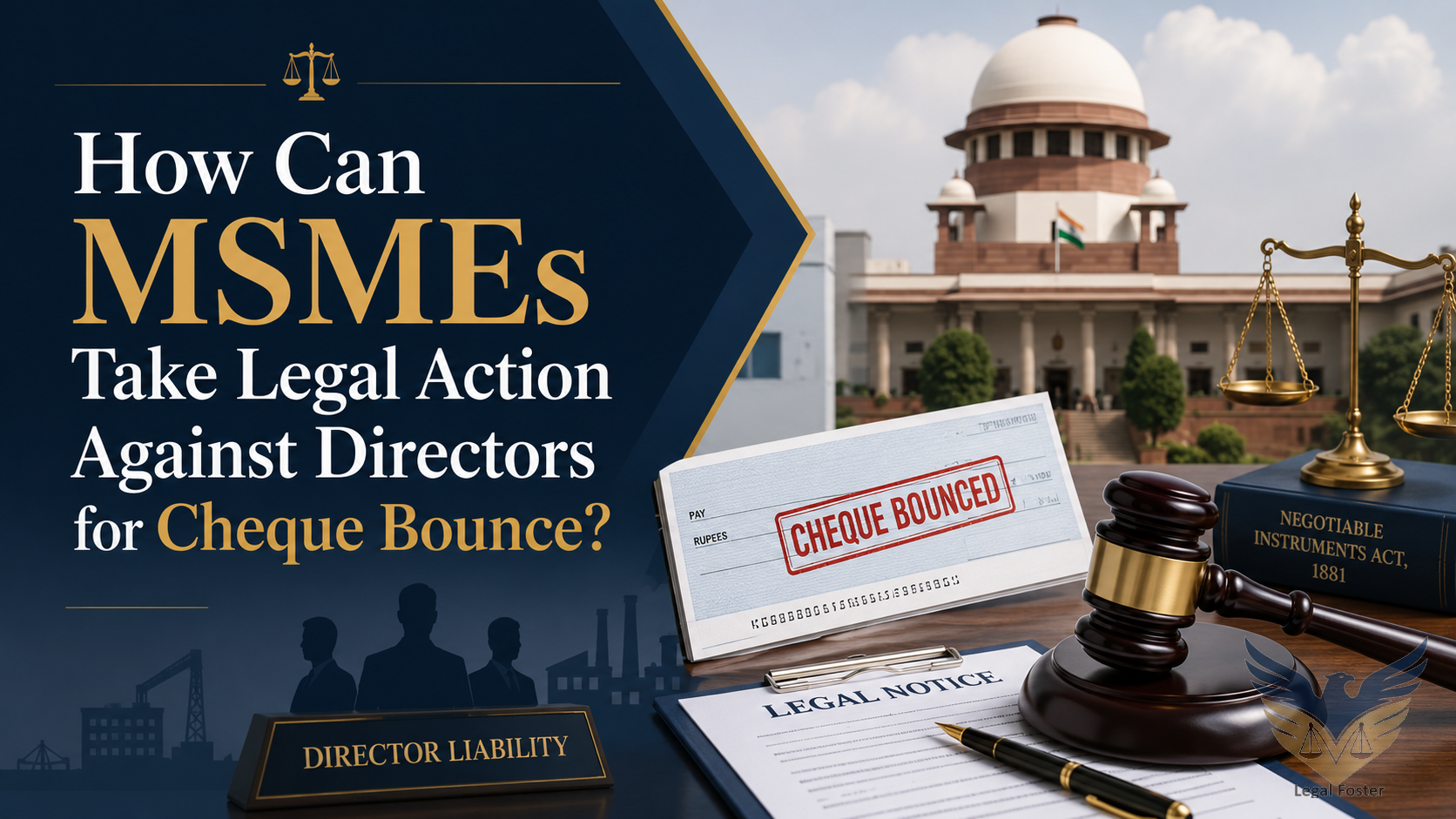
How Can MSMEs Initiate Legal Action Against Directors for Cheque Bounce Cases?
Facts: Micro Supplier (MSME) supplies goods to private limited company worth few lakhs. No payment is received for months despite several phone calls. Finally one director of the company signs his signature on his behalf in favour of company on a cheque made out to supplier. MSME happily deposits the cheque. Joy turns into cash-flow hell when the cheque gets bounced.
If an MSME finds itself trying to recover past due accounts receivable, one bad cheque can turn into many more bad receivables. Wages for employees, GST liabilities, payments to suppliers and working capital needs are just a few of the items that can be affected.
“Customers should be instructed to preserve not only the cheque and return memo, but also the supporting invoices and any other evidence of the link between the cheque and a legally enforceable debt incurred by the company in the normal course of its business,” says BK Singh Advocate.
“One should keep in mind that in these cases, time begins to run against you. Clients should be reminded that Section 138 has prescribed strict time limits within which the notice must be served and complaint filed.”
Also useful to explore at the beginning are the remedies under the Micro, Small and Medium Enterprises Development Act, 2006. Where the applicant is a micro or small enterprise and the statutory preconditions are met, these remedies can be pursued in addition to filing a suit for cheque bounce.
BK can help you figure out if the cheque was issued by the company, who authorized it on behalf of the company, who were the directors ‘in charge of and responsible for the conduct of the business of the company’ and whether there is an MSME specific remedy available in addition to proceeding with a cheque bounce complaint. The course of action to be taken would differ from case to case.
Why Does Director Liability Matter to MSMEs Across India in 2026?
Director liability becomes personal when dealing with MSME’s because companies run through human beings. However, the Company law also treats a firm as a separate legal entity. You cannot photocopy a list and release all directors of an MSME for verification. You also cannot ignore the authorised signatory who produced the bounced cheque.
Cheques are issued by companies from one city to creditors in another city entirely. Businesses based in Delhi NCR, Noida, Gurugram, Ghaziabad may deliver goods to Mumbai, issue invoice from Bengaluru and do the banking transaction from Chennai. The cheque may even be sent to a Karnataka Branch of a Bank based in Delhi. All these facts affect your collection of evidence, jurisdiction and strategy for speedy disposal of matter.
Small businesses consider defaulted amounts as a matter of life and death. They run on thin margins. ₹5 lakhs is an inconvenience for a big business. However, it can halt payroll and purchases of necessary raw-materials for a small unit. Also add small business owners treating the business account as family savings.
Incorrect names lead to technical defenses and duplicate legal costs. Dormancy is worse. The Limitation under Section 138 NI Act doesn’t stop just because the buyer told you to wait for his fresh cheque.
MSME Lawyers lets you sieve company liability from personal liability of directors. Early scrutiny of documents also help you understand if you are dealing with a case of defective goods, invoice disputes, part payments or settlement cheques or if you have a clear cut commercial debt.
Quick Facts About Company Director Cheque Bounce Liability
- Section 138 gets attracted where a cheque issued towards discharge of any legally enforceable debt or liability is dishonoured and certain statutory requirements are fulfilled.
- Typically, the company will have to be joined as an offender if the offence is alleged to have been committed by the company itself under Section 141.
- A director cannot be held liable merely on account of his name being there on the company documents.
- The authorised signatory person may be directly liable as he signed the cheque on behalf of the company and it got dishonoured.
- Typically, a notice of demand must be issued within 30 days of receiving information of the dishonour. The drawer has 15 days from the date of receipt of notice to make good the payment. Explore delayed- payment compensation under MSMED Act separately for micro and small suppliers.
- The above rules have been compiled from Sections 138, 141 and 142 of The Negotiable Instruments Act, 1881.
What Documents Should an MSME Preserve?
Docs determine whether you can link the cheque to an admitted & enforceable commercial debt. Don’t screenshot half a conversation – keep full records of everything – invoices included – say MSME Lawyers.
Keep it in date order and file this as an MSME should:
- Cheque returned to you
- Bank memo with reason for return
- Deposit slip/bank statement
- PO/work order/ written contract
- Tax invoices and ledger
- Delivery challans/e-way bills/ transport receipts
- GRN/service accepted as complete
- Email/chat screenshots/receipt acknowledgement of payment
- Previous notices/lawyers’ letters
- Udyam cert. & class of business
- Company Master details & existing directors’ info.
- Who authorised the cheque
- Any correspondence about stop cheque/settlement etc.
Save ALL of the electronic chat. The screenshot you took may have cut off the date or other messages before or after it which provide context. Cheque amounts don’t match the ledger is another frequent issue. Credits, returns, adjustments or disputes related to goods delivered mean the two don’t line up. Determine why first. Don’t jump to legal conclusions.
BK Singh Advocate can analyse the transaction trail, highlight gaps and advise on who appears responsible for authorising payment.
When Should an MSME Consult a Lawyer?
Ideally advice should be obtained at the first available opportunity – usually immediately after receiving the memo from the bank. Waiting around for “I’ll pay you, honest, I’ll pay you” will consume any minimal notice period and may prejudice your rights.
The following are some specific situations where advice should be obtained:
- The cheque was issued by a company account.
- A director has personally signed the cheque but the liability belongs to the company.
- The purchaser is asking you to “re-present” the same cheque multiple times.
- Only some of the invoices are recognised as valid debt.
- The director has (or is claiming to have) resigned.
- Separate directors were responsible for purchasing, raising accounts payable and authorising the cheque.
- The company appears to be dormant, or otherwise insolvent / without assets.
- The purchaser is offering to make a partial repayment / provide other security.
- There is an existing civil/arbitration/MSEFC proceeding underway.
- The value of the cheque does not match the amount owing on current accounts.
Obtaining a new cheque does not automatically cure any legal problems associated with the original default. Similarly, an MSME should not rely on a vague promise to pay unless they confirm the due dates for payment, what will happen if there is a further default and whether any rights are being waived.
If unpaid vendor invoices exceed the cheque amount, please consider our Vendor Payment Recovery service available through MSME Lawyers.
How Can MSME Lawyers Help?
MSME Lawyers can assess whether a worthwhile Section 138 complaint appears to exist, appropriate company and director defendants, whether notice requirements are satisfied and how cheque- bounce litigation stacks up against other remedies.
Sometimes the service includes general advice as to review of paperwork, particulars of demand notice, company information, correct venue, settlement terms and coordination with delayed payment remedies. The analysis is not undertaken with the assumption that every director should be named as a defendant.
BK Singh Advocate analyses the paper trail of the transaction. ie. who placed the order for goods/services, who accepted the delivery, whose account was debited by the cheque and who controlled the payment. These aspects matter for purposes of determining director liability.
Where the seller is protected by statutory delayed-payment protections, MSME Lawyers may also assess whether a MSME delayed-payment claim can be pursued simultaneously. Not every forum will be appropriate in each situation and no outcome can be guaranteed.
If you are a client based in Delhi, New Delhi, Noida, Greater Noida, Gurugram, Ghaziabad, Faridabad, Meerut, Hapur or any other Indian business city, you can email in the documents related to the transaction to receive a preliminary legal opinion.
Frequently Asked Questions
1. Can we initiate criminal proceedings against all directors of the company?
No. The mere fact that an individual is a director of a company does not automatically mean that they can be made liable. The complaint would have to make specific allegations that the director was responsible for the conduct of the company’s business at the time when the offence was committed. Often times a signing director, managing director or individual associated with the transaction will have greater responsibility than let’s say an independent director or non-executive director.
2. Will the director who signed the cheque be personally liable?
The director who signed the cheque can certainly be prosecuted personally under sections 138 as well as 141 for his personal involvement with respect to the dishonoured cheque. This does not mean that the company’s liability now becomes his personal liability for all purposes. BK Singh Advocate can help you understand the difference between their criminal liability and your civil recovery.
3. Should we name the company in the complaint?
Yes, in most cases. Since the cheque was issued by the company, it would be termed as the “principal offender”. Therefore, the company would need to be named as an accused person in order to invoke vicarious liability against its officers. There may be some limited nuances to this legal position depending on specific facts.
4. Can I invoke Section 138 of NI Act as well as MSME Samadhaan against the defaulter company?
Yes, both proceedings can be initiated parallelly. You can simultaneously file for initiation of complaint under Section 138 of NI Act as well as request for MSMEC reference u/s 14 of MSMED Samadhaan. The reason you can initiate both is because these are 2 different statutes punishing 2 separate wrongs. Section 138 complaint pertains to cheque bounce. MSMEC samadhaan is invoked for delay in payment to micro or small supplier. MSME lawyers at BK Singh & Associates can help you understand if any of these processes overlap, assist you with documents required for filing and help you decide which route commercialise suits you best.
5. Does Section 138 not apply to “security cheques”?
No, Section 138 applies to security cheques as well. In fact the courts have gone into facts such as – was there a legally enforceable debt outstanding at the time when the cheque was presented for payment? If there was liability, merely because the cheque was written as a “security cheque” would not defeat the claim. Other facts such as agreement, invoice history, payment terms would also need to be looked at.
6. What if the director resigned before the cheque was dishonoured?
The date of resignation, date on which they signed the cheque, date of presentation of cheque and what their role was in the company needs to be reviewed thoroughly in such cases. If this was a case of wrongful signing by a former director who was not responsible for conduct of the company’s business when the cheque was presented for clearance, they would have a strong defense. Their resignation letter and supporting MCA documents would be crucial in such cases.
7. Can we settle this dispute instead?
Yes. Offences under Section 138 are compoundable by nature pursuant to Section 147 of the NI Act. The language of the settlement should clearly mention payout amount, schedule, costs if any, withdrawal / compounding of proceedings and consequences of any future default. BK Singh Advocate can help you review if settling the case would be detrimental to the MSME or would it prejudice any of their current rights.
8. Can we claim interest under MSMED Act in addition to the cheque amount?
Yes. You can claim interest under MSMED Act in addition to the cheque amount if you are an eligible micro or small supplier and meet certain conditions. This would be over and above your right to initiate a suit for recovery under Section 138. Please note that when claiming interest under MSMED Act, date of registration, supply records and payment terms would be needed to ascertain the amount of interest you would be able to claim.
9. The company claims we supplied them defective goods.
If there is a genuine dispute raised by the company regarding the quality of goods supplied, this could impact whether the liability represented by the cheque was a legally enforceable liability. The MSME should ensure they have a record of product acceptance, any quality inspection reports, date of complaint by the supplier, correspondence sent for replacement/repair and if any credit notes were issued. If the defect was brought up by the supplier well after the cheque was dishonoured and cannot be substantiated with documents, it will be viewed very differently than if there were valid documents to support the complaint made at the time of delivery.
10. What is the time limit to initiate a case?
Immediately. The legal notice demanding payment should be sent within 30 days of when the payee receives notice of the dishonor. Lawyers at BK Singh & Associates can go over the return memo, validity of cheque, notice sent to proper address, all documents pertaining to transaction so that you don’t lose your 30 days to file a complaint.
Final Thoughts
Director liability for bounced cheques is possible. But his signature, status and control of company finances matter. Suing every director indiscriminately may rebound. Even leaving the company off the hook may be equally dangerous.
An MSME’s first recourse should be documentary evidence: cheque, return memo, invoices, delivery proof, ledger & communication. Delay can cut off statutory rights and open window for commercial settlement.