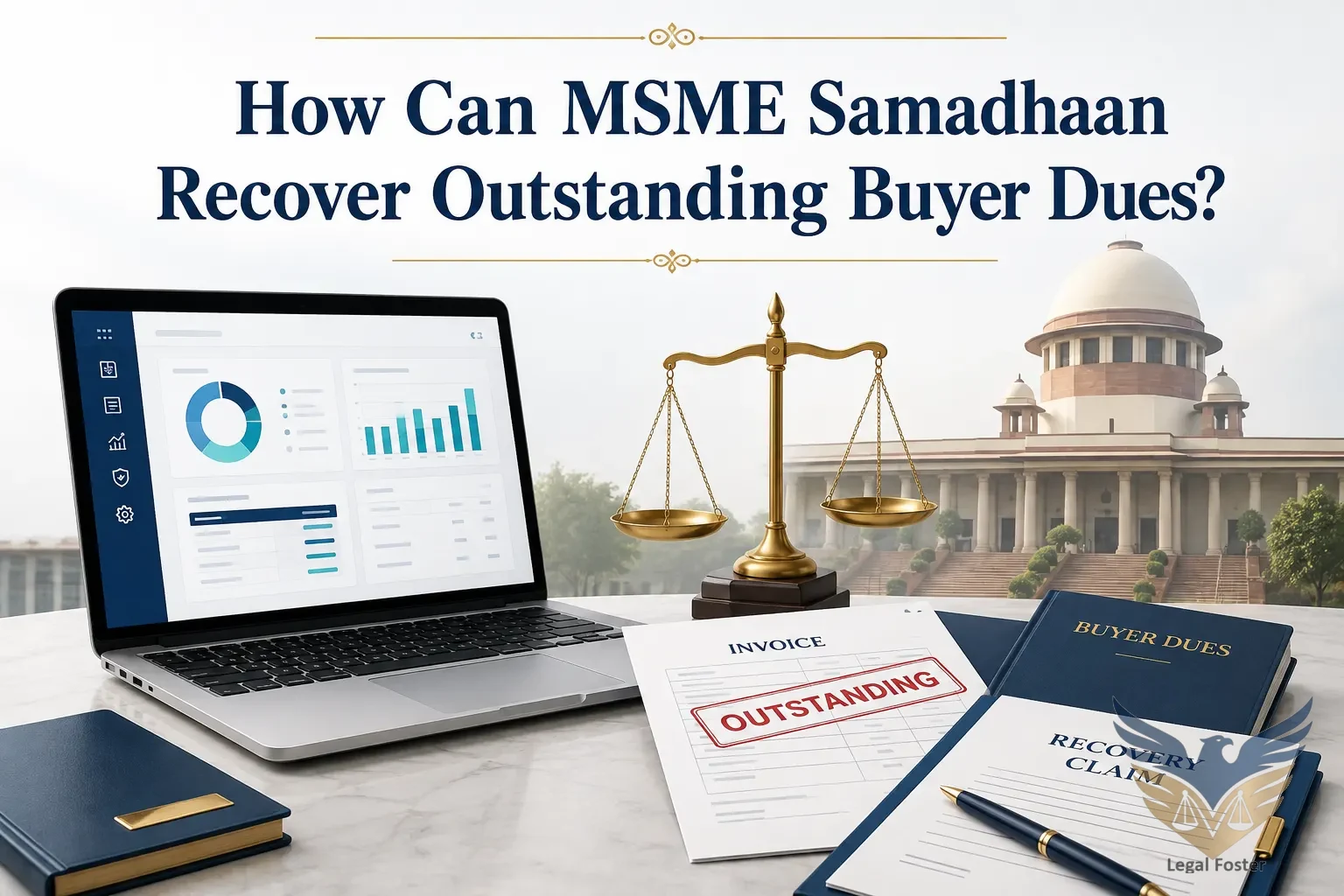
How Can MSME Samadhaan Help Recover Outstanding Buyer Dues?
One unpaid invoice doesn’t look like much. At least not for the first few days.
Accounts are processing, the buyer reassures you. You receive an email saying payment will be released after the next billing cycle. Someone else responds, they’re waiting for finance to approve.
Meanwhile, your supplier has paid for inventory. They’ve spent money on GST, wages, transportation, and procurement for your next order.
Weeks. Months.
Late payments aren’t an inconvenience unique to small businesses. They hurt your cashflow, relationships with vendors, credit limits, and ability to fulfil new invoices.
So it’s no surprise that business owners want to know MSME Samadhaan can help them chase unpaid invoices.
If you’re a supplier and the nature of your transaction falls under the late-payment guidelines of Micro, Small and Medium Enterprises Development (Facilitation of Units) Act, 2006, the answer is yes. The portal and MSME Facilitation Council scheme were created so eligible small businesses could take advantage of them for late-payment disputes.
That being said, there’s more to filing an overdue invoice on the portal than simply submitting your documents and getting your dues.
BK Singh Advocate says his firm first reviews if the business is covered by the act, when goods or services were supplied, whether the buyer accepted them, when payment was due as stated on your terms and conditions, and whether your paperwork substantiates the amount you’re claiming.
Through MSME Lawyers, firms can get their Udyam registration, purchase orders, invoices, delivery notes, contract, correspondence and any communication from buyers raising disputes assessed before deciding how to frame a late-payment claim.
Something else to keep in mind for 2026
Per the Ministry of MSME’s Annual Report 2025–26, “new delayed-payment cases shall be filed [through] MSME ODR Portal from 15 October 2025 onwards. It will be integrated with Samadhaan portal.” That said, the previous Samadhaan system will apply if you have invoices that went unpaid before 15 October 2025. But don’t assume the process and guidelines haven’t changed since the portal was launched a few years ago.
Why Do Unpaid MSME Invoices Matter So Much in 2026?
An unpaid invoice that’s an insignificant accounts-payable bite to a large buyer could represent an order that pays a seller’s Friday’ payroll.
Manufacturers may have purchased raw materials. Service providers could have paid salary to support staff and monthly subscription fees for business software. Suppliers of machinery or packaging may have financed their next shipment based on receivables. Engineering, design or IT firms, logistics providers or other professional services companies may need collections to fund their next order.
Delays start a chain reaction when payments aren’t received.
Cash reserves disappear. Available credit lines are maxed out. Taxes and payroll become immediate liabilities. The supplier may continue to keep pushing supplies to the same customer, not wanting to sour a relationship by shutting off the supply valve altogether.
BK Singh Advocate says he has witnessed multiple businesses continuing to transact for weeks, if not months, after invoices previously went past due. “It can create a knot of transactions with partial payments, several POs, disputed debit notes, phone conversations and emailed assurances,” he says.
Untangling those transactions matters if you’re filing a suit for payment recovery instead of attaching a statement due at the end of an account.
The Ministry of MSME continues to list Sections 15 to 24 of the MSMED Act as the legal recourse for delayed payments to micro and small enterprises. On its RAMP page, the ministry includes language that “eligible micro or small” businesses can use the delayed-payment mechanism as long as they have a valid Udyam certificate.
Quick Facts About MSME Samadhaan and Unpaid Invoices
Fact Sheet On The Credit Linked Bill Discounting
Chapter V: delays- payment protection only for qualifying micro and small enterprise suppliers.
Section 15. Provides time within which payment should be made by buyer.
Section 15. Period of Payment – Notwithstanding anything contained in any other law for the time being in force, the payment shall be made by the buyer within 45 days in writing from the date of acceptance or deemed acceptance.
Section 16. Provides for compound interest with monthly rests at three times the RBI notified bank rate where payment is delayed as intended in Act.
Section 17 Allows the buyer to be liable only for the amount due along with interest as per Section 16.
Section 18 Provides MSEFC statutory dispute resolution forum for amount due under Section 17.
Ministry material reveals new delayed-payment complaints are being recorded on MSME ODR Portal, aligned with Samadhaan
Can an MSME Claim Interest on Unpaid Invoices?
Section 16 may be one of the stronger features of the delayed-payment regime.
Interest under Section 16 is charged at three times the rate of interest which is notified by the Reserve Bank with monthly rests if payment has not been made in accordance with Section 15. This is subject to certain statutory preconditions.
This statutory interest can turn otherwise long-delayed payments into commercially significant amounts.
However, care must still be taken to properly quantify the underlying claim.
The underlying principal, date from which interest is to be sought and record of payments made should all tie-up.
Payments towards the outstanding principal must be accounted for as well.
An overstated claim will detract from what would otherwise be a bona-fide claim for principal.
MSME Lawyers may want to bifurcate the principal and statutory-interest portions of a claim before proceeding with a reference.
What Documents Should an MSME Supplier Keep Ready?
Documents will often tell you whether an invoice claim is straightforward. Editing Cost Documents
Typically, a vendor should have documentation that demonstrates: The business relationship;
Supply & acceptance;
The amount outstanding and subsequent negotiations.
Documents that may help you…
UYAM certificate;
Purchase order/work order
Agreement in writing or rate sheet;
Tax invoice;
Delivery challan;
Goods receipt/acknowledgement;
e-way bills if applicable.
Service record
Email chain
WhatsApp chat pertaining to matter
Statements / ledger entries;
Buyer acknowledgement;
Debit or Credit memos.
Details of part-payment.
Buyer complaints for quality etc.
Any earlier compromise settlements.
TDS or any other document which you think may help.
BK Singh Advocate will typically try and order these documents in a timeline. Editing Cost
One invoice could have been supplied perfectly fine.
Second invoice could be for returned goods.
Third invoice could be partially paid.
Mixing all three together will allow the buyer to dispute the entire amount unnecessarily.
Vendor Payment Recovery Service can help you where you have multiple buyer ledger accounts outstanding from your vendor that need a commercial review.
Should an MSME Send a Legal Notice Before Filing?
Send A Demand Notice Can Help. There is no magic bullet notice that will result in collection simply because it is sent.
The benefit of the notice is that it put’s the sale, the amount unpaid, contract context and your legal request in writing.
It also can open the buyer up on a defense before you expend more effort or money moving forward with further action.
You may receive a legitimate dispute from the buyer.
You may be offered part of the money due.
You may be flat out denied any liability.
Each of these responses may call for a different next step.
Before sending a demand for payment that states a position that is contrary to your invoices or contract terms you may want to review our MSME Demand Notices for Collections.
How Can MSME Lawyers Help With Samadhaan and MSEFC Matters?
Stage 1: Suitability. Duh. Stage 2: Deal sheet.
What was supplied? What is claimed due? What payment terms did the buyer commit to? How much interest are you legally able to claim? Have you initiated some other remedy already?
BK Singh Advocate can review your Udyam registration information, the invoices raised, purchase orders & orders, proof of delivery, agreement and correspondence with the buyer to opine if the statutory delayed-payment remedy is appropriate or not. If the matter is referred to the Council’s ADR mechanism, MSEFC’s arbitration & conciliation petitions service may be needed.
Not every claim has to be silk-pleaded either.
If you’re a supplier filing a ₹20 lakh claim you don’t always have to attempt to turn every clean debt claim into some sort of fraud litigation petition just to turn up the heat. A squeaky clean commercial history will help you far more than weaponising every statute in the books.
Frequently Asked Questions
1. Can MSME Samadhaan help me recover unpaid invoices from my business?
No. This scheme is for bona fide delayed-payment claims by micro or small suppliers who meet certain conditions. Evaluate the supplier eligibility, transaction details, registration type and supporting documents carefully.
2. Is MSME Samadhaan still available to use in 2026?
Yes. Filing has changed recently. Effective 15 October 2025, all new delayed-payment claims filed through the MSME ODR Portal are being transferred to Samadhaan as per the Ministry notification.
3. Will BK Singh Advocate help determine eligibility of my unpaid invoice?
Yes. BK Singh Advocate will review your Udyam registration, purchase order,invoice, supply/payment details, payment terms with buyer and correspondence to help you understand whether your unpaid invoice qualifies under the MSMED Act late-payment scheme.
4. Buyers have 45 days to pay all invoices isn’t it?
Section 15 refers to that the parties cannot contractually agree to a payment term in writing that exceeds 45 days from the date of acceptance or deemed acceptance. The invoice due date varies depending on the transaction.
5. Can I claim interest under MSME law along with the amount overdue?
Yes. Eligible suppliers can claim statutory interest under Section 16 if your facts and figures qualify. Interest is compounded monthly at a rate of 3 times the RBI notified bank rate.
6. Will MSME Lawyers be able to assist me if the buyer gives a quality defence?
Yes. MSME Lawyers will review your purchase order, delivery Note, inspectionReports,complain timeline, correspondence and payment history to evaluate if you should proceed based on how the buyers defence affects their liability.
7. Can MSE Median enterprises approach MSEFC for delayed payment?
Medium enterprises should not expect similar late-payment remedies as available to micro and small suppliers. MSEFC was created to provide relief to micro, small and medium enterprises.
This Act does not apply to mediansized enterprises.
8. Should I send a legal notice before approaching Samadhaan?
Under Section 18, reference is made to advocates but nowhere does it state that the advocate must have first sent a legal notice. From a commercial standpoint, sending a legal notice can still be beneficial depending on your dispute and documents.
9. The buyer has offered to make a partial payment, what should I do?
Avoid accepting a partial payment amount without first understanding why. Determine if the amount is being applied to an account, is a settlement in full or if the buyer is asking you to forgo interest or future claims.
10. When should I get in touch with BK Singh Advocate?
If you have any overdue invoices that the buyer is disputing, have complicated documents, unclear settlement terms or wish to have a professional review your documents to help you figure out if Samadhaan, MSEFC or some other debt recovery agency can assist you then you should get in touch with BK Singh Advocate.
Final Thoughts
MSME Samadhaan can help you recover money owed by buyers on unpaid invoices. But customers shouldn’t expect this to be a magic “submit invoice and get paid now” button. Undergo Qualification. Gather Evidence. If you’re a creditor that qualifies as a micro or small supplier you can use strong remedies under the MSMED Act. These include timely payment provisions, statutory interest and the Facilitation Council mechanism.
There have also been recent developments in the legal and technology arena.
The Ministry has mandated that all future pending-payment complaints be filed ONLY on MSME ODR Portal instead of on previous government sites effective 15 October 20 25. MSME ODR Portal is connected to Samadhaan. Additionally, The MSMED (Amendment) Act, 20 26 got presidential assent last week. It has a clause that empowers the government to notify it into force. Till such notice is issued, businesses can refer to and follow the law which is presently in force as on the relevant date rather than reading about draft amendments on internet sites which could have been posted there many years ago. At MSME Samadhaan, with BK Singh Advocate leading our team of MSME Lawyers, we can analyze the suppliers registration, invoices, contract, delivery evidence, buyer complaints, claims history to decide if the delayed-payment portal or maybe even another commercial recovery program would be right for you.
Author Bio
BK Singh Advocate has been advising Micro and Small Businesses on issues related to delayed payments, outstanding invoices, MSME Samadhaan and ODR, MSEFC cases, commercial recovery and recovery claims on settlements. BK Singh Advocate analyzes Udyam registrations,purchase orders,invoices,goods delivery proof,payment receipts, account statements and correspondence with buyersMSME Lawyers before assessing possible solutions. Cases have included clients located in Delhi NCR and across India subject to jurisdiction and facts. Focus is driven by the strength of documentation, statutory eligibility and commercially sensible recovery options rather than guaranteeing a certain recovery figure/settlement.