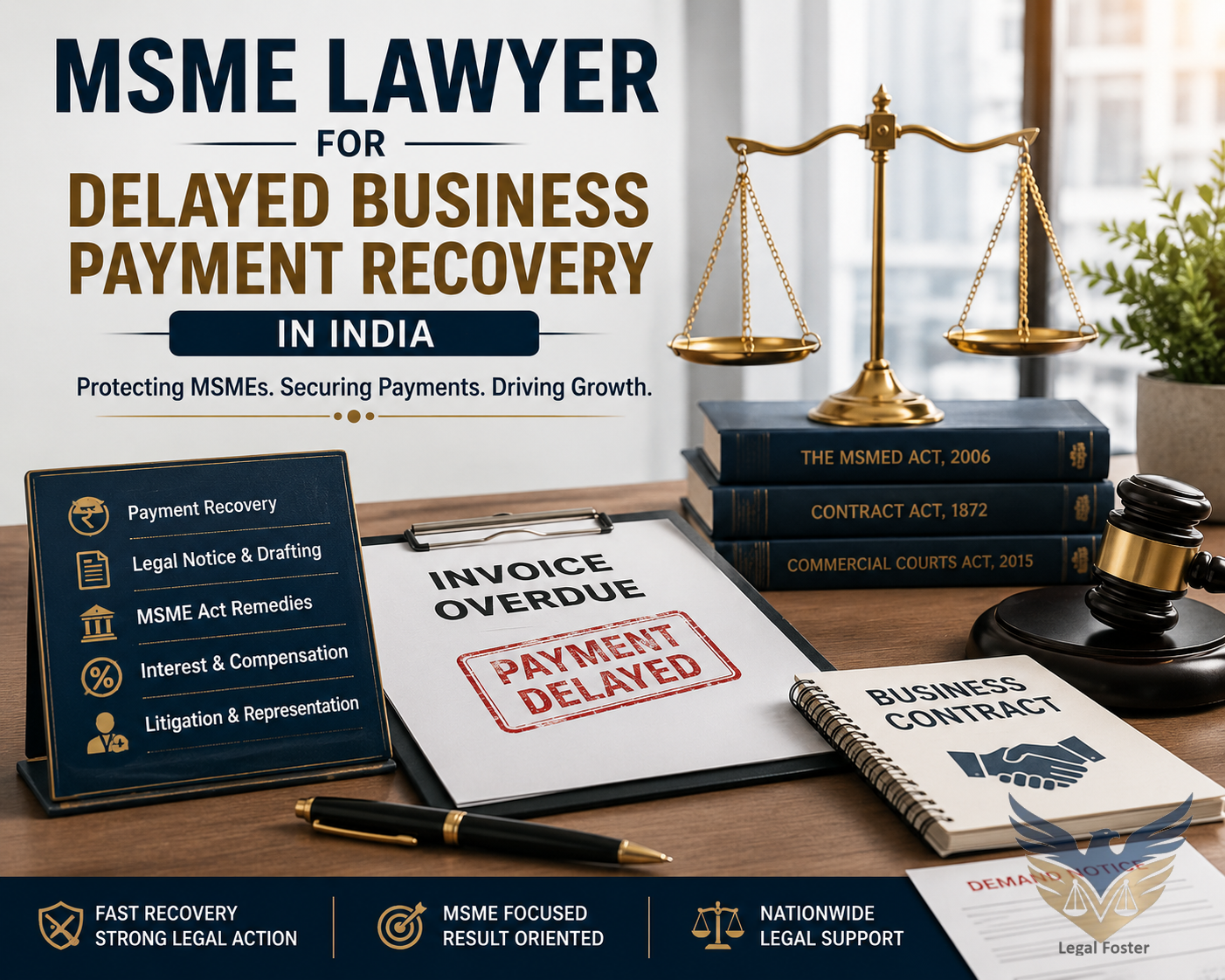
How Can an MSME Lawyer Help Recover Delayed Business Payments?
It is uncommon for an unpaid business invoice to remain “just an invoice.” The manufacturer has probably already paid for the raw material. The service business has paid staff wages and GST payments. Your small supplier might require the same funds to fulfill your subsequent order. However, the buyer reassures you, “We’ll clear it next week.”
Weeks turn into months,
That’s when unpaid bills start to affect working capital, vendor relations, and daily business choices. The supplier does not want to cease future shipments because the buyer may be significant. Continuing business only exposes you further by not writing off previous debts.
An MSME lawyer can help an eligible micro or small business identify whether the unpaid amount is eligible for the unique overdue-payment provisions of the Micro, Small and Medium Enterprises Development Act of 2006 or whether another commercial collection course is advised.
Clients may come to us with one overdue invoice. There can also be twenty invoices in question that include POs, contested set-offs, returned material, buyer refusal to confirm ledger balances, or even a compromise offer that would entail forfeiting a portion of the claim.
Paperwork matters.
BK Singh Advocate will usually go over the Udyam registration itself, purchase orders, invoices, delivery confirmation, contracts, emails, WhatsApp chats, payment history, and buyer objections before assessing our legal position. Ideally, a demand for recovery should reflect the underlying commercial transaction and not rely exclusively on a ledger balance. If a buyer refuses to clarify ledger balances, we can request documentation through discovery as part of a lawsuit.
The MSME Act’s Sections 15 through 24 establishes a mini legal ecosystem for late payments as they relate to micro and small business suppliers. Every state government must establish a Micro and Small Enterprises Facilitation Council to hear such complaints; these are usually referred to as MSEFC. MSME Samadhaan and the soon-to-launch MSE Online Dispute Resolution platform are both still valid avenues for qualified late-payment grievances, as per recent Ministry of MSME notifications.
Consulting with an attorney does not imply that anyone is being sued. Usually, the first objective is figuring out who owes what, whether the MSMED Act applies, what documentation you have, and what commercial route of recovery is best.
Why Are Outstanding Business Payments a Serious MSME Problem?
Accounts receivables are seldom excess cash lying around for small businesses. They’re often referred to as working capital.
Take the case of a manufacturer in Ghaziabad who is waiting on ₹12 lakh to be paid by a corporate buyer. He has to go out and procure raw materials to produce his next batch of goods. He can’t go to his employees and say, “paychecks will be paid when our customer decides he wants to push that invoice approve button.” He has to pay GST. Running a business incurs costs whether or not your customer is holding your payments hostage.
A software business in Noida deals with the same challenge when a delighted customer consistently drags their feet on paying invoices. So does a freelancer based in Gurugram who did months of work specified in a contract, only to be presented with “we missed some information” deductions when it’s time to pay up.
Any business operating in Delhi, New Delhi, Greater Noida, Faridabad, Meerut, Lucknow, Jaipur, Mumbai, Pune, Bengaluru, Hyderabad, Chennai, Kolkata or Ahmedabad will run into this problem at some point. You sell a product or service. The buyer doesn’t pay. You’ve done your bit and fulfilled your responsibility in a business arrangement but the cash is stuck with your customer.
BK Singh Advocate advises businesses to look past DSO (number of days on invoice). A good customer who consistently accepts they owe you money but needs more time is different than a customer who all of a sudden denies the existence of the transaction and starts blaming the quality of your product or threatens legal action against you.
It changes your recovery strategy.
Quick Facts About MSME Payment Recovery
- Sections 15 to 24 of MSMED Act, 2006 contain the statutory delayed- payment mechanism under which Eligible micro & small supplier Enterprises can seek remedy.
- If there is a written agreed payment term then section 15 caps the agreed period from date of acceptance/ deemed acceptance to not exceed 45 days only.
- In case of no agreed written payment term then statute brings in the concept of appointed day.
- Section 16 lays down the payment of interest @ Three times the rate of interest as mentioned ( Compound interest with monthly rests ) by RBI notified as bank rate provided conditions satisfied.
- Section 18 allows referred delayed payments to be adjudicated by Micro and Small Enterprises Facilitation Council.
- Failure of Conciliation. If Conciliation is not successful, dispute to be referred to arbitration as envisioned under section 18 .
- Provided hence this scheme :-
- Provided that nothing contained in this scheme shall be in effect of the provisions of section 20.
- As per recent notification by Ministry. Valid Udyam Registration itself is enough for a micro or small enterprise to seek remedy through Samadhaan portal for delayed-payment claims if they fulfill the eligibility criteria.
How Does a Lawyer Assess Whether the Payment Claim Is Strong?
In general, the documents evidencing a bona fide commercial recovery will all tell the same story.
The purchase order will reflect what was ordered. Delivery notes will confirm goods were delivered to the buyer. An invoice will reflect the contract price. Emails or confirmation of accounts will confirm that price was accepted. Bank statements may even show previous payments being made for the same commercial transaction.
Problems arise when those documents don’t match up.
What happens if you have an invoice for ?8 lakh from a buyer who only shows ?6.5 lakh on his ledger due to a credit note being issued. How about unsigned delivery challans? Perhaps the buyer raised a written quality complaint on delivery a few days later. Any of these irregularities can be explained. They don’t automatically defeat a claim. But they raise questions that should be asked.
MSME Lawyers will ask if the amount being claimed is for goods previously accepted; defective/disputed work; agreed deductions under the contract; retention money, interest or set-offs; duplicate Invoices? Or is there an overall contractual dispute?
The better the paperwork, the better and more definitive the legal advice. :
Which Documents Should an MSME Keep Ready for Payment Recovery?
Documents must be kept before letters are misplaced and employees who handled the transaction are no longer with the firm.
Some useful documents are:
- Udyam certificate/ PAN certificate /any older registration certs
- Purchase notes/order notes/receipt notes/ordering tickets/agreed quotes
- Agreement or MOU and any amendments
- Sales taxes/invoices/e-Invoices
- Delivery challan/ goods-receipt notes
- Vehicle receipt/ GR Copy/Tax bill
- Completion Certificate/service receipt
- Acknowledgement e-mails from customer/receipt/payments
- WhatsApp/ professional text messages.
- A/c statements/receipts showing outstanding
- Bank statement showing earlier or part payment
- Debit memo/Credit memo/ negatives
- GST bills/invoices related to the sale
- Quality dispute letter/complaint letters
- Terms of payment/settlement documents
Any previous legal notice or Letter before Action.
Let’s say your vendor got a text or hand-written note and thought nothing of it because it’s not “official.” Don’t throw it away. “We accept the invoice, we will pay you next Friday” could become very important if the buyer suddenly backs-track and claims they didn’t agree to pay you anything.
Time frame is another factor BK Singh Advocate mentions. If a quality issue wasn’t mentioned until you were sent 6 monthly reminders thenoo….that time frame will need to correspond with any document that was produced at the time of delivery.
When Should an MSME Speak to a Payment Recovery Lawyer?
Sometimes waiting till the “Cart is completely broken” may not make commercial sense. .
Talk to a Lawyer when the contractual time frame has elapsed and the buyer has ceased providing you with a credible payment timeline. This step might become necessary if the buyer arbitrarily changes its liability position. .
- Some other Indicators could be :
- Payment promised after several promises followed by no response;
- Offsets without justification on agreed invoices;
- No willingness to confirm the open balance;
- Claims raised on goods that were previously accepted;
- Dispute of services you billed and were accepted;
- Numerous outstanding invoices over multiple PO’s;
- Ask you to accept a large “full and final” discount;
- Cheque issued by the buyer bounces back even though post dated;
- Buyer threatening set off by way of set off by counter claim;
- Buyer not being clear on MSMED Act interest amount;
- Buyer going into receivership or facing serious financial distress;
- Threatening to initiate Samadhaan or MSEFC procedure.
.
If you are a supplier planning to issue a legal notice, utilize the certified MSME legal notice format service to help you recover your dues. .
The MSME Lawyers at our firm can help you understand if this situation has now escalated from being a simple debt recovery case to a contractual dispute.
Should You Accept a Reduced or Partial Settlement?
Sometimes. Maybe. Not always.
Legal rights and commercial realities don’t always coincide.
You may be offered the entire principal owing if you waive interest. You may be offered 3 payments. You may be offered 70% paid today in exchange for a distressed buyer’s undisturbed closure.
Whether that’s commercially advantageous depends on how much you’d receive, probability of collection, need for liquidity, your relationship with the debtor and what terms are being requested.
Semantics matter as much as dollars. “Paid in full” means something different than “received on account”. Acceptance of principal only is not the same as paid in full. Payments made over time are not the same as discounted note.
Ask yourself what rights you are keeping or giving up before you write that settlement check, suggests lawyer BK Singh Advocate. It’s alot harder to pursue the balance once you’ve signed an unconditional full and final settlement agreement.
How Can MSME Lawyers Assist With Business Payment Recovery?
At MSME Lawyers, our process often begins with a review of the amount outstanding and the supplier’s legal standing. Documents reviewed may include Udyam details, purchase orders, invoices, payment terms, proof of delivery, acceptance of dues, ledger statements, as well as any disputes from the buyer.
Next, instead of asking, “Should we file a suit?”, we ask,
“What lawful avenue will fit the business need?”
Sometimes the facts support an informal conversation. Other times, a formal demand letter is warranted. Still, depending on the facts, Samadhaan/ MSEFC scrutiny, conciliation, arbitration proceedings or some other commercial remedy may be the best path for recovery.
Repeatedly overdue supplier or vendor invoices can also be analyzed under BK Singh & Associates’ MSME vendor payment recovery program.
BK Singh Advocate customizes the game plan to fit your business objective. Maybe you need quick cash. Maybe you want to save a key customer relationship. Maybe you want full repayment of a disputed contract amount. All of these situations may require different strategies.
We weigh all possible outcomes. Jurisdiction doesn’t exist in every situation. Not every supplier will be registered under Udyam or other MSME platforms. Not every contract term will be enforceable. Moreover, evidence, defenses, and ability to pay will vary from buyer to buyer.
Frequently Asked Questions
1. Can I issue a demand notice for delayed payment after 45 days?
If you are a micro or small supplier that is eligible, you can certainly look into the delayed-payment scheme under MSMED Act. Where parties have agreed to payment terms in writing, Section 15 clarifies that the period cannot exceed 45 days from the date of acceptance or deemed acceptance.
2. Can MSME ask for interest if payment is delayed?
Yes. Section 16 would come into effect. Section 16 mentions interest payable on a compound basis on monthly rests at a rate three times that which is notified by the RBI and published by a scheduled bank. Calculation would depend on what dates are involved, what payments were made (if any), and which Sections are applicable.
3. Can a medium MSME raise delayed- payment demand under MSEFC?
Not necessarily. Micro and small suppliers are the ones covered by the above delayed-payment Sections. Check that you are registered as an MSME on UAMSMSE and go over the facts of the sale before taking this step.
4. Buyer is claiming that quality of goods were not good. Can we still demand payment?
The goods were accepted or not according to sale terms is separate from whether you’re entitled to payment. Purchase conditions, inspection reports, any notice of rejection provided, delivery notes, when the buyer made the complaint, are a few examples of evidence that would matter. BK Singh Advocate would need to review all the paperwork ahead of commenting.
5. Should I issue a legal notice for MSME overdue payment?
Not every business dispute has to happen the same way. Whether you even need to send a legal notice or it would be worth sending one depends on what process you want to start, your agreement and facts. That being said, sending a detailed legal demand letter can help formalize how much is rightfully owed and what your buyer claims they owe.
6. What is MSME Samadhaan?
MSME Samadhaan is what the Central Government has named as the portal for delayed-payment grievances submitted by eligible micro and small enterprises. Until further notice, the Department has announced that duly registered MSEs are able to submit an application. MSEFCs will hear those delayed-payment disputes that are admissible.
7. My buyer is a big corporate. Can I still raise a delayed-payment complaint?
Just because your buyer is large, does not automatically mean your MSE cannot consider making a claim if eligible. Your MSME Lawyer will help you determine if you qualify as a supplier first, and if the nature of the sale and amount owed warrant such action.
8. Can I use old WhatsApp messages and email conversations as evidence?
Potentially, yes. The payer would have the onus of establishing that the chats are authentic. If authentic, chats that acknowledge delivery, confirm invoice amounts are correct, ask for more time or accept that there is an amount due can help when viewed along with the rest of the transaction.
9. Can I accept part payment from buyer and still chase them for the rest?
Yes, but make sure you and the buyer are on the same page. Is the company making you part-payment against part of the principal amount owed, on account, as a part of a payment plan or to settle? Your intentions should line up and be confirmed before accepting the funds.
10. When should I consult a lawyer about pending invoices?
Not when your client cuts you off completely. Responding to you but not paying, repeated broken promises to pay, being told the goods aren’t yours to bill, sudden deductions, or if the past-due balance is disrupting your cashflow are situations where communication can help. Consulting sooner also allows your lawyer to advise you on preserving documents and explain your options upfront.
Final Thoughts
Late Payments can slowly turn a profitable order into a working-capital burden.
Under MSMED Act, eligible micro and small enterprises benefit from a delayed-payment framework. This includes statutory interest relief along with MSEFC-relate remedies. The recent notifications by the Ministry still talk about Samadhan and the MSE based ODR scheme as part of the late payment ecosystem for
Legislation cannot replace documentation.
Purchase orders, Udyam certificate, invoices, proof of delivery, acknowledgements, bank statements and correspondence from buyer will always be crucial in figuring out what is actually recoverable.
BK Singh Advocate can help review your transaction trail and guide you on whether negotiations, legal notice, MSEFC or maybe even a different commercial recovery route should be exercised. The best course of action would be one that can hold legal muster and understands the commercial realities of the dispute.