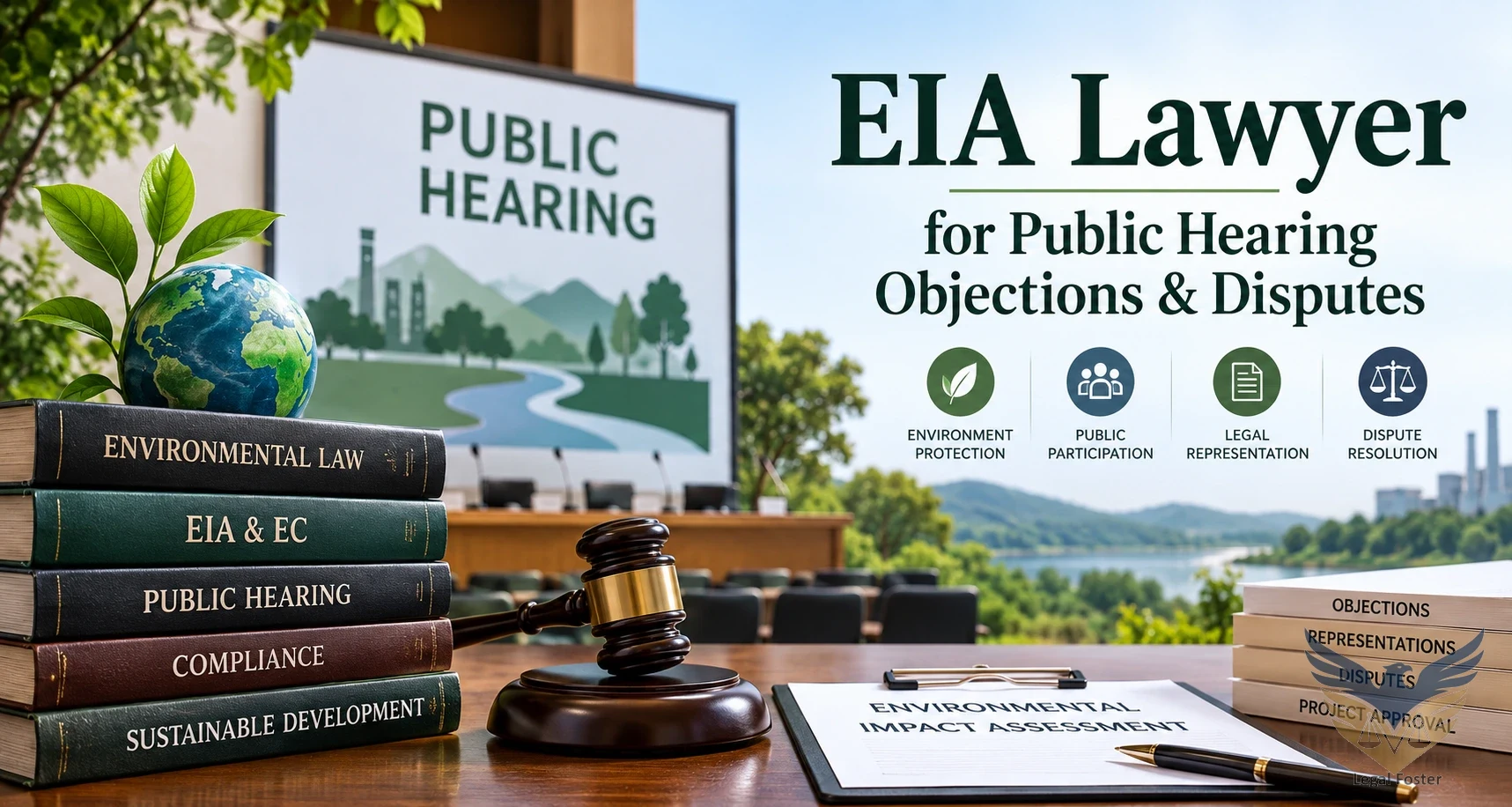
Sometimes you might find yourself in a situation where you need to appear in a public hearing that has been called for various industries like industrial set ups/mining projects/infrastructural projects/energy projects etc. What looks like a normal meeting to some might concern issues like ground water contamination, dust, traffic, trees, farmland, noise pollution, dumping of waste and overall impact on the surrounding area for those who live close by such projects.
Equally there will also be many questions raised to the project proponents and based on how those queries are resolved the application for clearance will either be accepted or denied.
Hiring an EIA lawyer for Public Hearing objections if you want to know how to go about filing objections in a public hearing and what you can do if there is a dispute in regard to granting environment clearance. Read this to know more.
A public hearing is called pursuant to a requirement under the Environment Impact Assessment Notification, 2006 for those projects that come under the categories mentioned in the notification. It allows any person whose livelihood or well being might be affected by the project or have reasonable interest to participate.
Do not think that the public hearing is where the dispute ends.
There will be plenty of documents exchanged and presented. The draft EIA, EMP, TOR, reports i.e. biodiversity, forest, Technical expert committee reports, Public hearing notice, objections filed, minutes of the PH, project proponents reply, EAC or SEAC discussions and finally the order granting clearance (if it even grants the clearance). Keep all these handy.
You will need them if there is a dispute.
If you are looking for someone who can help you out with these matters contact BK Singh. He is an Advocate who specializes in environment clearances with the help of his firm NGT Lawyers . He can help you understand your stance and what you can do in regard to a public hearing.
Why This Issue Matters Across India in 2026
Environment clearances appeals/cases can happen anywhere not just in big cities alone. Coal mines Belt, Industrial areas, NH/Expressways, power plants, small and big factories, dumping grounds etc. all can affect the society's around it or colony's which can spread out to agricultural land and upcoming areas of the city.
Delhi NCR has many such examples. Many Delhiites in Delhi, Noida, Greater Noida, Ghaziabad, Gurgaon & Faridabad reside around these places.
The same type of disputes can happen around mines and industries in Rajasthan, UP, Gujarat & Jharkhand. Around Infra Projects and beaches in Mumbai & Chennai. Around software companies and upcoming cities Bangalore and Hyderabad. Around Ahmedabad and Kolkata
This can turn against you if you come to know late about an environment issue. Because in most cases when they hit the court, they focus on the paper work and what's written there and what's required. They will not look into how much it annoys you.
If you're a developer/business house you can land up in the same situation if your objections were not taken care of properly. Any discrepancy that might occur in your EIA can pop up again when its time for compliance/checking or when the case goes to environment clearance.
At NGT Lawyers we treat all Environment Clearances as paper work related dispute rather than what happens at the arguments during the hearing. We can take your case too after reviewing the project and stage of environment clearance if you desire. Advocate BK Singh
Quick Facts
- EIA Notification 2006 is very relevant document when situation arise to obtain environment clearances prior to commencement of project as schedule in EIA notification.
- Public Consultation is STEP 3 in road map of obtaining environment clearance provided your project comes under environment clearance umbrella.
- Public consultation involve organizing a public hearing in the locality & accepting representations from persons having reasonable interest to that environment.
- Detailed procedure regarding how to conduct public hearing is listed under Appendix IV of EIA Notification.
- It is STATE POLLUTION CONTROL BOARD / UNION TERRITORY POLLUTION CONTROL COMMITTEE who sits the chair to conduct public hearing.
- Environment clearance order passed u/s 16 of N green Tribunal act 2010 can challenged before N green tribunal by a affected person/parties on satisfying some conditions.
- Technical expert can have role what so ever played by lawyers in EIA/project clearance matter.
What Is an EIA Public Hearing Objection?
An EIA public hearing objection is nothing but an objection supported by few arguments on how the project can impact our environment during its EIA process.
It could be with regard to air pollution or water consumption or sub ground water or waste or forest or biodiversity or agriculture or traffic or resettlement or noise or any other impact which is mentioned in the project documentation or you could mention objections based on facts that you know of in your area.
When a public consultation is carried under EIA regulations its purpose is to understand what kind of objections do the people living around the project area or with an interest in it have. So make sure your objection is valid.
By saying that you don't want a factory in your area has simply told them you dont want it. But if you say why has the Draft EIA not mentioned where will the water be sourced from. Where will the traffic come out. What about the seasonal flow of water. How about the villages situated nearby. These are points that need to be answered.
BK Singh looks at a properly made environment related application in three aspects. What is mentioned in the EIA.What is happening on the ground. What should be happening as per the Environmental regulations.
A lawyer who specializes in the EIA can help you prepare a better Public Hearing Objection by structuring these points.
How Does the EIA Public Consultation Process Work?
Public hearing is usually included in the EIA process for Category A and Category B1 projects. (unless exempted or modified for certain categories of projects). So first things first. Identify the category of your project before deciding whether you will or will not have a hearing.
Public hearings usually consist of two parts. One part is the actual public hearing, conducted near the project site for affected villagers and others. The other part is submission of written comments by anyone who may be reasonably expected to have an interest in the projects environmental impacts.
Guideline IV(i)(f) says that the hearing should be held in a "timebound orderly and transparent manner.. ensuring maximum public participation at the site of the project or in its vicinity"
Once again, the relevant SPCB or UTPCC will have a procedural role. In this case, a MoEF circular actually lays out the process step by step. The promoter submits draft EIA/EMP and a request for hearing to the pollution-control board. They host the hearing and forward the transcripts to the environmental clearance granting authority.
For villagers and citizens. the key point to remember is that the hearing becomes official record.
For the project promoter, it is every bit as critical that legitimate issues are identified and responded to. They should not be argued away in generalities.
If either villagers or promoters feel that the hearing was not conducted in accordance with the rules, the environmental lawyers at NGT can assess the hearing transcripts from either perspective.
What Legal Framework Governs EIA and Project Approval Disputes?
Appeals under one provision are extremely rare. The statute that applies will depend on the project/activity, its potential environmental impacts, whether approval has already been granted, and what type of relief is being requested..
Environment Protection Act, 1986
India’ statutory environmental regime begins with and derives from the Environment (Protection) Act, 1986 .
Issued under that parent Act, the Environmental Impact Assessment (“EIA”) Notification, 2006 governs prior environmental clearance for projects/activities to which that Notification applies.
EIA Notification, 2006
Projects are subject to stages of clearance under the EIA Notification. These stages include Screening, Scoping and, depending on the applicable category, a public consultation/appraisal process.
To that end, the EIA Notification separates projects into two categories Category A and Category B. Each category contains different projects which it is responsible for appraising.
Category A projects will be subject to the Ministry of Environment, Forest, and Climate Change (“MOEFCC”) and Expert Appraisal Committee (“EAC”) at the central level. Category B projects are left to a State Environment Impact Assessment Authority (“SEIAA”) and SE state level Expert Appraisal Committee (“SEAC”) for certain projects.
NGT lawyers will identify this classification early in the case. Filing an objection at the incorrect stage of the process or with the incorrect authority can distract from the true legal issue in dispute.
Procedure regarding Public Hearing
Appendix IV of the EIA Notification lays out the basic requirements for public hearing.
Did affected communities receive the material? Were they given an opportunity to participate? Were objections recorded verbatim? Were environmental considerations heard? These are all factors of modern environmental litigation.
See e.g. an order from NGT in 20 26 digging through the record to determine if communities had the opportunity to be heard at the public hearing and if those concerns were considered. Just because you disagree with how the public hearing was conducted does not mean you can prove it was conducted illegally.
National Green Tribunal Act, 20 10
Once an environmental clearance decision has been made and a suit is filed contesting that decision, NGT lawyers look to Section 16 of the NGT Act, 20 10 .
Many environmental clearance orders will include the boilerplate language that this section allows for an appeal to the NGT within 30 days of the order. What you may not know is that Section 15(2) of the NGT Act allows the Tribunal to hear applications under Section 16 beyond the 30-day mark if “sufficient cause” is shown. Sufficient cause is not a term to be thrown around.
BK Singh will ask whether the suit directly challenges the validity of the environmental clearance decision, failure to comply with conditions of the clearance, or a broader question as to whether the project will have an adverse environmental impact. Each of these questions can be contested under different provisions based on this analysis. They are not mutually exclusive.
What Can Be Raised During an EIA Public Hearing?
A good constructive counter will often point out an environmental issue and reference it back to evidence
“For instance, residents may ask whether the project/site adequately assesses groundwater availability if surrounding villages depend on borewells for their water.”
“Farmers may object to the deposition of discharge/drainage/dust onto crops.”
“If the development site is meant to be industrial, neighbours may question whether the EIA report screened-in schools, hospitals, homes etc. from the neighbouring area.”
Some other typical comments/questions could be:
- incorrect description of land uses/habitation around the proposed site;
- inadequate assessment of air quality/cumulative emissions;
- water extraction/water availability;
- treating/discharging wastewater;
- mismanagement of hazardous waste/solid waste;
- forestry/ wildlife impacts/ wetlands/ impacts on biodiversity;
- explosives/blasting/vibration;mine dust;
- traffic/ deliveries;
- restoration of land/occupation concerns if relevant; or
- inconsistencies between maps/site visuals and the EIA reportor something happened concerns specific to disaster management if it is a hazardous facility.
Experts at NGT Lawyers know that the NGT prefers brief applications backed up with mapping/photos/records/etc. rather than pages of boring allegations. Advocate BK Singh may suggest you separate your legal and scientific reasoning into different sections to allow each point to be answered properly for technical purposes.
Does Every Project Require a Public Hearing?
No, Projects schedules under the environmental- clearance regime are SUBJECT TO exemptions and project- specific carve outs. Public hearing applies to Category A & B1 projects where the rule is applicable, but certain categories & instances are exempted from this requirement.
This is why so many confusion arise from quick-read online news summaries.
The guy reading about mining project public hearings may assume that same rule applies to his building construction project. The person reading about a megamall project may assume all expansions need a new public hearing automatically.
Both could be wrong. Category, schedule inclusion, project capacity, new vs expansion, location, amendments to the rules itself. There are a lot of variables.
If you think an approval should be challenged due to lack of public consultation, your EIA Lawyer for Public Hearing Objections should first help you understand if a public hearing was even required by law
Companies should double check relevant category themselves before spending hours composing a legal argument that has no merit for their project.
Can Residents Challenge an Environmental Clearance After the Hearing?
Does Hearing in Public Finalize the Issue ?
No.sending something for hearing before the public is not an end in itself.
If Environmental clearance is ultimately granted,the person concerned can review whether the order is appealable under section 16 NGT Act and whether he has grounds to challenge the order.
The question is not whether ‘somebody’ put his contention/agreement to the project.
Legally speaking,the better question would be whether the process by which environmental clearance was granted was lawful and did consider material environmental issues.
An appeal challenging environmental clearance could be based on challenges to the EIA process (gaps/information not considered),material environmental issues not considered,flaws with the appraisal itself,public-consultation deficiencies or any other ground available under the statute and supported by the record.
BK Singh advises his clients not to relax only because they get to know that Environmental clearance has been granted. The Limitation under NGT Act is strict enough that questions of dates of receipt, knowledge and availability of EC record should be addressed immediately.
An NGT attorney can review the EC paper,minutes of appraisal, hearing transcript and supporting environ. information to decide whether there is grounds to file an NGT appeal or some other action.
What Documents Should Be Collected?
EIA objections should be fact based. File notes trump emotional testimony weeks/months after the fact.
Technical Documents
- DEPENDANT ON THE ISSUE...this could include groundwater studies, hydrology studies, air dispersion modeling studies, ecological/environmental impact studies, traffic studies, waste audits, drainage surveys, noise surveys, risk assessments etc.
- Advocates should remember that while we Articles NgT will organize a legal review of these documents we realize that sometimes technical issues are best left to professionals i.e.credentialed scientists/environmental consultants vs lawyers.
- PROJECT DOCUMENTS
- Documents/Copy of what you should keep:
- Project & Clearance Records
- Documents that pertain to the Project should include:
- Form 1/applicable application form;
- pre- feasibility report;
- Terms of Reference (ToR) and terms of reference letter;
- draft and final EIA report;
- EMP/ Environment Management Plan;
- public hearing notice;
- Executive summary;
- Copy of the public hearing proceedings;
- Copy of representations submitted & received acknim;
- project proponents reply to representations;
- EAC/SEAC mins;
- copy of the EC letter and conditions.
- subsequent compliance certificates.
- FACT: Documents that outline project records according to the ENVIRONMENT CLEARANCE document are Form1, PFR, ToR letters, EIA/EMP Reports, Public Hearing, EC letters, compliance certificates.
Ground-Level Evidence
Residents should consider dating and keeping old photographs, maps, deeds, hydrographs (location of water sources on property), representations to statutory bodies(any other evidence that can be verified and directly relates to the environmental issue involved).
NEED FACTS NOT AN IDEALIZED SCENARIO....
An old photo with no date or proof of where it was taken could be meaningless.
When Should You Consult an EIA Lawyer?
Legal intervention is easier to contemplate when the issue has ripened past the general environmental question and become a concrete approval process.
Why consider seeking advice early?
- Public hearing notice issued;
- Prepared EIA appears to contain material factual inaccuracies;
- Environmental information is difficult to locate;
- You want to ensure your written submission gets consideration;
- Public hearing opportunity is a sham on the material issue;
- Environmental clearance issued notwithstanding pending submissions;
- Applicant/project faces formidable opposition during the appraisal stage;
- Terms of clearance appear to contradict applicant/project proponent statements;
- Your NGT statute of limitations clock may have already started;
- You have several overlapping environment clearances.
Early intervention can be valuable because environmental litigation is conducted on the administrative record. Once the clock has started, no lawyer should bank on the deadline passing unnoticed. BK Singh can evaluate the stage of the proceeding and advise if what is needed at this juncture is representation, review of the record, drafting of responses or an appeal of the environmental- clearance or something else.
How Can NGT Lawyers Help?
NGT Lawyers represent individuals, societies, businesses and project proponents with EIA public hearings, environmental clearance or related NGT litigation across India. Depending on the need, this may include reviewing draft/final EIA documents, identifying issues for substantive comment at the public hearing, reviewing project approval consistency with EIA document, preparing submissions, analyzing environmental clearance conditions and/or assisting with NGT litigation. Proponents come to us needing help properly responding to environmental objections, reviewing document compliance or assessing litigation risk throughout the approval process. Citizens/affected parties usually have different needs: identifying valid environment concerns, preserving those concerns through proper documentation and determining if the law provides a viable forum/ remedy. Mr. BK Singh and his Associates believe in approaching each case with a comprehensive document based game plan. We will not promise that every comment will stop a project or every EC will get cancelled. Environmental relief is granted based on the statute, evidence, appraisal record and facts surrounding the specific concern. We can schedule consultations for cases in Delhi NCR (Noida, Greater Noida, Ghaziabad, Gurugram, Faridabad) or other regions of India even if the environmental litigation is in Mumbai, Pune, Bengaluru, Hyderabad, Chennai, Kolkata, Ahmedabad, Jaipur, Chandigarh, Lucknow, Kanpur, Prayagraj, Varanasi, Agra etc.
Frequently Asked Questions
1. What does an EIA lawyer do at a public hearing dispute?
Ans. The EIA lawyer will study the environmental-clearance file, applicable EIA norms, draft hearing summary and any intended objections. The environmental lawyer will help determine if there are any environmental merits to the issue raised at hearing as opposed to unrelated matters. Legal representation can be provided at hearing, for written representations or for any follow-up proceedings. Advocate BK Singh can assist you with these.
2.Can villagers object to an industrial project?
Ans.Yes. If there is public consultation as part of the environmental- clearance then affected persons can raise legitimate environmental concerns. Referencing specific impacts on groundwater, emissions, solid waste, drainage or tree- cutting along with supportive evidence will have better chance than vague comments.
3.Can we make written representation without appearing at hearing?
Ans.Under the EIA process public consultation is generally comprised of two parts- the local public hearing as well as written submissions from anybody who has an arguable environmental interest. Please refer to specific notification as format may change based on the category of project concerned. NgT Lawyers can help you understand hearing notification and project proposasl.
4.Can environmental clearance be appealed before the NGT?
Ans.Yes. Section 16 of NGT Act mentions appeals that can be filled against certain orders including the orders which grants or refuses environmental clearance. Whether and how a person can challenge such decision would depend on the nature of the order, facts of the case and provisions of the statute.
5.How long do we have to file an appeal against an environmental clearance?
Ans.Common time limit for filing appeals as mentioned in most environmental- clearance orders is 30 days under Section 16 NGT Act. NGT Act allows condonation of delay if sufficient reasons are provided but please don’t procrastinate filing your case with hopes that NGT will spare you. Advocate BK Singh can also help by reviewing specific dates.
6.Will a public hearing delay a project?
Ans.No. Public hearing is only a single step in environmental consultation process. Issues raised during public hearing are one of the many considerations that the authorities review while deciding about the project. Well researched and supported objections can help when project environmental impacts are examined by authorities or NGT.
7.What if EIA report is based on wrong information?
Ans.Specify the exact facts that are incorrect in the EIA report. Do you have any supportive evidence like official map, photographs, records etc which proves that EIA report is inaccurate? Remember only those flaws which would impact the environment can be questioned legally.
8.Can an NGO or society object to EIA?
Ans.Yes. An NGO or society which represents affected peoples concerns or has genuine interest in environment can make a representation during public consultation or can even file a petition in the court of law. Determine first if you have legal standing to file a case instead of thinking you can file a case because you are a society or an NGO.
9.Can we consult lawyers before public hearing?
Ans.Yes. Proponents of the project can consult environmental lawyers before making their submissions to better understand the process, formats for documentation and issues that are likely to be viewed seriously by the authorities. Advocate BK Singh can provide you environmental legal opinion but you may still require consultants for technical EIA data.
10.Do NGT Lawyers only work on EIA cases in Delhi?
Ans.No. NGT Lawyers can work with you on environmental issues from Delhi NCR and also projects located in different states. Based on the location of the project we will determine the competent authority, NGT bench with jurisdiction, type of project and applicable state environmental records on a case by case basis instead of viewing every case from DELHI only.
Final Thoughts
EIA public hearing only becomes productive when environmental concerns are specific, validated and submitted on record timely. Local residents should not assume that passion alone can substantiate an environmental offense. Project proponent should not assume that just booking a hearing date or reading aloud the EIA study concludes the investigation. Strong environmental points are established from hearing documentation. If it relates to incorrect facts stated in the EIA, pending public objections, disputed environment clearance or upcoming NGT hearings then document review in initial stages can prevent unnecessary future roadblocks. BK Singh and his team of NGT Lawyers can assist you with your EIA public hearing objections, environment clearance complaints and any other National Green Tribunal matter across India. Every potential challenge should be analyzed according to the actual project documents, applicable notification provisions, limitation schedule and evidence available.
Author Bio
BK Singh (Advocate) specialises in Environmental cases dealing with National Green Tribunal work. Advocate BK Singh deals with environmental clearances, Challenges to EIA approvals, Pollution Control Board appeals, objections during public hearing or any project specific litigation involving environmental issues. This involves reading the statutory file and identifying issues of legal significance relating to the environment and drafting them concisely with practical solutions in laymans terms that the courts, residents welfare associations and corporates can understand. This includes the EIA Notification of 2006, The Environment (Protection) Act, 1986 and procedures under the National Green Tribunal Act, 2010. Clients located in Delhi NCR as well all other states in India are represented depending on the facts and jurisdiction after review of the documents.