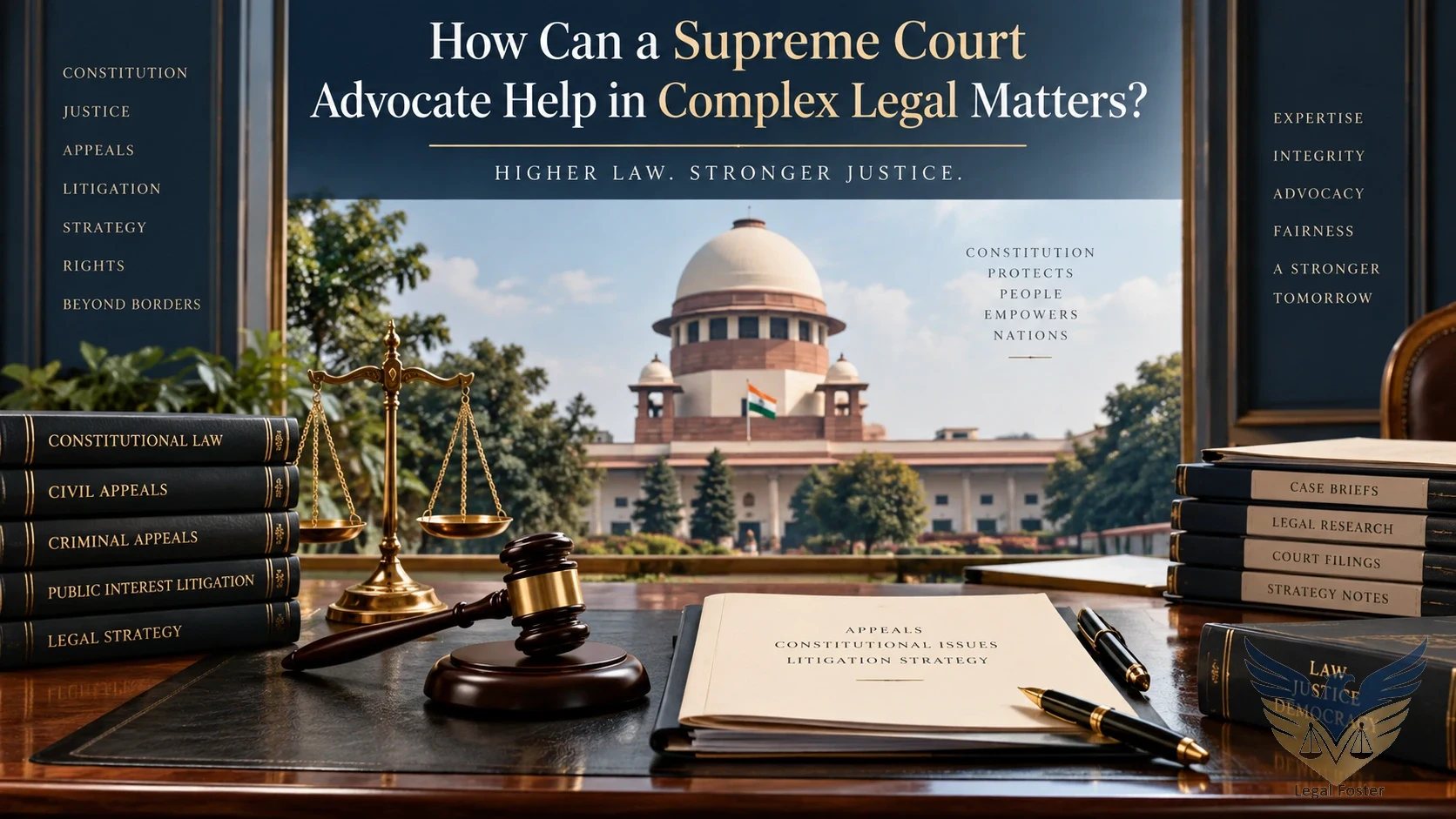
How Can a Supreme Court Advocate Help in Complex Legal Matters and Appeals?
Instances reach up to the Supreme Court when all other options for redress have been tried or exhausted in lower forums, or when compelling legal questions have arisen. When lawyers and clients require help interpreting the law, understanding constitutional questions, correcting procedural errors, or persuading a judge, they turn to the Advocates Supreme Court.
Clients have questions that are appealed to or have to be heard at the Apex Court of India. The Supreme Court hears some cases that differ from ordinary lawsuits.
They tend to involve substantial legal principles, interpretation of the laws, constitutional rights or remedies assistance with, procedural errors, or questions concerning the welfare of the general public.
Petitioners approach the Supreme Court when they lose a case/ order in the High Court/Tribunal/Court. These cases include Special Leave Petitions (SLPs), civil appeals, criminal appeals, constitutional filings, arbitration matters, commercial disputes, service issues or defending individuals rights.
The Supreme Court has very tight procedures. One minor error in framing your petition, calculating limitation, documentation, or identifying grounds can make a difference to your matter in front of the Judges of India. Conducting a thorough legal analysis of your matter will allow you to understand whether you have a substantial question of law, appealable issue or any remedy left.
BK Singh Advocate will assist you with your Supreme Court matter from the very beginning. We will go through your records, discuss your previous orders, work on your legal strategy and help you at every stage of your appellate journey.
SC Advocacy Handles Civil Cases Criminal Matters
Constitutional Disputes, Business litigation
and Tribunal cases that require Supreme Court litigation.
Why Does Supreme Court Representation Matter in India in 2026?
Appeals to the Supreme Court of India include constitutional cases, legal interpretations, and appeals from every court and tribunal throughout India. Legal jurisprudence is dynamic and complex. It is always helpful to seek consultation before knocking the doors of Supreme Court.
Supreme Court Lawyers in Delhi NCR, Mumbai, Bengaluru, Chennai, Hyderabad, Kolkata, Ahmedabad, Lucknow, Jaipur, Chandigarh and all other cities handle cases of clients who wish to knock the doors of apex court in matters involving substantial question of law or when a substantial injustice has been caused.
Your Supreme Court Advocate guides you through practical aspects of approaching Supreme Court of India like maintainability, limitation, documents to be filed, judgments that support your case & what remedies are available under law.
Many new clients believe that every order which is not in their favor can be challenged in India’s Supreme Court. Supreme Court would in most cases want to see that a valid point of law is involved which requires the consideration of the Supreme Court. Every case is unique and is dependent on facts, laws involved & the procedures that were complied with.
Litigation before Supreme Court India for business owners, professionals and individuals can involve huge money, personal liberty and serious legal repercussions. Seek assistance at the earliest stage possible and determine the appropriate legal route to prevent any unnecessary complications.
Quick Facts About Supreme Court Litigation
- SC or Apex court of India.
- The Supreme Court of India is the highest judicial forum and final court of appeal.
- Appellate jurisdiction of Supreme Court deals with matters appealed from high courts, tribunals and other forums recognised by law.
- Under Art.136 of the Constitution, Supreme Court has been vested with the power to grant Special Leave to Appeal.
- Special Leave petition is not a matter of right.
- Matters brought before the Apex Court require astute drafting, precise documentation and thorough understanding of the procedure to be followed.
- Civil and Criminal Appeals involve different considerations.
- Facts and evidence play an important role in any matter along with the provisions of law and the judges perspective.
What Does a Supreme Court Advocate Do?
Supreme Court Advocate means Advocate who does law related work to help you review and draft your pleadings and represents you in Supreme Court of India. Where as in Supreme Court he might have to go through thick jurisdiction and file your submissions systematically.
Appeals Reading of orders passed by lower courts, framing of issues, verifying procedure adopted by lower courts and drafting of submissions as needed in the matter of appeals.
Cases where BK Singh Advocate can assist you:
- Special Leave Petition (SLP)
- Civil Appeals
- Criminal Appeals
- Matters related to Constitution
- Writ-Related matters
- Tribunal Appeals
- Commercial/ Business Disputes
- Arbitration Related Contests
- Service matters
Relief would depend on the facts of the case.
How Can a Supreme Court Advocate Help in Appeals and SLP Matters?
As a first step, a Supreme Court Advocate will help you to analyse whether your appeal/petition before the Hon’ble Supreme Court is legally maintainable. Supreme Court is not a court of appeal in all matters.
Types of Appeals :
Special Leave Petition Under Article 136
Article 136 of the Constitution empowers the Supreme Court to grant special leave to appeal from any judgment, decree, determination, sentence or order in any cause or matter passed or made by any court or tribunal in India.
Article 136 vest wide powers in the hands of Supreme Court. But the jurisdiction of Supreme Court under Article 136 is however exercised at its discretion. Hence, while filing an SLP before the Supreme Court a petitioner is expected to raise legal questions which are examinable by the Court.
Civil Appeals
Appeals relating to matters such as property/inheritance, contracts, commercial disputes, family disputes, arbitration, consumer disputes and other disputes involving civil rights are filed under Civil Appeals.
It’s imperative to precis the facts, questions of law and grounds of challenge. As the Apex Court on appeal only interferes if there is some legal error committed which requires to be set right by it.
Criminal Appeals
Appeals against conviction and acquittal as well as certain orders such as bail etc. passed in criminal cases are known as Criminal Appeals. As the name indicates, these appeals pertain to criminal prosecutions.
Once again a Supreme Court Advocate goes through the entire trial court and High Court record including the orders passed, points relating to evidence etc. and advises you of the grounds which are available to you under criminal law.
What Types of Matters Can a Supreme Court Advocate Handle?
Can you handle my case? Supreme Court Advocate Practice Areas
Do SC Advocates handle all types of cases?
SC Advocates can appear for you in any type of cases depending on the subject matter, history of forum and remedy sought.
Supreme Court Civil cases usually involve disputes pertaining to property, contract, family & inheritance, business/commercial disputes, injunctions and other suits where civil damages are claimed.
Research becomes very important in such cases as one needs to analyze previous decisions, study the evidence on record in previous courts and frame the questions of law involved for Supreme Court.
Disputes involving property/inheritance can get quite messy because of multiple parties involved, old records and interpretation of the same.
Criminal Appeals/ Defense
SC hears criminal appeals against judgments involving interpretation of criminal law, challenges to sentence, bail applications and other criminal questions.
One would need to carefully examine the investigation, trial procedure, analysis of evidence and findings on appeal before approaching Supreme Court.
BK Singh Advocate goes through our client’s criminal case history and identifies potential legal questions which can be challenged in Supreme Court.
Please Note Supreme Court also has writ jurisdiction over Civil matters if they involve infringement of Fundamental Rights.
Criminal defenses are handled differently than Civil suits.
Constitutional
Cases involving interpretation of constitutional provisions, statutory validity, infringement of fundamental rights or action against public authorities are treated as constitutional issues.
These issues require special attention as constitutional law affects larger public than a regular civil or criminal matter.
Associations, traders and businesses can be involved in disputes related to arbitration, contracts, commercial laws, tax laws, insolvency and other business litigation. Supreme Court Advocates handle such disputes too.
The decision would be analyzed not just on legal grounds but practicality of such decision.
Services/Suits
If the appeal involves a government servant, it would come under this category. If you are part of a statutory body or an individual government employee, disputes relating to your services such as illegal recruitments, work conditions, promotion, misconduct allegations and retirement benefits can be appealed with help from SC Advocates.
A strategy would be formed based on the service rules that apply to you, any orders passed by Tribunal/High Court(if any) and the facts of the case.
How Does a Supreme Court Advocate Prepare a Case?
Advocacy ahead of litigation in Supreme Court involves reading through entire case history. Cases are not entertained by the Court lightly. Only substantial questions of law which call for interference are entertained.
Legal Research typically involves :
- The judgment/order complained against in Supreme Court.
- Pleadings, evidence and other material of the lower proceedings.
- Identification of errors of law / substantial questions
- Framing of grounds as per law.
- Preparing them compliant of SC mandate.
Our clients come to us when they have already been into litigation for years. By then it becomes very important to properly vet the matter as bar of legal advocacy in Supreme Court is very high.
Our Supreme Court Advocate makes sure our clients know their possibilities & limitations.
What Documents Are Required for Supreme Court Proceedings?
Documents may vary from case to case depending on facts. But some of the common documents that are filed are:
- Certified copy of the judgment/order against which the challenge is sought to be filed.
- Orders passed by the lower courts / tribunals.
- Copy of the petition filed before the previous forum.
- Pleadings/written statements etc.
- Record of evidence (if required).
- Copies of notices and correspondence.
- Affidavits and applications filed supporting the facts.
- Any ID and authorisation proof.
Proper documentations help you get rid of unnecessary delays. There may be procedural delays if the documents are not properly stacked. BK Singh Advocate will review your record and will advice you on the documents and cases you are missing for your case.
When Should You Consult a Supreme Court Advocate?
At what stage should a Person retain a Supreme Court Advocate?
In general, when the matter has progressed to a stage wherein the Supreme Court is seen as the place to seek relief/remedy/hearing of appeal/constitutional matters etc.
When consulting a lawyer at an earlier stage, its helpful to understand whether the remedy entitled to an individual is by way of SLP appeal or writ petition review or some other remedy.
Many individuals approach the Supreme Court after they have received an order passed against them by a High Court / Tribunal / Authority etc. At this stage it may be apparent that you do not agree with the decision. But is it a matter you simply disagree with, or are the legalities of the order in question, procedure on which it was passed and entire history of the case important to consider.
Professional Counsel would be advisable if the matter:
- Is an Order of a High Court which denies or uphold important legal rights
- Has serious legal finical consequences of an order passed by a Tribunal
- Is a Criminal matter where you wish to appeal a conviction/order
- Involves interpretation of constitutional provisions which deal with fundamental rights.
- Commercial/Business dispute which involves serious contractual concerns.
- Is a matter which deals with interpretation of statutes.
BK Singh Advocate can assist you, family, other professionals and businesses to determine if the Supreme Court is the appropriate forum to approach based on the merits of the case and facts/events of prior legal proceedings.
What Mistakes Should Be Avoided Before Approaching the Supreme Court?
5 Mistakes To Avoid When Going To Supreme Court
SUPREME COURT cases aren’t easy cases to prepare. Many people lose faith in our justice system or loose simply because they attempt to go to the Supreme Court without knowing the procedure or understanding how appellate jurisdiction works.
Believing that “Every” Matter can be heard by the Supreme Court:
Just because you lost in Court previously doesn’t mean that the Supreme Court will hear your matter. The Supreme Court is not a first appeal court. You should know what law applies to your facts and what remedy you should be looking for prior to instituting any proceedings.
Neglecting Limitation:
Each individual type of proceeding has limitation requirements. Even if time has become an issue there may be remedies available to you. These remedies are very fact sensitive and reason specific.
Instituting a Proceeding without all records:
Orders, pleadings and evidence (O.P.E) along with other important documents will be required when starting Supreme Court proceedings. In some cases these records will be used to frame the matter correctly.
Thinking you are entitled to a certain result:
No Attorney will ever be able to guarantee you a specific result. Facts, Evidence, applicable law and judicial discretion factor into every decision.
An experienced Advocate will sit down with you, discuss the merits of your case and fully explain any potential limitations and reality of your situation prior to proceeding with your matter.
How Can BK Singh Advocate Help in Supreme Court Matters?
Supreme Court cases require research, precision drafting, procedural expertise and persuasive advocacy. At BK Singh Advocate, we help our clients with their legal problems which need to be heard/prepared in Supreme Court of India.
The legal services we provide include:
Know The Case:
Firstly it is essential to know the facts of the case/history of dispute, go through the orders passed and see the legal remedies that can be sought.
Help with Drafting:
Drafting of petitions for Supreme Court is highly important as the Supreme Court analyses the legal issues/problems stated in front of the Court.
Help/Bail Regarding Appeals/Cases/Petitions:
Clients approach us for help regarding SLPs, Civil Appeals, Criminal Appeals, Constitutional Matters etc. We help you take the right path.
Act As A Point Person For Both Client and Counsel:
Dealing with matters in SC often requires balancing clients, attorneys, files, drafts and court proceedings. It can be helpful to have someone who can talk to the attorneys and keep clients in the loop.
Looking for a reliable and Experienced Supreme Court Advocate India? You can always rely on BK Singh Advocate for proficient legal assistance as per your requirements.
Why Is Experience Important in Supreme Court Litigation?
Cases that come through the Supreme Court are held to a different standard than many cases that are heard through lower courts. Not only does the Court hear your average small claims case, but they also hear legal, constitutional and other significant issues on a day-to-day basis.
Remember; each case is unique. An experienced advocate understands that no two cases are alike. They understand that different cases require different approaches. A landlord/tenant issue is going to involve different legal matters than a criminal appeal or constitutional matter.
Experience can help an attorney to:
- Identify legal issues
- Understand limitations of an appeal
- Review lower-court rulings
- Factually prepare your case in a way that matters legally
- Prepare your pleadings to the standard required by the Supreme Court.
More times than not a person or business will have to retain the Supreme Court during a very important time in their life. They could be facing extreme financial distress, loss of freedom, impact to their business or just trying to put an ending to a long legal battle. Advising your client in a clear and concise matter can help them understand their legal options.
Frequently Asked Questions
1. What does a Supreme Court Advocate do?
Ans. A Supreme Court Advocate can litigate and help you with your case in Supreme Court of India and help you with Appeals, Special Leave Petition, constitutional cases, criminal matters, civil disputes, and any legal proceedings you require assistance with.
2. Can I go to Supreme Court directly?
Ans. One cannot directly approach court. But can go to court by the legal process only which has been recognised by law. Depending on the nature of dispute and facts of the case, the appropriate remedy would be available. It would also depend on what orders are already passed, if any. The relief would be available as per the provision of law which applies to the particular case.
3. What is SLP before Supreme Court?
Ans. Special Leave Petition is a petition file Article 136 of Constitution before Supreme Court. It is filed for getting permission to file an appeal against any judgment/order passed by any court/tribunal.
4. Is SLP matter of right?
Ans.No.It is not. Article 136 only provides discretion power to the Hon’ble Apex Court. The Hon’ble Supreme Court may choose to hear the matter if it deems fit to do so. Supreme Court would entertain the matter if the particular matter requires to be heard by the court on any of the legal ground.
5. Does Supreme Court deal with civil & criminal matter?
Ans.Yes.The Supreme Court hears Civil Appeal, Criminal Appeal, Constitutional Matters. Along with these any other matters which law permits to be heard by the Apex Court.
6. How long do Supreme Court cases take?
Ans. It would be different in every case. Nature of the matter, procedure to be followed, complex facts involved in the dispute and whether Supreme Court agrees to hear the dispute by including it in their cause list.
7. What paperwork is needed for Supreme Court case?
Ans. Orders passed by previous courts,records of the Case, Pleadings done, Documents produced as evidence, Affidavits and any other document which might have been used in the dispute.
8. Can BK Singh Advocate help with SLP?
Ans. Yes. BK Singh Advocate can help you with any issue related to Supreme Court. He can analyze your SLP and related issues with respect to appeals you have. He can do this once he learns the facts of the case.
9. Why Supreme Court drafting is needed?
Ans. Drafting is important because in the pleadings you have to place before the court all the facts related to the case, legal points and reasons that your matter needs to be heard by Hon’ble Supreme Court.
10.How to meet Supreme Court Advocate?
Ans.You can share all the case history, previous orders if any passed and any documents related to the dispute that you have with an advocate. A good advocate will help you understand what legal options are available to you.
Final Thoughts
Filing a case at Supreme Court for justice is not something you want to take lightly. The Supreme Court will only hear cases involving significant legal issues, appeals, and constitutional law. Once you know if you have standing to file the correct remedy and meet all the qualifications with a strong case, you'll be able to decide how you want to move forward.
Whatever your case may be. Whether its civil, criminal, business dispute, constitutional law or a tribunal appeal you want clarity on we can help.
Visit BK Singh Advocate to find a lawyer to assist you with your supreme court matter.