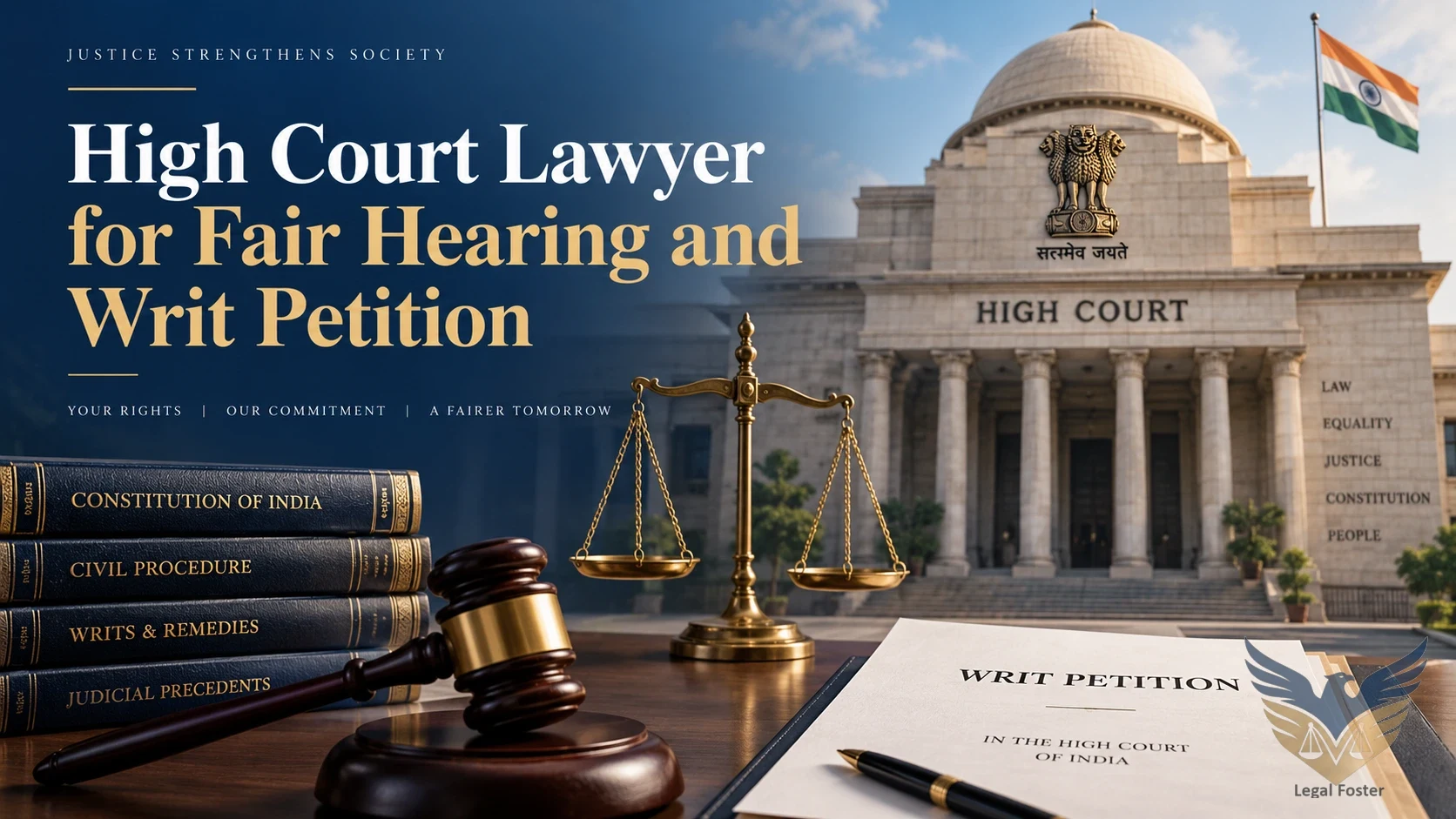
How Can a High Court Lawyer Protect Your Right to a Fair Hearing?
You receive an order that affects your property, business or job, licence or your government benefit or some other important legal right. But something smells fishy about the way the decision maker handled the situation. You know that the other side received an order without meaningfully allowing you the opportunity to be heard.
You have documents which were never considered. You submitted a response which was never noted. You were assured of a hearing which never took place. Now the question is, can the High Court help you? Can a lawyer help you file a writ challenging an order passed ex parte i. e. without hearing you?
In the right circumstances, Yes. That person who is adversely affected by an administrative order/statutory order/tribunal order or any other lawfully challengeable order can potentially file a writ petition in the High Court under Article 226 of the Constitution of India if it is found that the order was passed in violation of natural justice. The specific remedy available would depend on a number of factors including what authority passed the order, under what statute, if there is alternate remedy available, limitation, jurisdiction etc. Facts of the case would also matter greatly.
So if you reside in Delhi NCR, Noida, Ghaziabad, Gurugram, Faridabad, Meerut, Lucknow or Mumbai, Bengaluru, Hyderabad, Chennai, Kolkata or anywhere else in India.
BK Singh Advocate reads the impugned order and analyses the order itself, the notices you have received earlier, the reply you provided, the record of any purported hearing, the statute involved, the alternate remedies available and the urgency involved to determine the correct course of action.
Why Does an Order Passed Without Hearing You Matter in 2021?
An order issued without hearing you can cause repercussions far shorter of litigation’s end. An order can shut down a commercial venture. An order can threaten possession or development. An order can terminate your employment. An order can suspend or cancel a licence or approval.
If you reside in Delhi NCR, such a legal issue can quickly become an emergency. You may receive an order passed by a public authority located in Delhi, Noida, Ghaziabad, Gurugram or elsewhere seemingly out of the blue just to realize that the authority issued its order without even reading your reply and attachments.
The legal issue is not simply that you lost. The legal issue is whether you were provided a fair opportunity to be heard under the law.
Natural justice has been generally recognized by Indian courts to be an essential principle of procedure. However, the right to a hearing in advance is not absolute. Depending on the statute involved, the nature of the power being exercised, the true urgency of the situation and the overall scheme of the statute, this right can be tweaked or limited. Even the Supreme Court has recognized that there could be circumstances where the statutory scheme or true urgency of a situation obliterate the need for a prior hearing.
A person receiving an order which goes against them should understand this distinction. They can no longer go and file a petition claiming, “I wasn’t heard and I want the order cancelled.” Instead, the petition will have to normally explain what type of hearing was required, what (if anything) happened in its stead, why the opportunity was inadequate or not given and why, in light of the circumstances, the decision being challenged was made illegally.
BK Singh Advocate can analyse your facts and situation to tell you whether you have been legitimately deprived of natural justice or suffer from something else that must be challenged through a separate legal process.
Quick Facts
- Article 226 provides constitutional writ jurisdiction to the High Courts. Writ jurisdiction includes for filing suitable writ petitions against public authorities regarding legal rights.
- Natural justice generally requires a reasonable opportunity to be heard before an order is passed against you.
- Orders passed in violation of this principle and without hearing you can be challenged in an appropriate situation, relief is not granted as a matter of course.
- Alternative remedy available would also be a factor which will be considered for purposes of deciding whether a writ petition should be entertained by the High Court.
- Violation of natural justice has also been recognized as one of the instances where the general rule of requiring a person to pursue an alternative remedy may not prevent the High Court from interfering.
- The details of the remedy would depend on what authority passed the order, nature of order, statute governing the order, limitation etc. Always remember to keep a copy of challenged order and previous correspondence.
Can High Court Lawyer Challenge Such an Order?
Yes. Where there is an authority/decision body whose orders are subject to judicial review and such an order is passed in violation of natural justice, in excess of jurisdiction or without following the mandatory procedure prescribed by law or is otherwise made in violation of public law. A suitable challenge can be initiated.
Indian courts are courts of law and not courts of conscience and their jurisdiction can only be attracted when a legal right has been violated.
Article 226 allows the High Courts to issue certain directions, orders or writs to any person or authority, as the court thinks appropriate for the purposes of that Article. As you may already know, this power is exercised at the discretion of the High Court. This means that the simple fact that a person has been legally wronged will not automatically mean that the High Court will agree to hear your petition.
There are several instances where a writ petition would certainly be heard. One such instance is where the facts demonstrate that a person has, for all intents and purposes, been judged by an authority without being granted the opportunity that is required by law. Delhi High Court has on various occasions stated that violation of natural justice is one of the many instances where the general principle that a person challenging an order is required to first exhaust an efficacious alternative statutory remedy before invoking the writ jurisdiction of the High Court would not apply.
The relief sought can vary depending on what kind of legal defect is involved. Quashing or setting aside of the impugned order and order for fresh consideration after hearing the petitioner are are few of the reliefs that can be sought in an appropriate case.
The High Court would normally not act as if it’s the first investigator of facts. Courts have repeatedly held that the High Court in its writ jurisdiction does not act as an original agency of decision just because someone may have been aggrieved by an administrative action. The scope of judicial review and the nature of the challenge would impact how far the High Court can go in its writ jurisdiction.
Advocate BK Singh reviews your proposed challenge and informs you whether the same needs to be brought as a writ matter, statutory appeal/revision/review or some other legal proceeding.
What Documents Should You Show to High Court Lawyer?
A no hearing challenge is rarely possible to be evaluated merely by reading through the order passed. Quite often, this challenge is disposed of by the record surrounding the order. Whether a party’s procedural grievance is valid depends heavily on the record surrounding the order.
Documents related to the matter
- Copy of the order challenged
- Copy of notice or show cause notice issued to you
- Copy of your written reply/statutory reply /representation
- Proof of filing of the reply
- Emails/ Acknowledgements / receipts / Online filing Systems.
- Copy of notice of hearing and Correspondence.
- Copy of any prior orders passed in the same matter.
- Copies of any Applications/ Affidavits filed in relation to the matter.
- Copies of documents submitted along with the application/petition before the administrative authority.
- Any supporting documents like photos,inspection reports,lodgement receipts, licences, approvals, official documents etc.
- Copy of statutory appeal/Revision filed(if any).
- Chronology( arrange in date wise order) of significant events.
All supporting documents properly arranged heading wise if the order is related to property,job,running business, registration,licence,collection, Government schemes,etc.
BK Singh Advocate can review your entire set of documents related to the order. While you may only have specific documents in your possession, the agency holding the application often has documents you’ve never seen or might not know existed.
When Should You Contact a Delhi High Court Lawyer?
Instantly is another situation in which you should hire a lawyer. Suppose you receive an order and believe that you were not provided an opportunity to be heard. In that case, you should retain counsel immediately.
Where there is risk of demolition, sealing, dispossession, cancellation, recovery, termination, suspension, attachment or any immediate action threatened after the order. If there is a short limitation period within which to file the remedy.
Not all legal remedies have limitation. Also, writ jurisdiction is not subject to just 1 Limitation Act timeframe like every other statute dictated appeal/suit. But discretion can be influenced by delay.
It's always better to obtain a certified copy of the order and opening of the file sooner rather than later.
Don’t wait until the remedy available to you has expired before you seek legal help.
Things that a lawyer may have to consider when evaluating no hearing issues:
- Issuing Authority
- Enacting Statute or Authority
- Date of when Order was received.
- Notice served? Or not served?
- Reply filed? Or not filed?
- Was hearing opportunity granted? If so,was the reply heard?
- If statutory appeal/ revision is provided?
- Do you require immediate relief in order to avoid an injury?
Limitation
Is the High Court have territorial jurisdiction & subject matter jurisdiction to entertain the petition.
Can a person represent himself or can a lawyer represent a person in High Court?
High Court of Delhi itself says – “ Writ Petitions as also other proceedings can be filed by an Advocate only, in accordance with the rules of this Court and the requirements for filing.””
Why Does City Matter For High Court Legal Issue?
Suit/Matter can be against an Authority which is located in one City, against a person who lives in a different city and the party on whom order is passed happens to be operating a property/ business at another location. Hence territorial jurisdiction would never solely depend on where the client lives.
Client from Delhi NCR can file a writ/petition in Delhi High Court if subject matter of the suit involves Delhi High Court based on
- Authority against whom suit/ proceeding is to be initiated,
- Where Cause of Action arose,
- What Indian Law would apply to the suit and
- Various other jurisdictional factors.
Client from Noida, Ghaziabad,Gurugram, Faridabad, Meerut or any other city nearby Delhi do not presume that just because the Delhi High Court is close by, they can file a case here.
Client from Lucknow,Kanpur,Prayagraj,Varanasi, Agra, Jaipur, Chandigarh,Mumbai,Pune,Bengaluru,Hyderabad,Chennai,Kolkata, Ahmedabad or any other city in India cannot presume that you cant file a case against anyone residing here or against an authority located here just because the High Court in that city would have territorial jurisdiction over you.
BK Singh Advocate analyses higher forums keeping jurisdiction, limitation, documents in your possession and relief needed in mind.
How Can BK Singh Advocate Help You With Orders Passed Without Hearing You?
BK Singh Advocate begins with the record of the proceeding. The objective is to first understand what the real legal issue is instead of jumping the gun and assume that every order which was not in your favour needs to be challenged in the High Court as a writ petition.
This review would include reading the impugned order, the notice and your reply, the hearing records if any, the statutory provisions that have been relied on, any prior orders passed and available appeals/revision.
Depending on the outcome of the above review, any matter would be looked at from the following angles.
- Violation of natural justice
- Jurisdictional error
- Procedural impropriety
- Failure to consider material facts
- Failure to hear the parties if law required a hearing to be given.
- Analyzing alternate remedy and the reason one wouldn’t want to pursue the same.
- Limitation / delay in seeking relief.
- Need for urgent relief to avoid irreparable loss.
- Nature of interim / perpetual relief needed etc.
The Law Firm runs an updated Supreme Court | High Court | Tribunal Services Page where they mention some of the cases/events involving adverse orders, jurisdiction challenges, natural justice, writ petitions,appeals, revisions and interim reliefs handled by them at the higher forums focusing primarily on records and filing the matter in the right forum.
If you have a legal matter involving an order passed against you, realistically speaking the first thing you should do is protect the record and speak to a lawyer about your legal options.
BK Singh Advocate would first review the order along with the facts and advise you on whether your matter requires a writ petition, statutory remedy, appeal/revision/review or some other legal proceeding that is available to you under the law.
Frequently Asked Questions
1. Is it possible to file a writ against order passed without allowing me to hear?
Yes. But only if the law required a fair hearing to be given and you weren’t afforded that opportunity. Also, whether such a petition would even be maintainable would depend on what authority passed the order, what law governs the order, is there any alternate remedy available, is the High Court empowered to entertain the petition, etc.
2. Can I knock at the doors of High Court just because I was not heard?
Yes. Not allowing a party to speak can be a violation of natural justice. Natural justice is one of the ground to file a petition in High Court under Article 226. Naturally, High Court has also recognized this as an exception to the general rule that you first need to approach the lower forum. But the facts and merits of the petition would still be analysed.
3. What if I received a notice but wasn’t heard?
If you received a notice but were not heard, that too would be analyzed by the courts to determine whether you were given a fair chance to respond. The court would review the notice sent, how much time was given to respond, whether you sent a reply (if any), was a hearing requested/needed to be given under law, are there any mandatory requirements under the statute that were ignored, etc.
4. Can every unfair order be challenged in High Court?
No. The ability to file a writ petition in High Court cannot be invoked as a right against every decision or order which you may not like. The High Court would normally only look into matters that involve the recognized grounds of judicial review. So if there is another effective remedy available, the High Court would usually not entertain your matter. Also, violation of natural justice is just one of the several exceptions to the general rule.
5. Can I file writ if my reply was completely ignored by the authorities?
Yes. If you sent in a reply and the authority ignored the same, that would constitute evidence to show that the authority did not take note of material facts before passing the order. However, the entire record would be looked into by the court.
6. What if the order states that no personal hearing was required?
It would depend on what law applies to the decision. There are plenty of situations where orders can be passed without hearing a party. Either on the basis of written representations made by the parties. Or under special powers vested with the decision maker for taking urgent action.
7. Can High Court delete the order passed without hearing?
Yes. High Court can delete the impugned order and direct the authority to decide the matter afresh. But the authority would have to follow the procedure as required by law and hear you if necessary. Also, deletion of order is not guaranteed and would depend on the facts.
8. What papers should I show to a lawyer for orders passed without hearing me?
Send the entire order sheet received against you. Along with a copy of notice served on you, your reply if any. Proof of reply being dispatched or received. Any communication relating to the hearing. Any prior orders passed in the same case. Any applications/ affidavits filed along with the authorities regarding this matter and replies received. All supporting documents you have received throughout the process. Documents heading wise if it involves property, business, job etc.
9. What if there is provision of appeal against the order?
You normally cannot file a writ petition if there is provision of appeal. If a remedy of appeal is provided, you would first be required to appeal the order. But violating natural justice is a well established exception to this rule. Other exceptions include when something is beyond the jurisdiction of the decision making authority, inordinate delays, etc.
10. How can BK Singh Advocate help you if I received an order without allowing me to hear?
Advocate BK Singh would first read the order, checks the history of notices/ replies sent by you to the authority, check what kind of authority it is, what alternative remedies are available and what is the limitation for filing a petition. Urgency of the matter can also be dealt with. We would then advise you on the correct course of action rather than leaping to conclusions.
Conclusion
Just because you weren’t heard when an order was passed against you, it does not mean that every order is condemnable. But if the order passed without hearing you has consequences that immediately impact that person’s property, employment, business opportunity, license, money or some other recognizable legal right, then the order cannot be simply ignored indefinitely.
But the mere fact that you were not afforded an opportunity to speak in person does not make every order void ab initio. Instead, what needs to be studied is whether the procedure used was legally adequate in those circumstances. Was a personal hearing required under the applicable law? Did the statute require the authority to provide a genuine opportunity to be heard.
To start analyzing your legal issue, look at the order passed, the statute under which it was passed, the chronology of events leading up to the order and what remedy you seek. Relief under Article 226 may exist and may be a viable option in the right circumstances especially if there is a clear ground of challenge like violation of natural justice.
Received an order where you were not heard at all? Preserve the order sheet and speak to an experienced lawyer immediately. BK Singh Advocate would review your order from the perspective of jurisdiction, natural justice, limitation, maintainability of petition and documents needed and relief available to you legally.