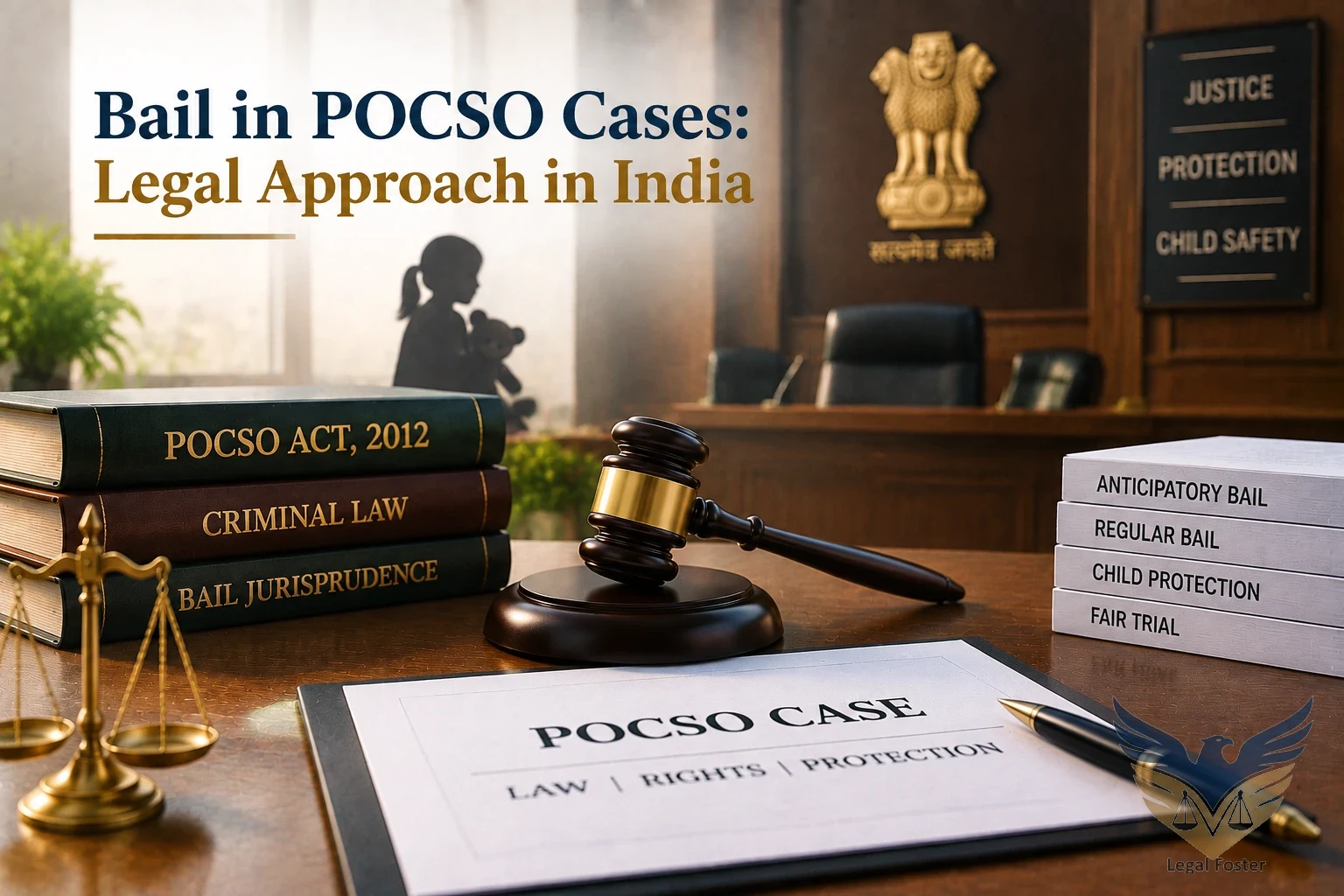
Bail in POCSO Cases Legal Approach Needed by Family Members in India
An FIR under POCSO can completely disrupt a family’s lives within hours. Facing an allegation of sexual offending against a child will cause any parent concern, and rightfully so. An FIR, police questioning or arrest may result in custody and/or a remand hearing/bail application in the appropriate criminal court.
“What about bail?” is often one of the first things someone accused asks their lawyer. The simple answer is, it depends. While POCSO allegations are serious – the law understandably affords children special protections against sexual assault. An accusation does not give the court a free pass to automatically restrict their judicial discretion when it comes to bail.
The legal requirements to file bail applications in 2026 involving India’s POCSO Act, 2012 will almost always involve Bharatiya Nagarik Suraksha Sanhita, 2023 (BNSS), in conjunction with the POCSO Act itself. Subject to the statute that governs the Court hearing the matter, of course. As Section 31 POCSO explicitly states, the provisions of the CrPC read with POCSO shall apply to any proceedings before the Special Court. (These are criminal procedural law provisions about bail & bonds.) Some recent examples of orders from the High Court have additionally reflected the trend of filing what are technically “regular” bail applications under BNSS read with Section 31 POCSO.
But what exactly is bail? By definition, bail is the process by which a court considers releasing an accused person from custody (with whatever conditions imposed by law) while the criminal case continues. It is not the same as convicting or acquitting someone of the offence.
If you live in Delhi, Noida, Ghaziabad, Gurugram, Faridabad, Meerut or anywhere else in India, it’s likely that the first few days will be a whirlwind. You might not even know what some of the sections in the FIR mean. Maybe your son/daughter/relative/spouse is already in judicial custody. Maybe the police haven’t finished their investigation.
Does that mean you should rush to file your bail application? Advocate BK Singh says NO. He says let’s start at the beginning of the case diary and NOT start with a presumption based on the gravity of the allegation. See factors listed below which impact bail application.
Why Should Bail Matter In POCSO Cases In 2026?
POCSO cases are different than your run-of-the-mill criminal offence for several reasons. The victim is always a child, for one. With each alleged POCSO offence therefore, a Special Court needs to balance its judgement with compassion for the child as well as respect for time-tested principles of personal freedom and criminal procedure.
Recently, in January 2026, our Supreme Court laid down that bail in POCSO cases must follow regular principles of bail. The factors mentioned above must be considered like nature/ gravity of allegations made against the accused, whether the accused could possibly have committed the offence, chance of offence being repeated, possibility of witnesses being threatened or evidence being tampered, chances of the accused absconding from justice etc. But that does not mean every single bail plea would be considered the same way. As the Supreme Court stated, the threshold can be higher or lower depending on facts and circumstances of each case.
For instance, if your family is dealing with an arrest in Delhi or any city in the NCR, then your main concern is likely to be getting out of custody ASAP. But if your family finds themselves in a different set of circumstances - let’s say you’re reading this article because you want to know about bail and you think your family isanticipating an arrest - then the legal remedy you need could vary depending on whether the individual has already been arrested.
BK Singh Advocate takes every case on the principle that in order to know what legal steps to take, we first need to recognise where in this process someone actually finds themselves. Are they at risk of arrest? Have they already been taken into custody? Was bail rejected in a previous hearing? All of these change what you can do.
- The POCSO Act, 2012 is “special” statute dealing with sexual offences against children.
- Section 31 POCSO pulls in (“incorporates”) the Cr. P.C (“criminal procedure code”) Scheme as is applicable to bail and bonds in proceedings before POCSO Special Court.
- Till the point the new BNSS, 2023 Act is not in force the CrPC scheme will be applicable (read with POCSO) and post commencement of BNSS bail/bonds provisions would apply subject to transitional issues if any and facts of each case.
- Making an allegation under POCSO Act does not lead to an irrebuttable presumption that bail cannot be considered by the Court.
- While deciding bail, age of the alleged child victim is relevant factor.
- Courts have the power to look into issues of witnesses being threatened, evidence being manipulated, risk of absconding, repeating the offence etc.
- Granting of bail is not treating an offender as acquitted of the offence. It simply means continuation of criminal prosecution will be outside of custody.
What is the core legal issue in Bail Application Under POCSO Act?
Whether considering the allegations made in the FIR/complaint, evidence on record, relevant laws/statutory provisions and the circumstances/applicable law against the accused; custody is legally necessary or could release on sufficient terms be considered.
POCSO cases do NOT happen in vacuum bubbles. For example, sometimes one FIR can include offences under POCSO in addition to Bharatiya Nyaya Sanhita, 2023 or possibly some other statute.
This matters because
- The Court would read the FIR & complaints made, see what sections of POCSO have been invoked against the accused. Each section has its own punishment listed. The Court could take note of the allegations in the FIR, examine the stage of investigation and material produced before it.
- Based on the discretion provided by statute and bail principles, the Court could decide to reject or accept the Bail application.
- Criminal history of the accused (if any), likelihood of fleeing from appearing before courts, influencing witnesses are some of the other factors that fly into play.
As Advocate BK Singh would tell his clients – the court has NOT to rehear the trial when deciding on a bail application. That being said, the Court does not have to ignore any evidence because it is a bail application.
Which law will decide bail matter in POCSO offences?
The primary special law is the Protection of Children from Sexual Offences Act, 2012 . It talks about forming Special Courts to handle POCSO investigations and trails. As mentioned earlier, Section 31 POCSO allows for the CrPC Scheme of criminal procedure to apply to cases pending before the POCSO Special Court. However, any bail application or decisions would still have to follow the POCSO Act.
Now since BNSS is also the new criminal law (which has replaced CrPC), the present criminal procedural scheme will have to be read with the BNSS too.
This recent order from Sikkim High Court in 2022 explicitly says, “Cannot decide bail matter under POCSO. Bail application for regular bail shall be decided under Section 483 BNSS read with Section 31 POCSO.”
That’s if the accused person is filing for regular bail.
The bail application form itself will change if the Accused applies for Anticipatory bail or regular bail or even some kind of interim relief. Additionally, the Court in which you file the bail application will be different based on what offence is made, where your local court is and if you’ve already been arrested/arrest is imminent/arrested and bail rejected.
In the matter of Special Court under POCSO, it would have powers to the extent that the Special Court is treated like a Court of Session for purposes mentioned in POCSO. If a matter is filed in High Court along with the above mentioned case, then High Court powers come into play too.
Courts have recently made other decisions that will help us understand how the mind works. The Supreme Court also came out with a decision while rejecting a bail plea earlier this year 2026. While deciding a bail application at the beginning of January 2026, the Court observed that -
“The grant of bail cannot be put under any additional restrictions just because the offence is alleged to have been committed under the POCSO Act. If the statute expressly mandates such restriction, then only such restriction can be applied”. However, this does not give liberty for courts to forget the gravity of the offence and age of the child victim.
So while the law does give special focus on protecting children as per POCSO, it cannot just be plugged into every bail application assuming the child will always get priority. Every case requires assessing the law first and then apply those guidelines to the facts.
What is the process for Seeking Bail in a POCSO Case?
Ascertaining the exact allegations leveled against the accused (some arrests are made on flimsy legal grounds and get discharged early on). Whether the accused is looking at the stage of arrest, after arrest and in judicial custody or whether they want to challenge an existing order refusing bail.
Gathering documents: Scrutinizing the FIR, what sections would apply to the facts of the case, what investigation material would the defence have access too, custody memo/order (if any) and any previous orders passed by the court.
Figuring out where to file.
Determining whether you want/need to file for anticipatory bail or regular bail or some other form of interim relief based on if the accused is already in custody or fears arrest.
Filing the bail application/petition and awaiting a hearing before the appropriate Court. If bail is granted, courts often attach conditions to bail.
BK Singh has pointed out “Preparing and filing an application is step 1 of many. Courts have to assess it, prosecution would respond, court considers stage of investigation, facts etc”.
Documents / Evidence
Make sure when you go into a POCSO bail hearing with a POCSO bail matter that you have all the necessary documents organized and ready to show your lawyer. This can help your consultation go through quickly. Here is a list of some documents that may be helpful:
- ✓Copy of FIR/complaint (if you’re able to get access to it)
- ✓ Memo of arrest and remand papers
- Copy of any bail applications previously filed and orders passed.
- Any notices received by the police from the accused
- Copy of the chargesheet(if already lodged)
- Copies of any medical/forensic reports that the accused can obtain.
- Identity/address proof documents
- Proof of employment/school or family members who rely on the accused as per law.
- Record of criminal offences if the accused has faced any previously.
- Copies of any other orders passed in the related proceedings.
Documents should not be altered in any way and should be produced in their original form. Also, electronic evidence such as WhatsApp chats should be preserved and not forwarded between many people.
Avoid speaking to the child/complainant/witnesses without your Lawyers advice.
When Should You Contact a Bail Lawyer?
At the earliest opportunity where:
- An FIR has been registered under offences mentioned in POCSO;
- Police have spoken to the Accused;
- Arrest of the accused is likely;
- The Accused has been arrested;
- Remand Proceedings are initiated against the accused; or
- The accused had their bail application rejected.
Please contact a lawyer if any of the above is true. Time is of the essence in situations where the family doesnot have a copy of FIR or arenethat aware of what sections have been registered under.
A lawyer will be able to guide you on whether your matter would be considered for anticipatory bail or regular bail or some interim relief or second bail application or some other legally viable option.
Advocate BK Singh provides free case-specific consultations on Bail/FIR and Criminal Proceedings (Depending on Jurisdiction & availability) in Delhi NCR.
How can Best Bail Lawyer help with a POCSO Bail Matter?
Bestbaillawyer.com is focused on bail and related criminal defense matters such as Anticipatory bail, Regular bail, Assistance with FIRs and Arrests, Court Appearances and more. Click here to know more about Bail and Legal Services provided by Advocate BK Singh.
As far as POCSO bail applications or matters are concerned, we always start with analyzing the real case record. Advocate BK Singh will walk you through the allegations made against you/your family member, where the matter stands from a procedural point of view, what documents you have at your disposal and which bail forum would be appropriate to approach.
Also, if the matter is pending in Delhi or NCR’s criminal courts, there is information on this site about bail lawyers in Delhi. Learn about Bail lawyer services in Delhi .
If you need emergency bail help, schedule a consultation through this site rather than asking BK Singh for informal help. Click here to navigate to Bail Consultation and Contact Page.
If the matter is pending in Court of Session, we have put together court specific bail guides which can help users understand the difference between custody, bail and continuing a criminal matter vs settling it outside of court. Read our Sessions Court Bail Guide.
Analyze your situation and discuss your legal options with Advocate BK Singh. Advocate BK Singh will review the allegations made against you, documents available to you and your custody status. No predictions will be provided to you before he has access to/read your case details.
FAQs
Q1. Will I get bail in a POCSO case?
Ans. Yes. Just because your mom/dad/sister/brother filed an allegation under POCSO, doesn’t mean the Court can’t hear your bail application. The Court would look at the relevant laws (BNSS, CrPC and POCSO) and the facts of your case including nature and seriousness of allegations made against you, evidence added, age of the victim, stage of investigation, whether material/ witnesses are at risk of being tampered with.
Q2. Is bail under POCSO different from Criminal Bail?
Ans. POCSO offenses are tried under a separate child protection law. Also, cases are heard in Special POCSO Courts. The question of bail is slightly different however, as it is adjudged under applicable criminal procedural laws. (Keep reading to find out which!) While deciding bail, courts do take into consideration the gravity of allegations and age of child.
Q3.What BNSS section would allow me to file for regular bail?
Ans. It depends on the facts of your case and where your case is pending. Section 483 of BNSS allows for regular bail to be filed in the High Court or Court of Session. If the facts/reasons for seeking regular bail satisfy that Court, your Hon’ble Court can grant bail. You will see in the above paragraph some recent orders from our very own High Court granting bail in POCSO cases using Section 483 BNSS read with Section 31 POCSO Act.
Q4. Can I apply for Anticipatory bail if my family is facing a POCSO case?
Ans. Again, this depends on lots of factors. Your accusations/facts, the law that applies and what Court you’d be filing the bail application from. Each case is different and has to be judged on its own facts. Just because someone didn’t get bail in a POCSO case, doesn’t mean you cannot get bail if your facts are stronger.
Q5. My police just filed a chargesheet, can I still seek bail?
Ans. No. Just because the police filed a chargesheet, it doesn’t automatically entitle you to bail or mean that you can’t apply for bail. The Court has to take into consideration the principles of bail first, then review the facts before it.
Q6. If I get bail, does that mean I’m innocent?
Ans. No it does not. When someone is granted bail, that person is not convicted of the offence. A bail order only means that the person posting bond/ sureties prescribed by the Court can remain outside of custody while the case is pending. All of the evidence has to be heard and reviewed by a judge at trial before a determination is made.
Q7. Will courts see the age of my child when deciding bail?
Ans. Yes. The Supreme Court has told all lower courts this very fact.
Q8. What paperwork should I give to the bail lawyer?
Ans. See our list above. We recommend gathering as many of the documents listed above and showing them to your lawyer. The more your lawyer knows about your case upfront, the faster he can assess your legal options.
Q9. Will conditions be imposed on me if I get bail in a POCSO case?
Ans. Yes. If you get bail conditions can and most likely will be imposed. Every condition the court imposes on you when granting bail has to be followed.
Q10.Do lawyers guarantee bail in POCSO cases?
Ans. No credible lawyer in India will guarantee results. Advocate BK Singh can review your records, explain the law that applies to your situation, discuss potential remedies with you and go over any procedural requirements with you.
Conclusion
POCSO investigations/complaints need to be handled delicately because there are 2 major interests at stake. Firstly, the wellbeing and protection of children. Secondly, an accused persons rights under India’s criminal laws and procedures.
Courts in SC have said that the fact an offence is booked under POCSO does not mean bail shall not be considered by courts at all. But this doesn’t give anyone license to escape custody if the allegations are serious, complainant is a minor and evidence/supporting material indicates you are guilty of the offence. Factors like the seriousness of the allegation, age of child, material on record, investigation stage and likelihood of tampering offences/witnesses can influence a court’s decision.
An individual who is accused of something under POCSO or at risk of arrest should take action ASAP. The sooner you know what legal options are available, the better. Time only makes an already stressful situation worse. Knowing what’s contained in the FIR and which sections your family member has been arrested for are the first steps. Getting reliable legal advice at the right time can clear things up. If you or your family have been affected by a POCSO FIR/arrest/custody, Advocate BK Singh can go over the facts with you and let you know what legal route is best suited for your situation.