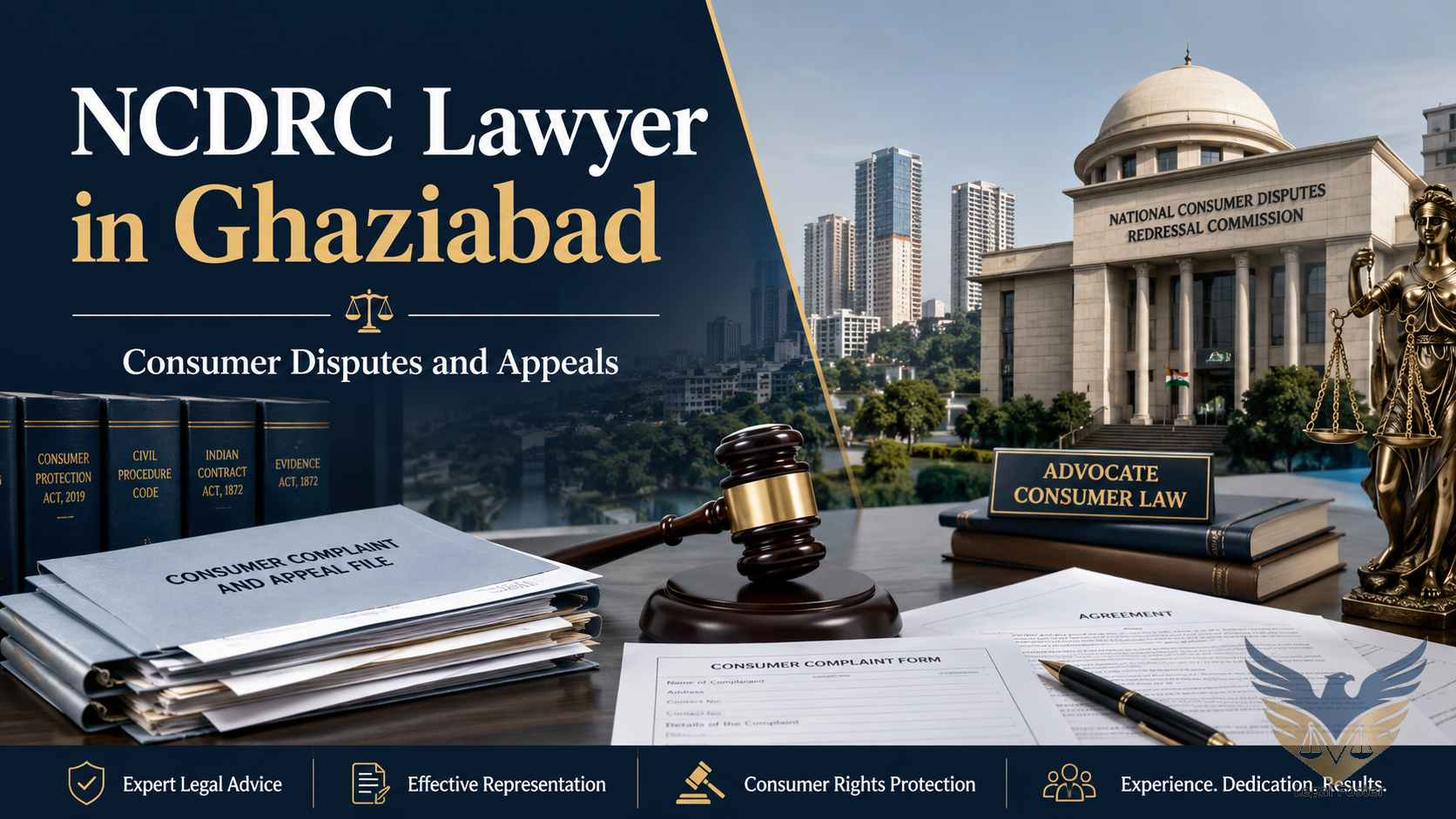
Consumer disputes are stressful when your seller, builder, bank, insurance company, hospital or any service provider isn't righting a serious wrong. Many try resolving consumer complaints through emails, registering complaint calls, sending legal notices or local negotiations.
But when money is large or the issue escalates up to the National Consumer Disputes Redressal Commission, you want expert legal guidance. Experienced NCDRC Lawyers in Ghaziabad can analyse your paperwork, highlight legal technicalities and present your case in plain terms based on compelling evidence.
What Types of Consumer Matters Can Reach the NCDRC?
Original complaints with higher claim value and appeals or revision petitions against orders passed by State Consumer Disputes Redressal Commissions can come up for consideration before the NCDRC.
Consumer disputes may relate to delayed possession, poor construction, unfair banking charges, insurance claim settlement, negligence in medical services, false advertising, product liability, cyber fraud or below-par professional services.
The appropriate forum may depend upon the value of consideration, the nature of relief, the forum from which an earlier order has been passed and the remedy sought by the parties. Consumer lawyers in Ghaziabad can assess whether the dispute involves an original complaint, first appeal, revision petition, review application or execution-related proceeding.
Why Do Strong Documents Matter in Consumer Cases?
Consumer disputes are heavily dependent on documentary evidence. An invoice, agreement, receipt, email, payment history, photographs, expert opinion, warranty card, medical report or previous consumer commission order may become important in establishing what was promised and what actually happened.
A genuine claim can become difficult to establish when important papers are unavailable, contradict the allegations being made or do not clearly establish the connection between the deficiency in service and the loss claimed.
Documents That May Become Relevant
- Contracts, agreements and booking documents
- Invoices, bills and payment receipts
- Email chains and written correspondence
- Photographs and supporting technical evidence
- Bank statements and payment records
- Medical reports or expert opinions where relevant
- Previous pleadings, evidence and consumer commission orders
A consumer court lawyer in Ghaziabad may review the complete record to identify missing documents, contradictory dates, limitation concerns and claims that may not be adequately supported by the available evidence.
Can Delay Harm an NCDRC Case?
Yes. Consumer complaints, appeals and other remedies are subject to statutory limitation requirements. An unexplained delay can become a serious legal obstacle.
Valuable time is sometimes lost while consumers continue waiting for telephone assurances, internal investigations, promises of refunds, settlement discussions or repeated responses from customer-care departments. Such correspondence does not necessarily preserve the consumer's legal remedy indefinitely.
Where delay has already occurred, the circumstances and supporting documents become important. Whether delayed proceedings can still be entertained depends upon the applicable law and the facts explaining the delay.
Why Are Appeals and Revision Petitions Different?
An appeal and a revision petition should not be treated as interchangeable remedies. An appeal generally permits examination of findings of fact and law within the scope allowed by the applicable statute.
A revision petition ordinarily operates within a narrower jurisdiction and may focus on jurisdictional errors, material irregularity or improper exercise of authority by the consumer commission whose order is being challenged.
The legal service required from NCDRC Lawyers in Ghaziabad therefore depends significantly upon the stage at which the dispute has reached them. Previous complaints, replies, evidence, written submissions and the impugned order may all affect the legal issues that remain open for consideration.
What Problems Commonly Weaken Consumer Claims?
A consumer may have suffered genuine financial loss or poor service but still face difficulties if the case presented before the commission contains gaps or inconsistencies.
- Inflated compensation or damage claims without supporting material
- No reliable proof of payment
- Missing signatures or incomplete agreements
- Ambiguous promises regarding goods or services
- Conflicting or unexplained dates
- Incomplete details regarding the opposite party
- No clear connection between the deficiency and the loss claimed
Another common problem is presenting the dispute mainly in emotional language without establishing the factual connection between the representation made by the service provider, what subsequently occurred, the evidence supporting the grievance and the relief being claimed.
How Can NCDRC Representation Support a Client?
Professional representation can help organise a complicated consumer dispute into clear factual and legal issues. Depending upon the matter, legal assistance may involve reviewing jurisdiction, pleadings, documents, existing evidence, written submissions, interim issues, appeals, revision proceedings or execution-related concerns.
An experienced consumer lawyer can also identify objections that may be raised by the opposite party. These could involve maintainability, limitation, territorial jurisdiction, commercial purpose, consumer status, absence of deficiency or lack of evidence connecting the alleged conduct with the compensation demanded.
Realistic Case Assessment Matters
Clients should receive realistic guidance regarding the strengths and weaknesses of their case, possible objections and the nature of relief that may realistically be available. Quality legal representation cannot guarantee a specific result.
It can, however, help a consumer make informed decisions and reduce the possibility that jurisdiction, limitation, incomplete documentation or other legal problems weaken an otherwise legitimate grievance.
Frequently Asked Questions
1. Do NCDRC Lawyers in Ghaziabad accept consumer cases?
NCDRC-related legal assistance may concern original consumer complaints, appeals, revision petitions, review matters, execution proceedings, interim applications and challenges involving orders passed by State Consumer Commissions. The correct remedy depends upon jurisdiction and the stage of the particular dispute.
2. Can I file a complaint against a builder before the NCDRC?
Builder disputes may involve delayed possession, defective construction, false representations, unfair charges or failure to provide promised facilities. Whether the dispute can be directly entertained by the NCDRC depends upon the applicable jurisdictional requirements and facts of the case.
3. Can I challenge rejection of an insurance claim?
Yes, an unjustified insurance claim rejection may give rise to a consumer dispute depending upon the facts. Important records may include the insurance policy, proposal documents, premium receipts, medical documents, correspondence, claim papers and the insurer's rejection or repudiation letter.
4. What documents may be required in an NCDRC matter?
Relevant documents may include agreements, invoices, receipts, bank statements, email correspondence, legal notices, photographs, expert reports and documents already filed before the lower consumer commission. In appeals or revisions, previous pleadings, evidence and the order being challenged can be particularly important.
5. Is there a limitation period for consumer complaints?
Yes. Consumer complaints, appeals and other proceedings may be subject to statutory limitation periods. Where proceedings are initiated late, the delay ordinarily needs to be satisfactorily explained. Acceptance of delayed proceedings is not automatic.
6. What is the difference between an appeal and a revision petition?
An appeal generally provides a broader opportunity to challenge findings within the scope permitted by law. Revision jurisdiction is comparatively narrower and may focus on jurisdictional error, material irregularity or improper exercise of jurisdiction by the commission whose order is challenged.
7. Can compensation be claimed for mental agony?
Compensation may be sought where the facts support harassment, inconvenience, mental agony, financial loss or deficiency in service. The amount claimed should have a reasonable connection with the circumstances and should be supported by relevant facts and available evidence.
8. Can a corporate body file a consumer complaint?
Consumer status for a company or other corporate body depends upon factors such as the nature of the transaction and whether the goods or services were obtained for a commercial purpose. The specific circumstances must therefore be examined before assuming that the entity qualifies as a consumer.
9. Can an NCDRC or consumer commission order be enforced?
Consumer commission orders can be subject to enforcement mechanisms provided by applicable consumer law. Where the opposite party fails to comply with an operative order, the successful party may need to consider the appropriate execution or enforcement remedy based on the order and forum concerned.
10. When should I meet Advocate BK Singh?
Legal consultation may be particularly important where the dispute involves a substantial consumer claim, an adverse State Commission order, limitation concerns, significant documentary evidence or an existing proceeding before the NCDRC. The appropriate advice depends on the facts, documents, jurisdiction and present stage of the case.
Conclusion
While choosing NCDRC Lawyers for a consumer dispute connected with Ghaziabad, experience in consumer law, documentary assessment and representation before the relevant consumer commission can become important.
Legal guidance is especially relevant in higher-value disputes, appeals, revision petitions, limitation-related matters and cases where the available evidence may determine whether the claim succeeds or fails.
NCDRC Lawyers provides legal services for consumer dispute matters. Each matter should be reviewed on its individual facts, supporting documents, jurisdiction and existing stage of proceedings. Advocate BK Singh may be consulted for case-specific legal advice after reviewing the relevant record.