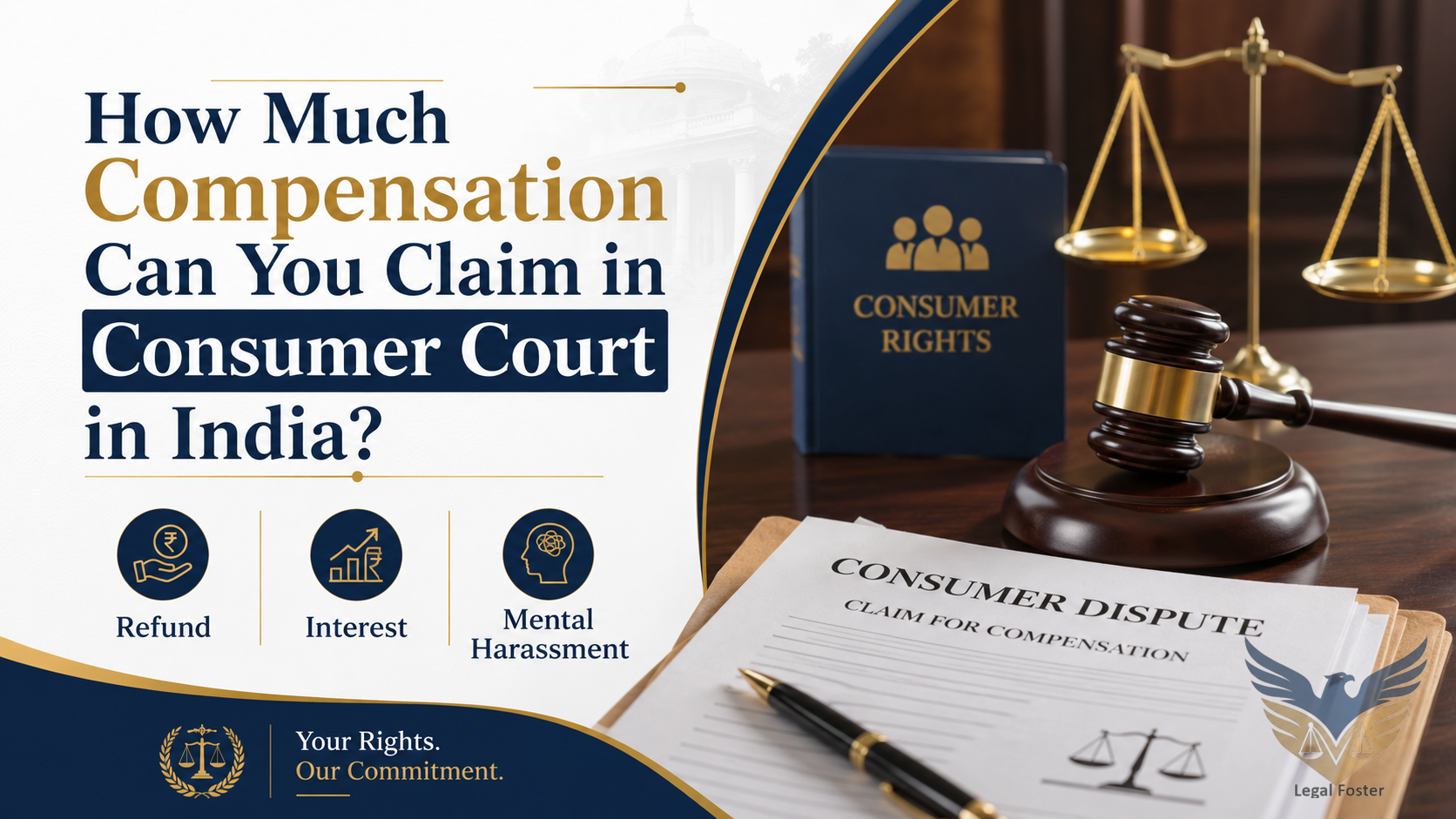
What Compensation Can You Claim in Consumer Court in India?
A practical overview of refunds, interest, compensation for loss, mental harassment, litigation costs and punitive damages under Indian consumer law.
Why Does Consumer Court Compensation Matter in India in 2026?
Consumers in Delhi, Noida, Ghaziabad, Gurugram and Faridabad are dealing with higher-value transactions. Consumers in Mumbai increasingly accept contracts on e-commerce platforms, while Bengaluru consumers frequently deal with insurance policies, digital promises and electronically recorded transactions.
Bigger transactions do not always mean better protection. A consumer may lose money and time, but financial loss is only part of the harm. A homebuyer may keep paying rent because possession is delayed. An insurance policyholder may have to use emergency savings after a claim is unfairly rejected. A family may repeatedly contact a service provider without receiving a responsible response.
That is where compensation matters.
When a promise is not kept, a simple refund may not cover every form of loss, injury, inconvenience or harassment suffered by the consumer.
Consumer Commissions may award a refund with interest, compensation, replacement of goods, removal of defects, correction of deficient services, litigation costs and, in suitable cases, punitive damages under Section 39 of the Consumer Protection Act, 2019.
Compensation is not guaranteed merely because a consumer is dissatisfied. The consumer normally has to show that the wrongful conduct, negligence, defect or deficiency of the opposite party caused a legally recognizable loss or injury.
NCDRC Lawyers and Advocate BK Singh can help consumers understand which losses may be legally supportable and whether the amount demanded is reasonable in light of the available documents.
Quick Facts About Consumer Court Compensation
What Can Consumer Court Compensation Actually Include?
Consumer court compensation is financial relief for loss or injury connected with defective goods, deficient services, negligence, unfair trade practices or another legally recognized harm arising from a product or paid service.
- Faulty or defective goods
- Poor or deficient services
- Negligence by the opposite party
- Unfair trade practices
- Other loss or injury connected with a product or service
Compensation may be awarded in addition to a refund or replacement, interest on the amount paid, directions to correct the deficient service and reimbursement of reasonable litigation costs. A consumer complaint may contain several legally distinct heads of claim; it is not always limited to one combined amount.
Can You Ask for Interest on a Refund?
Yes. Where goods or services were not delivered as promised, the Commission may direct that the price or charges be refunded with interest. The rate is not automatically the same as the rate charged under the transaction. The Commission may consider the nature of the transaction, the period during which the consumer was deprived of the money, contractual terms, conduct of the parties and the overall fairness of the result.
Can You Ask for More Compensation Than You Paid?
Yes. A Consumer Commission may award an amount higher than the original price where the consumer proves an additional financial loss, injury or legally recognizable hardship caused by the opposite party's negligence or service deficiency.
For example, delayed possession of a home and the resulting rent or financing burden may represent separate forms of harm. A builder's delay in refunding an advance may also lead to claims involving mental harassment, loss of rental income or litigation expenses. Each head of claim is examined independently against the documents produced.
Can You Claim Compensation for Mental Harassment?
Yes. Mental agony, harassment, pain and inconvenience may be compensable where the facts justify such a claim. Repeatedly ignored complaints, prolonged uncertainty, needless travel, financial pressure, stress or inappropriate conduct may be relevant.
However, a general statement that the consumer suffered severe harassment may not be enough. The complaint should connect the conduct of the opposite party with the actual hardship alleged. Claims involving refund, mental harassment and additional financial loss remain subject to jurisdiction, limitation and evidentiary requirements.
How Does Consumer Court Calculate Compensation?
Section 39 of the Consumer Protection Act, 2019 does not prescribe one standard mathematical formula for compensation. The amount is discretionary and depends on the proved facts of the case.
Depending on the facts, the relief may include:
- Removal of a defect or correction of a deficiency in service.
- Return of the price or charges paid, together with interest considered appropriate by the Commission.
- Compensation for the loss or injury suffered by the consumer.
- Relief arising from a product-liability claim.
- Directions to stop an unfair trade practice.
- Costs payable to the parties, including reasonable legal expenses.
- Punitive damages where the facts and circumstances justify such an award.
Consumer complaints are ordinarily instituted before the appropriate Consumer Commission according to the applicable jurisdictional rules. Appeals may lie before the State Commission or National Commission, depending on the order challenged and the governing provisions.
Consumers do not receive a fixed amount merely because a particular figure is written in the complaint. Advocate BK Singh and NCDRC Lawyers can assist in identifying payment transactions, defining the alleged deficiency, connecting the loss with the opposite party's conduct and separating reasonable claims from unsupported or exaggerated demands.
Which Documents Will Advocate BK Singh Review?
Consumer disputes are largely decided through documentary evidence. Oral statements alone may not establish how much was paid, what was promised, when the deficiency occurred or how that deficiency caused the claimed loss.
Commonly relevant documents include:
- Invoice, receipt, booking document or purchase order
- Agreement, policy, warranty or applicable terms and conditions
- Bank statement and proof of payment
- Email or chat history and complaint reference numbers
- Notice of rejection, cancellation, repudiation or shortfall
- Photographs, inspection sheets or technical assessments
- Medical records where personal injury is alleged
- Rent receipts, repair bills and travel expenses
- Reimbursement records, where relevant
- Copies of legal notices and replies
- Orders passed by a District or State Commission where an appeal is proposed
Consumer Commissions may require parties to produce documents, affidavits, material for laboratory testing or other expert evidence. Random screenshots, incomplete conversations and unrelated bills can weaken a claim if the dates or amounts do not match the pleaded facts.
Advocate BK Singh can review the documents chronologically and identify which records support liability, which records support compensation and which documents may be used by the opposite party to dispute the claim.
How Long Can You Wait to Consult a Lawyer?
A consumer complaint should generally be filed within two years from the date on which the cause of action arises. A delayed complaint may be considered where sufficient cause is shown, but the Commission must record reasons for condoning the delay.
Many consumers assume that limitation remains suspended while emails and reminders continue. That assumption can be risky. The relevant date may depend on rejection, cancellation, possession, continuing deficiency, final denial or another event arising from the transaction.
Delay may also affect evidence. Emails can be deleted, employees may leave, policy papers may become difficult to trace and bank records may take time to obtain. Limitation therefore involves more than simply counting dates.
Early legal advice does not necessarily mean that litigation must immediately follow. It helps the consumer understand jurisdiction, limitation, documentary gaps and the realistic value of the proposed compensation claim before negotiations or other choices become more difficult.
When Should You Contact Advocate BK Singh About Consumer Compensation?
Legal review may be particularly relevant where the monetary value is substantial, several parties are involved, liability is denied or a Consumer Commission has already passed an order.
- A builder failed to provide possession or refund an advance.
- An insurer rejected a claim or paid substantially less than the claimed amount.
- A defective product caused property damage or personal injury.
- A bank, travel company or online marketplace denies responsibility.
- A hospital or paid healthcare provider is accused of serious service negligence.
- The opposite party has sent a detailed reply disputing liability.
- There is uncertainty concerning limitation or jurisdiction.
- An appeal is proposed against an order of the District or State Commission.
- The compensation demanded is substantially higher than the price originally paid.
A consumer may file a complaint without engaging a lawyer. However, legal assistance can become important where maintainability, jurisdiction, limitation, expert reports, technical proof, causation or grounds of appeal are disputed.
Advocate BK Singh can review a complaint draft, identify legal issues and assess whether the available evidence supports the proposed relief. At NCDRC Lawyers, consumer disputes and appeals are handled from the District Commission level through proceedings before the National Commission, subject to the facts and applicable law.
How Can NCDRC Lawyers Help With a Compensation Claim?
A compensation claim requires more than a list of everything that went wrong. The legal assessment may involve determining whether a consumer relationship exists, identifying liable parties, defining the specific defect or deficiency, connecting the conduct with the claimed loss and selecting the appropriate forum.
Consumer-Law Services
- Preliminary assessment of whether a consumer complaint is maintainable
- Review of agreements, invoices, insurance policies and correspondence
- Assessment of the appropriate Consumer Commission
- Analysis of refund, interest and compensation components
- Drafting and representation in complaints, replies, appeals or revisions
- Review of limitation and procedural objections
- Review of proposed settlements and related documents
Visit the About Us page to learn more about NCDRC Lawyers and the consumer-law practice of Advocate BK Singh.
The objective is not to promise the highest possible compensation. It is to present a legally supportable claim, backed by relevant documents, before the appropriate Consumer Commission.
Frequently Asked Questions
1. Can I get full compensation from a consumer court?
There is no single fixed compensation amount for every consumer dispute. The Consumer Commission considers the loss incurred, injury suffered, negligence or deficiency proved, evidence produced and the reasonableness of the amount claimed.
Jurisdiction is determined under the applicable legal rules and should not be created by adding an arbitrary or exaggerated compensation figure.
2. Can a Consumer Court award more compensation than the amount paid?
Yes. An amount greater than the original price may be awarded where additional financial loss, injury, mental agony or harassment is proved. Each separate head of compensation should be reasonable and supported by evidence.
3. Can I claim compensation for mental harassment?
Yes. Compensation may be claimed for mental agony, pain and harassment caused by the conduct or negligence of the opposite party. Vague statements are usually weaker than a clear chronology showing the actual inconvenience, financial pressure or prolonged uncertainty suffered.
4. Should I claim a high amount so that my case is filed before NCDRC?
No. An exaggerated compensation claim should not be used merely to attempt to change the forum. The proper Consumer Commission depends on the applicable jurisdictional provisions and the nature and value of the transaction.
5. Can I claim both a refund and compensation?
Yes. A consumer may seek refund of the amount paid and separate compensation for a proved loss or injury. Interest and litigation costs may also be considered separately. However, the same loss cannot ordinarily be compensated twice.
6. Which documents are necessary for claiming compensation?
Useful records may include agreements, invoices, payment proof, customer-care records, emails, notices, photographs, inspection reports, medical records, repair bills, rent receipts and copies of relevant orders or legal correspondence.
7. Can a Consumer Court award punitive damages?
Yes, in an appropriate case. Punitive damages are discretionary and may be considered where the facts reveal serious misconduct, gross negligence, fraud, malicious conduct or an unfair trade practice. They are not awarded automatically in every dispute.
8. What is the limitation period for filing a consumer complaint?
A consumer complaint should generally be filed within two years from the date on which the cause of action arises. A delayed complaint may be entertained where sufficient cause is shown and the Commission records reasons for condoning the delay.
9. Do I need a lawyer for a Consumer Court case?
No. Consumers may represent themselves. Legal assistance may nevertheless be useful where the dispute raises issues concerning limitation, jurisdiction, technical evidence, multiple opposite parties, expert reports, maintainability or appellate grounds.
10. Why consult Advocate BK Singh for a compensation claim?
Advocate BK Singh can review the appropriate forum, limitation period, evidence, liability issues and the distinction between refund, interest, compensation and litigation costs. The review can also identify whether the proposed claim is realistic and supported by the available records.
Conclusion
Consumer Commissions do not calculate compensation according to anger, guesswork or arbitrary multipliers. They consider the transaction, the proved defect or service deficiency, the loss or injury established through evidence and whether the amount claimed is reasonable.
Depending on the facts, relief may include refund, interest, compensation, replacement of goods, correction of deficient services and reasonable litigation costs. Punitive damages remain discretionary and are not awarded in every case.
Consumers dealing with substantial financial exposure, disputed liability, multiple parties or an order of the District or State Commission may benefit from an early legal review. A properly supported claim is less likely to fail because of avoidable issues relating to evidence, limitation or jurisdiction.