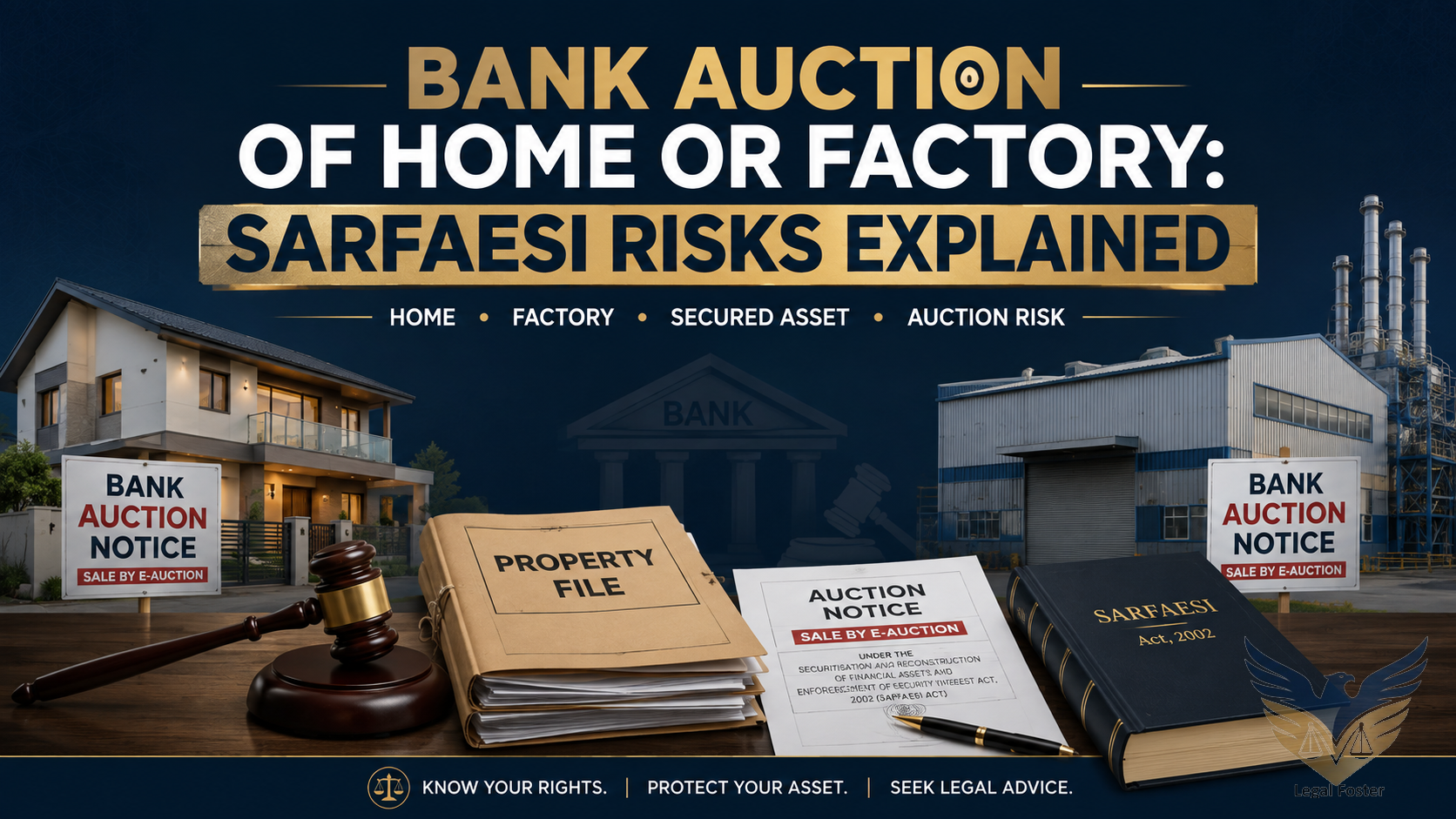
Home or Factory Under Bank Auction? Understand the Risks Before the Property Is Sold
Understand the practical and legal risks connected with SARFAESI auctions involving homes, factories, shops and commercial properties, including possession, valuation, reserve price, notices and DRT proceedings.
An auction notice does not merely indicate unpaid loan instalments. It may mean that your home, factory, shop, office or commercial property is moving toward an actual sale. Auction notices commonly contain a scheduled date, reserve price, inspection period and bidding information.
The pressure extends beyond the outstanding loan. Home loan borrowers may fear losing their residence and facing disruption to family life. Business owners may face loss of work premises, machinery, employees and customer confidence. Guarantors may also face enforcement when they have mortgaged their property to secure someone else's borrowing.
By the time an auction notice is issued, the secured creditor may already have invoked the SARFAESI Act, treated the loan account as non-performing, issued a demand notice, initiated possession action and prepared the secured property for sale.
Every Bank Auction Dispute Is Different
Some borrowers question whether notices were properly served. Others dispute the reserve price, outstanding loan figure, miscellaneous charges, possession procedure, property description or the extent of the property being auctioned.
Financial difficulty and alleged procedural violations should therefore be examined separately.
Time becomes especially important after the auction date is announced. Once bidding progresses and third-party rights begin to arise, the factual and legal position can become considerably more complicated.
Table of Contents
- Why Is a Bank Property Auction a Serious Issue?
- Quick Facts About a SARFAESI Auction
- What Is the Core Legal Problem in a Bank Auction?
- Which Law Governs Auction of a Home or Factory?
- What Problems Commonly Make a Bank Auction Disputed?
- Which Documents Reveal the Real Auction Problem?
- When Does a Bank Auction Require Immediate Legal Review?
- How Can a DRT Lawyer Assist?
- Frequently Asked Questions
Why Is a Bank Property Auction a Serious Issue in India in 2026?
A mortgaged asset may be the borrower's only residence, an ancestral shop or a functioning commercial unit employing workers. Loss of the secured property can affect residence, livelihood, business continuity and future access to institutional finance.
Bank Auction Litigation Can Be Document-Heavy
Banks may send communications by registered post, email, newspaper publication, affixture or online auction portals. Borrowers sometimes overlook earlier communications and discover only later that the matter has moved from demand to possession and finally to auction.
Consequences Can Continue Even After Auction
Sale of the secured property does not necessarily extinguish the entire loan liability. If the sale proceeds are insufficient, recovery of the remaining amount may continue depending on the applicable legal position.
Auction challenges may also affect successful bidders. Once a third party has paid consideration and sale confirmation or a sale certificate becomes involved, reversing the process may become more complicated.
Quick Facts About a SARFAESI Auction
- Section 13(2) generally concerns the 60-day demand notice stage.
- Measures under Section 13(4) arise after the statutory enforcement process moves forward.
- Possession notice and auction notice are separate documents serving different purposes.
- Rules 8 and 9 contain important provisions concerning sale of immovable secured assets.
- Valuation, reserve price, publication and service can become disputed issues.
- Merely filing proceedings before DRT does not automatically stay the auction.
- Auction confirmation and issuance of a sale certificate may create third-party rights.
What Is the Core Legal Problem in a Bank Auction?
A bank auction involves sale of a secured asset, generally a mortgaged property, to recover the outstanding secured debt. However, the dispute is not always simply about whether the borrower owes money.
A borrower may accept that instalments remain unpaid but still question the amount demanded, classification of the loan account, valuation, possession procedure or manner in which the property is being sold.
An Auction Notice Usually Signals an Advanced Recovery Stage
Advocate BK Singh is often approached after the auction notice has already been published. The relevant chronology may nevertheless begin much earlier with the demand notice, objections, bank response, possession notice and account statements.
Which Law Governs the Auction of a Home or Factory?
The main framework discussed in these disputes is the Securitisation and Reconstruction of Financial Assets and Enforcement of Security Interest Act, 2002, commonly known as the SARFAESI Act, together with the Security Interest (Enforcement) Rules, 2002.
SARFAESI allows eligible secured creditors to enforce qualifying security interests without first obtaining a civil court decree, subject to compliance with the statutory framework.
Concerns the demand notice stage before specified enforcement measures are taken.
Concerns specified measures available to the secured creditor after the statutory conditions are met.
Provides an avenue for an aggrieved person to challenge qualifying SARFAESI measures before the jurisdictional DRT.
The article refers to a normal 45-day period for approaching DRT under Section 17 from the relevant challenged measure, while maintainability and limitation depend upon the facts and the particular action being challenged.
Advocate BK Singh specifically examines the difference between a Section 13(2) demand notice and a measure taken under Section 13(4), because confusing the two can affect whether proceedings are premature or delayed.
Rules 8 and 9 and Sale of Immovable Secured Assets
Rule 8 deals with important requirements concerning possession and preparation of immovable secured property for sale, including possession notice, valuation, reserve price and sale notice requirements.
Rule 9 deals with the time and manner of sale, including payment by successful bidders, confirmation and issuance of sale certificates.
Readers facing an upcoming auction may also review: How a Bank Auction Is Challenged Before DRT .
DRT Relief Is Not Automatic
DRT may examine whether measures taken by the secured creditor comply with the SARFAESI Act and applicable rules. However, filing an application does not itself stop an auction.
Interim protection depends upon the alleged illegality, supporting material, urgency, conduct of the parties and the decision of the Tribunal.
An appeal against an order of DRT may lie before the Debt Recovery Appellate Tribunal under Section 18, subject to the applicable statutory requirements including pre-deposit provisions.
What Problems Commonly Make a Bank Auction Disputed?
Missing or Defective Notices
A borrower may claim that the demand notice, possession notice or sale notice was never received. The secured creditor may rely on postal receipts, courier tracking, affixture, newspaper publication or electronic records.
Conflicting evidence concerning service may therefore become an important factual dispute.
Suspected Undervaluation of the Property
A very low reserve price can attract scrutiny, especially where significant value remains in a house, factory or commercial building. However, a borrower believing the property is worth more does not by itself establish that the valuation is illegal.
Issues may involve an old valuation, incomplete inspection, incorrect address, inaccurate construction details or other property information.
Read more: Challenging an Undervalued Auction Sale Before DRT .
Incorrect Account or Liability Figures
Loan accounts may contain disputed interest, penal charges, legal expenses, insurance amounts or other entries. Borrowers may also allege that restructuring payments, deposits or other credits were not properly adjusted.
Accounting disputes do not by themselves automatically prevent enforcement, but substantial unexplained discrepancies can become part of the broader dispute.
Factory Auction and Business Disruption
Auction of a factory can affect more than the immovable property. Plant and machinery, licences, inventory, employees, utilities and third-party commercial arrangements may be connected with the premises.
Where the mortgaged property contains both the company's registered office and production facility, even publication of an auction notice can create concern among employees, suppliers and customers.
Which Documents Reveal the Real Auction Problem?
Documents do not merely support the borrower's version. They also help determine whether the alleged defect actually exists. Advocate BK Singh generally asks for the complete record in chronological order because one auction notice rarely explains the entire SARFAESI history.
Gaps in the record can hide limitation issues, contradictory acknowledgements or earlier enforcement action. Missing documents may also make it difficult to identify whether the actual dispute concerns liability, procedure, valuation, possession or sale confirmation.
When Does a Bank Auction Require Immediate Legal Review?
Urgency increases when an auction date is fixed, possession has already been taken or is imminent, bids have been invited, a successful bidder has deposited money, the reserve price has changed sharply or there is a dispute concerning the property description.
Do Not Automatically Believe That:
- Sending a representation to the bank automatically stays the auction.
- Settlement negotiations are equivalent to a stay order.
- Proceedings pending before another authority automatically suspend SARFAESI measures.
- Filing a civil suit automatically prevents confirmation of sale.
- A secured creditor cannot proceed merely because the property is a residence or a functioning factory.
Advocate BK Singh reviews these questions according to the timing, jurisdiction, documents and type of enforcement measure involved.
For related background information, see: Urgent SARFAESI Auction Matters .
How Can DRT Lawyer Assist in Understanding the Dispute?
A DRT lawyer may review SARFAESI notices, possession proceedings, auction publications, loan statements and recovery correspondence for borrowers, guarantors, families and businesses.
The purpose is to identify the actual legal and factual controversy rather than assume that every step taken by the bank is necessarily defective.
Advocate BK Singh reviews the chronology, notices, account information, security documents, valuation material and prior correspondence. Where a factory is involved, the business consequences and third-party interests may also require review.
Oral statements or informal assurances from bank officers should not automatically be treated as substitutes for written notices, signed communications, orders or proof of payment.
Neither DRT Lawyer nor Advocate BK Singh can guarantee that a borrower will retain the property. Interim and final relief depend on applicable law, evidence and orders passed by the competent Tribunal or court.
Frequently Asked Questions
1. Can a bank auction my only residential house?
A residential property provided as security for a qualifying loan may be subject to enforcement under the SARFAESI framework, subject to applicable law and compliance with the required procedure. Being the only residence does not by itself make an auction invalid.
2. Does receiving an auction notice mean my property is already sold?
No. An auction notice announces the proposed sale and its terms. Bidding, payment, confirmation and issuance of a sale certificate arise later in the process.
3. Can the bank auction a guarantor's property?
Property mortgaged by a guarantor may be exposed to enforcement subject to the guarantee, security documents and applicable law. The actual documentation should be examined before reaching a conclusion.
4. Is a low reserve price enough to cancel the auction?
A low reserve price does not automatically make an auction unlawful. The valuation process, property particulars, methodology and any resulting prejudice may become relevant.
5. Does filing a DRT case automatically stay the bank auction?
No. Filing proceedings and obtaining an interim stay are separate matters. A specific order may be required to restrain the relevant enforcement action.
6. Can a bank auction a running factory?
A factory offered as security may be proceeded against where the statutory requirements are met. The consequences can extend to business operations, machinery, employees, utilities and commercial arrangements.
7. What if I never received the auction notice?
Non-receipt may create a dispute regarding service, but the bank may rely on postal records, affixture, newspaper publication or electronic records. The complete service history should therefore be examined.
8. Can the bank continue with auction while settlement talks are pending?
Settlement discussions alone should not automatically be treated as suspension of SARFAESI enforcement. Written protection or an appropriate interim order may become important depending on the circumstances.
9. What happens if the property is sold for less than the outstanding debt?
Sale of the secured property may not necessarily discharge the entire outstanding liability. If a balance remains after adjustment of sale proceeds, further recovery issues may arise.
10. Why should auction papers be reviewed before the sale?
Notice, valuation, limitation, account, possession and jurisdictional issues may become more difficult once bidding, confirmation and third-party rights have arisen. Early review helps identify the actual problem at the relevant stage.
Final Thought
A bank auction can leave a family without its residence, disrupt a business and, in some cases, leave an outstanding debt even after the property has been sold.
The dispute may concern service of notices, valuation, preparation of the loan account, possession procedure or third-party rights, rather than merely the borrower's inability to repay.
Once bids are received, sale is confirmed and third-party rights arise, the situation may become more difficult to challenge. Borrowers and guarantors may therefore consult Advocate BK Singh through DRT Lawyer for document-oriented review of the SARFAESI chronology and enforcement record.
Home or Factory Facing a Bank Auction?
Keep the loan agreement, demand notice, possession documents, auction notice, account statements, valuation records and earlier proceedings ready so the complete SARFAESI chronology can be reviewed properly.
Visit DRT Lawyer