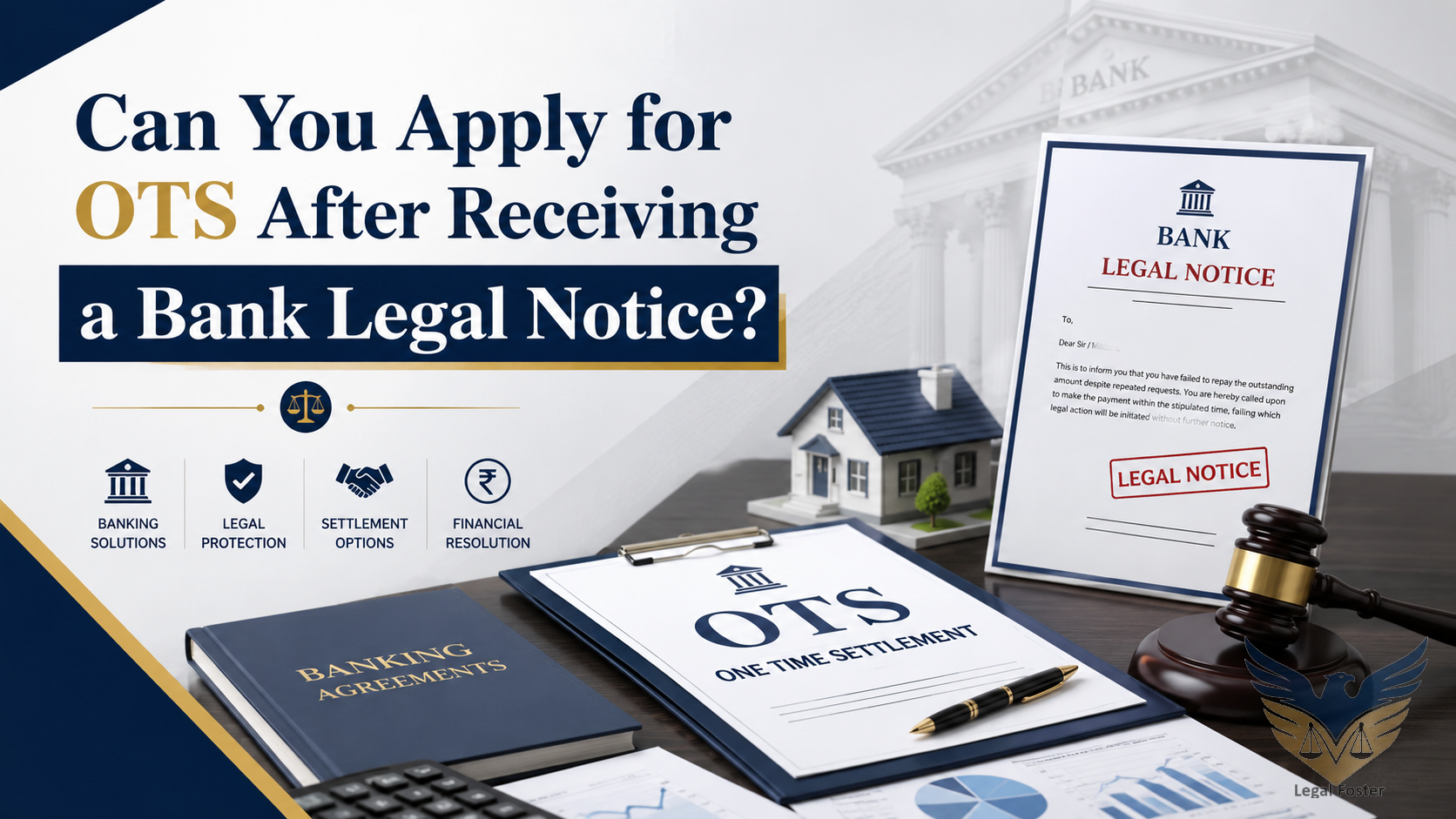
Can You Apply for OTS After Receiving a Legal Notice from the Bank?
A bank legal notice feels like a death knell to most borrowers. Already stressed about their finances, being served a notice just about destroys what’s left of their composure. The notice doesn’t only ask you to pay-up the entire outstanding balance. It mentions recall of loan and/or secured property, arbitration and/ or further recovery action. This is where borrowers feel that it’ too late to try and negotiate with the bank. That is not necessarily the case.
Lenders will first review your repayment history, loan category, security value, payment behavior till date, period of default, your financial distress and how much you’re offering to settle. “I can’t pay” is a claim that has no merit to it. Writing a proposal that highlights your current financial situation with documented evidence and where you’ll get the funds to settle looks more credible. A company owner in Delhi whose receivables have dried up may be staring at a loan recall notice.
A person in Noida with salaried income who lost his job may now be fighting recovery. Parents in Ghaziabad might be in panic mode over a home loan notice. Every borrower has their own set of circumstances. Each borrower has a different risk profile. LSA reviews each borrower’s situation with respect to the stage of the notice, available settlement options and monetary responsibilities.
This prevents borrowers from throwing money at Lenders. Loan Settlements that are negotiated after a demand notice and prior to any possession, auction or arbitral award may be looked upon differently by the lender than say a similar request coming in 6 months. But there is no cut-off stage where borrowers suddenly become 100% eligible for approval. Look for agencies that advice borrowers to use caution and look for agencies that stress documented communication rather than taking verbal calls/field agents at their word.
Why Does a Bank Notice Require Immediate Attention in 2026?
Loan recovery notices are flooding these days. Loan recovery notices are primarily document driven. A borrower anywhere in Delhi NCR or in other cities of India can receive these notices through registered post or email or branch channel or through an advocate acting on behalf of the lender.
A borrower who decides to ignore such document may lose precious time in finding out the response time. He may inadvertently face hike in charges and also lose the opportunity to explain his side of the story. Loan Recovery Notice can be for personal loan, business loan, credit card debt, auto loan or loan against property.
Consequences for default in different kinds of loans vary. While a secured creditor has the right to enforce his rights against the security by the procedure prescribed by law, an unsecured lender may have to resort to contractual clauses of recovery or arbitration or file a civil suit or any other remedy provided under law.
Loan Settlement Agency will analyse the contents of the notice received and will not treat it as a simple reminder notice. Receipt of a legal notice does not necessarily mean that the OTS was rejected. Nor does it mean that initiation of litigation or enforcement proceedings is imminent.
Quick Facts
- OTS stands for One Time Settlement. It is when you negotiate a settlement in full of the lenders account.
- You can send in an OTS offer after receiving a recovery notice.
- The bank is not legally bound to accept your settlement offer.
- OTS will not stop recovery actions from proceeding right away.
- If you get a verbal YES, take it with a grain of salt.
- Await written and confirmed approval before sending money.
- Remember it will still negatively impact your credit profile.
What Legal Rules Apply After a Bank Notice?
Comprise settlement Definition by RBI
One should note that compromise settlement has been recognised as one of the modes of resolution of stressed assets by RBI. The eligibility criteria, method of valuation, approval hierarchy and quantum of sacrifice is determined by the board approved policies of the regulated entities.
Please note that the lenders objective is to recover as much money commercially as possible and not let off every defaulter who approaches him. Besides RBI has carved compromises settlements away from technical write-off through its framework for compromise settlements.
Secured Loans and SARFAESI notices:
Section 13(2) along with Section 13 of SARFAESI Act mandates that if a secured loan account is a non performing asset and requisite legal conditions are met then the lender is allowed to issue a demand notice.
The notice usually calls for the borrower to clear off the stated liability within a period of 60 days.
Objection against Notice
The borrower is entitled to send a representation/objection. Section 13(3A) further provides that the secured creditor is required to take into consideration the borrower's representation/objection and intimate him with the reasons for rejection within 15 days. Please refer to Section 13 of SARFAESI Act for other time periods and obligations.
Unsecured loans and other proceedings:
Unsecured personal loans/ credit-card dues etc can not usually be recovered through SARFAESI against a separate property. You may pursue these through the underlying loan agreement, arbitration clause, civil law etc or some other remedy. Issuance of a settlement offer doesn’t automatically stop a pending arbitration hearing/ Lok Adalat notice/ cheque-bounce case/ recovery proceeding, etc.
While agreeing to a settlement, ensure that the terms of settlement clearly mention the account/ specific proceedings it intends to settle. Loan Settlement Agency recommends you to check if the terms include a specific mention of withdrawal/closure /settled (by way of compounding/consent) terms clearly stated in writing in the approval.
Unfair Recovery Conduct:
Humiliation, threats and intrusion into privacy are never justified upon default. Anonymous calling, repetition of calls, pre-dawn/late night calling, etc. are prohibited by RBI directions on recovery agents for regulated entities or their agents. Please note that RBI directions cover all interactions even if the money is legitimately overdue.
Filing an abusive practice complaint is different from filing for OTS. It does not erase the debt, and for all legitimate commercial reasons to reject a compromise offer are not harassment, in itself.
Which Documents Strengthen an OTS Proposal?
Financial hardship as a reason for settlement doesn’t cut it. Typically Loan Settlement Agency will advise you to first gather up the following documents before even quoting an amount:
- Full legal demand notice, envelope and email and acknowledgement receipt
- Loan approval letter, contract and payment schedule
- Current account statement showing principal, interest and fees
- Proof of earlier EMI payments and part payments via bank entries or receipts
- Termination of employment letter, pay-cut document or medical certificate
- Business bank statements, GST filings, ITRs and books of account showing losses
- List of assets, mortgage information and valuation report if applicable
Numbers need to add up. Quote a number that the borrower can’t possibly pay by the agreed upon date and you lose all credibility. Open up your bank account because someone on the phone tells you it will be closed that day is just as bad.
The settlement letter should mention the borrower name, loan account number, settlement amount approved, payment terms, waiver if any and implications of not paying. It should clearly mention about acknowledgement received, NOC or no dues certificate, stopping of any pending recovery process and reporting to credit bureau.
When Should a Borrower Consult a Lawyer?
Caution is particularly warranted if the notice refers to mortgage possession, property auction, arbitration, court date, Lok Adalat, guarantor liability or cheque dishonour.
Prompt review also makes sense if the demanded settlement amount seems inaccurate or payments are not being credited. Additional red flags:
- The lender has previously denied an OTS without correcting material records.
- Agents are giving varying amounts needed to settle.
- You are given an unreasonably short time to pay.
- You are asked to pay into an individual or unverified account.
- Possession or auction action has commenced.
- A co-applicant or guarantor received their own notice.
You are being harassed by threats, contact at your place of employment or public shaming. Loan Settlement Agency can analyze the notice wording and advise if the priority should be negotiation, statutory reply, recovery protection or recordkeeping.While an early review will not assure OTS acceptance, it can help eliminate preventable errors.
Frequently Asked Questions
1. Can I ask for OTS on receiving legal notice from bank?
Yes. Receipt of demand/ recall/ recovery notice does not prevent you from asking for OTS. Request preferably in writing alongwith account number, hardship certificate and realistic amount which you can pay should be sent to lender. Decision to accept OTS is purely at lender’s policy and discretion.
2. Is bank bound to accept my OTS proposal?
No. OTS is not a right but a matter of commercial negotiation between borrower & lender. Loan Settlement Agency cannot compel or instruct lender to accept any amount as OTS. Bank may accept your request or reject it or ask for more amount or propose some repayment scheme.
3. Will bank stop recovery process if I send OTS request?
No. Merely asking for OTS will not stop recovery. Recovery will continue unless lender sends you a written acknowledgement stating that they have paused recovery action against you or you have received relief from a competent forum like Debt Recovery Tribunal. All timelines should be complied with until officially relieved.
4. Does Loan Settlement Agency assure fixed percentage settlement?
No expert can assure you fixed percentage settlement. Loan Settlement Agency will assist you to know about your affordability, prepare necessary documents & communication with lender but lender is the ultimate authority who will approve OTS & decide the percentage based on recovery situation & their policy guidelines.
5. Should I pay money to recovery agent if he quotes a discount on phone?
You should never pay money to anyone based on verbal conversation. Ask the recovery agent to send you a legitimate settlement letter originating from an authenticated source of bank. Loan account number, settlement amount, due date, through which account money is to be deposited, waiver clauses if any and terms of closure should be verified by you before making payment.
6. Can I request OTS after receiving SARFAESI notice?
Yes. You can ask for OTS or loan restructuring along with a reply sent in response to Section 13(2) notice received from lender. Request for OTS does not relieve borrowers from filing all factual/legal grievances within time limit. Further OTS request does not pause Section 13(4) action in automatic manner.
7. Does Loan Settlement Agency handle secured personal loan cases?
Yes. Loan Settlement Agency can help you with personal loan, credit card loan & other unsecured loans issued by banks & recovery notices received from them. Response can be requesting OTS or repayment plan or seeking clarification on disputed accounts or filing complaint against recovery misconduct based on documents.
8. Will OTS impact my credit score?
OTS will affect your credit history as lender may report your account as “settled” or some other category rather than “closed” where full dues were paid back by you. Categories of reporting may differ from lender to lender depending on facts. Borrowers should be ready to accept this consequence before opting for OTS.
9. Can I ask RBI Ombudsman to order bank to accept my OTS?
RBI Integrated Ombudsman scheme deals with certain specific complaints related to service deficiencies & contravention of regulations. It cannot instruct lender to accept OTS overriding lender’s commercial decision making capability just because you have requested it.
10. What should I do after paying OTS amount?
Keep the settlement letter, payment evidence & receipt provided by lender. Ask for acknowledgement of closure / NOC or no dues certificate from lender in writing along with details of how they will be reporting your loan as closed with credit bureaus. Loan Settlement Agency also advises you to check whether associated legal suits have been recalled/closed.
Conclusion
OTC can still be requested by a borrower even after the borrower has received a bank attorney letter, provided that the letter is not being disregarded while a negotiation is underway. Settlement approval, statute limitations and debt collection efforts all run on parallel paths unless the creditor expressly says in writing that they do not. Your hardship must be legitimate, your balances must be accurate and where your settlement check is coming from must be able to be funded. Have Loan Settlement Company review the letter, documentation and terms of your settlement before you agree to something you can't take back.
Author Bio
Loan Settlement Agency deals with bank loan settlement and NBFC loan settlement grievances across India. OTS forms, legal notice verification, SARFAESI notices, account statement discrepancies, harassment by recovery agents and verifying settlement documents are some services we deal with. At Loan Settlement Agency we guide borrowers to respond through written communication, negotiate with a fair offer and scrutinize the terms sent by the lenders prior to paying up. We do not promise you waiver letters, pre-determined settlement percentages or predicted legal proceedings. We help working professionals, businessmen and distressed individuals from across Delhi NCR and India.