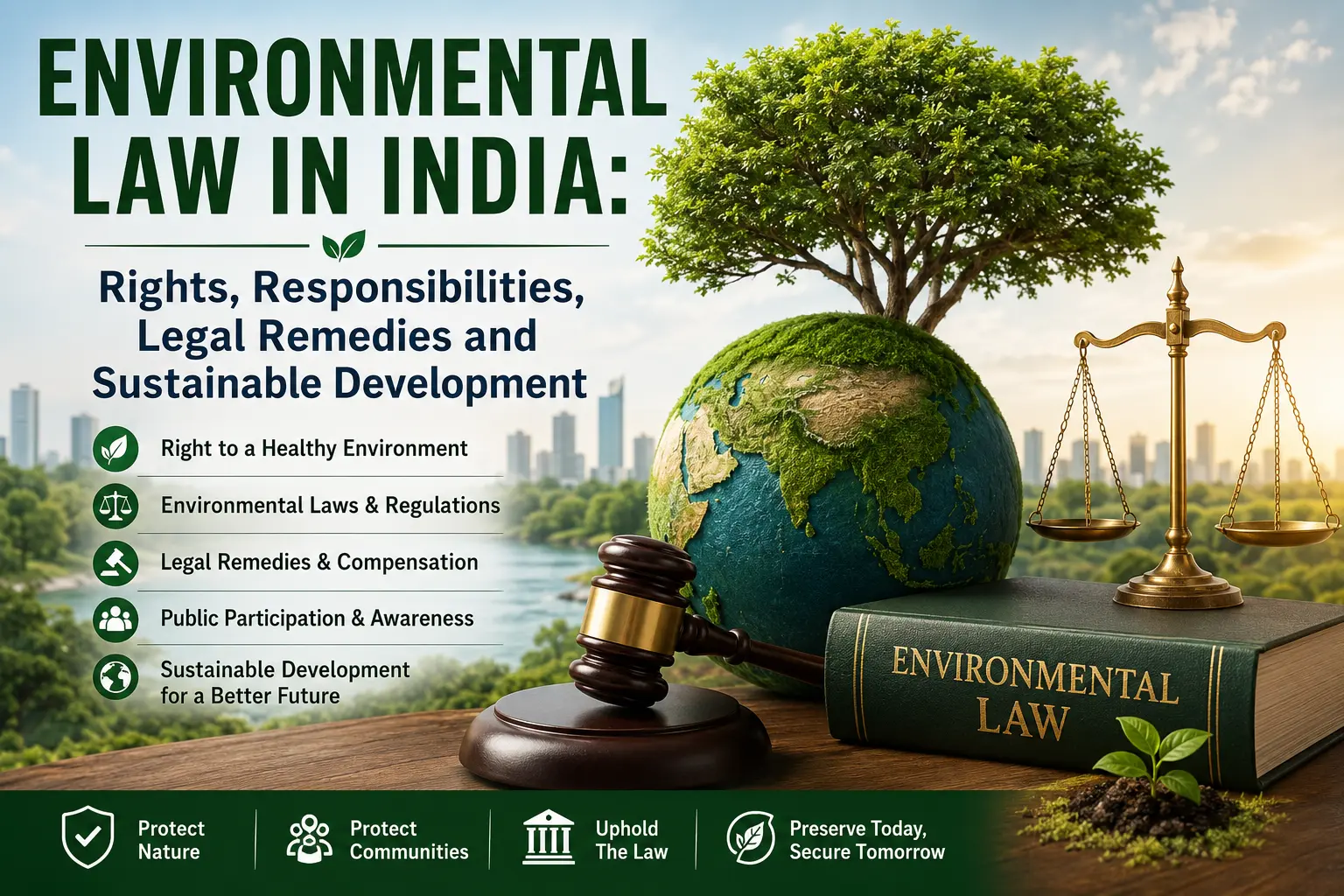
Environmental Law in India: Rights, Responsibilities, Legal Remedies and Sustainable Development
Environmental law today touches lives at every level. It’s not confined to forests, wildlife or large industries. It governs the air we breathe, water delivered to our taps, where we dispose our garbage, construct buildings, run factories, extract natural resources and impact the health of communities.
Increased urbanization, industrial growth and infrastructure development has led to enhanced economic growth and opportunities, but has also resulted in a rise in legal disputes regarding air pollution, groundwater contamination, illegal waste disposal, tree cutting, factory emissions, hazardous materials, construction dust, noise pollution and destruction of ecologically sensitive areas.
Environmental law not only governs development but also seeks to protect the public from health hazards and ecological degradation. It regulates activities that can potentially damage natural resources, establishes liability for pollution and provides remedies to citizens, communities, business owners and government bodies.
DEFINITION OF ENVIRONMENTAL LAW
What does Environmental Law Define?
Environmental law refers to the body of rules, statutes, regulations and judicial decisions that focus on the protection and preservation of the environment. Some specific areas that fall under environmental law include:
Environmental law is both preventative as well as remedial in nature. It works towards preventing pollution by ensuring that prior to any development activity, authorities and companies consider the potential environmental impact, secure necessary clearances and comply with set standards and guidelines. Environmental law also helps in cleaning up the environment by holding polluters accountable and providing compensation to those impacted by pollution.
Constitutional Foundation of Environmental Protection
Environment Protection under The Indian Constitution
The Indian Constitution
Entrusts responsibility for protection of the environment to both the State and citizens.
Article 48A instructs the State to protect and improve the environment. Article 51A(g) places a duty on every citizen of India to protect and improve the natural environment.
Indian courts have also held that the right to life under Article 21 includes the right to healthy environment.
The preamble to India’s National Green Tribunal Act also expressly acknowledges that the judiciary has found the right to healthy environment to be included in the right to life under Article 21 of the Constitution.
Environmental protection is thus a constitutional requirement connected to public health, human dignity and livelihood and not simply an policy preference. There is also a constitutional duty to protect our natural resources.
Environment (Protection) Act, 1986
The Environment (Protection) Act, 1986 is one of the umbrella legislation on environmental protection in India. It was enacted to provide for the protection and improvement of the environment and for matters connected therewith.
Under the Act, the Central Government can take any measures it deems necessary or expedient for protecting and improving environmental quality, preventing environmental pollution, and generally in matters relating to the protection of the environment.
The Central Government can set standards relating to emission or discharge of pollutants, handling of hazardous substances and operation of certain industries.
Directions given under the Act can require regulation or closure of any industry, operation or process. They could also entail stopping or regulating the supply of electricity, water or other services if necessary for enforcing the Act.
Notable rules and notifications under this Act include those on environmental clearances, hazardous waste, solid waste, biomedical waste, plastic waste, construction waste and noise pollution.
Water Pollution/Water Act
The Water (Prevention and Control of Pollution) Act, 1974 was enacted to prevent and control water pollution and maintain or restore the wholesomeness of water. Pollution control boards were also established under this Act and given regulatory and enforcement powers.
A water pollution complaint can relate to any of the following :
The Pollution Control Board has powers of inspection and can examine and sample treatment plants, machinery and water, if they believe standards are not being met.
Factories and commercial establishments may require consent from the State Pollution Control Boards or Central Pollution Control Board prior to establishment or operation. This will depend on the category of operation and the activity they are carrying out.
Scientific evidence can often make or break your case in a water contamination matter. Preservation of lab reports, Board inspection records, photographs, video clips, water samples, medical records and correspondence with official agencies can help establish the cause, extent and impact of water pollution.
Air Pollution and the Air Act
Air pollution is regulated under The Air (Prevention and Control of Pollution) Act, 1981. The statute confers powers and functions upon pollution-control boards regarding air quality, industrial emissions, regulated areas and more.
Examples of air-pollution complaints and legal issues include:
The Central Pollution Control Board was initially established under the Water Act and later given responsibilities under the Air Act. As CPCB turns 52, its main statutory functions include encouraging actions to keep streams and wells clean and air pollution-free by preventing, controlling and abating pollution.
Companies should note that a municipal licence or a commercial registration does not necessarily mean that environmental requirements have been met. Other laws focused on pollution control may require you to obtain additional permissions, consents or authorisations before engaging in certain activities.
Forest Conservation, Wildlife and Biodiversity
Forests, wildlife habitats, protected areas and biodiversity are also protected under environmental laws.
The Van (Sanrakshan Evam Samvardhan) Adhiniyam, 1980 regulates the requisition of forest land and use of forest land for non-forest purposes. For ease, it is commonly known as the Forest Conservation Act. Please note that the title changed when the Act was amended previously.
The Wild Life (Protection) Act, 1972 provides for the protection of wild animals and plants, as well as sanctuaries, national parks and other kinds of protected areas. The statute also allows for the constitution of national and state boards for wildlife and regulates activities that harm wild animals, their habitats and protected areas.
The Biological Diversity Act, 2002 governs access to biological resources and associated traditional knowledge, and helps ensure the conservation and sustainable use of biological resources. The Act was amended and changes came into effect on April 20,24. Parties should review the amended statute if they work with biological resources, intend to conduct research, or wish to commercially utilise biological resources.
Legal disputes can arise from illegal cutting of trees, diversion of forest land, construction of structures next to protected areas, mining operations, destruction of wetlands, damage to wildlife corridors or activities carried out without requisite clearances.
Environmental Impact Assessment and Environmental Clearance
An environmental impact assessment, commonly known as an EIA, is when the likely environmental impacts of a proposed project are assessed prior to authorising the project.
The scope of an EIA can include reviewing the impacts a project can have on air quality, water resources, soil, forests, wildlife, affected communities, traffic, public health and neighbouring land uses. According to India’s Ministry of Environment, Forest and Climate Change (MOEF&CC), “EIA is an important tool to ensure optimum utilisation of natural resources for achieving sustainable development.”
The procedure for obtaining environmental clearance can include:
An environmental clearance should not be viewed as a box-ticking exercise. Violating conditions of an environmental clearance, hiding information during the EIA process or developing a project beyond what was approved are just some actions that can lead to enforcement and lawsuits.
Environmental Laws: Quick Guide
Waste Management & Hazardous Substances
India has rules relating to municipal solid waste, plastic waste management, management of e-waste, biomedical waste, construction and demolition waste, battery waste and hazardous waste, among others.
The Solid Waste Management Rules, 2016 prescribe duties related to segregation, collection, transportation, processing and disposal of solid waste.
Special rules apply to hazardous waste, which can include substances with physical, chemical or toxic characteristics that render them dangerous to human beings and the environment. Hazardous and Other Wastes (Management and Transboundary Movement) Rules control generation, storage, treatment, movement, recycling and disposal of hazardous waste.
Illegal dumping cannot be justified by placing the waste on an open plot or outside the generator’s premises. Generators, occupiers, transporters, recyclers, local bodies and authorised facilities can each face separate legal liability.
Noise Pollution
Noise can be considered pollution under the law. Noise Pollution (Regulation and Control) Rules address sources of noise and set standards for various types of areas and times.
Government officers, District Magistrates, Police Commissioners and other authorities can be tasked with enforcing noise standards. Authorities planning development or regulating buildings must also address noise pollution when granting approval.
Noise complaints commonly involve noise from loudspeakers, industry, generators, banquet halls, construction sites, commercial premises and persistent loud disturbances during the night.
If possible, a person who wants to make a noise complaint should keep detailed records of dates, times, duration, location and type of noise causing the disturbance. A written complaint can be supported with recordings and official measurements of noise levels.
The National Green Tribunal
The National Green Tribunal was formed by an Act of Parliament called the National Green Tribunal Act, 2010. It was created to provide relief in environmental matters in an effective and timely manner. The NGT has jurisdiction over civil cases where a substantial question relating to the environment is raised and the dispute is related to implementation of laws mentioned in Schedule I of the NGT Act.
The NGT can provide :
The Tribunal has judicial and expert members. Proceedings are not fully bound by the Code of Civil Procedure and the NGT can dispense justice in a manner that is consistent with natural justice.
Limitation for filing before the NGT
It is important to raise environmental issues as soon as possible. The limitation period for raising environmental concerns should be considered at the outset.
Under Section 14, an application relating to an environmental dispute generally must be filed within six months from the date which the cause of action arose. The Tribunal may grant an additional period of up to sixty days if the applicant can show sufficient cause for the delay.
Claims under Section 15 for compensation, relief or restitution of the environment generally expire after five years. An additional period of up to sixty days may be granted if sufficient cause is demonstrated.
Certain appeals to the NGT under Section 22 have a thirty day limitation from the date of communication of the order. An additional period of not more than sixty days may be granted. Appeals against the order of NGT lie before the Supreme Court within the statutory period under the NGT Act.
The appropriate limitation period will depend on the type of application, relief sought and the date of the cause of action or communication.
Basics of Environmental Laws
A Guide by LetsVentilate
Key concepts of environmental law
Sustainable Development
Sustainable development allows progress, but that progress should not harm nature’s ability to support life or rob future generations of access to vital resources.
Precautionary Principle
If an activity is causing serious harm to the environment, authorities should not wait for complete scientific proof before intervening. Preventive action should be taken to avoid serious or irreversible damage to nature.
Polluter Pays Principle
Anyone responsible for polluting should be made to compensate those affected and pay for restoring the environment. Levying a fine or paying compensation is not permission to pollute.
Section 20 of NGT Act states that while hearing any matters the Tribunal shall apply these principles of sustainable development, precaution and polluter pays.
The Hon’ble SC has time and again upheld these principles as fundamental tenets of environmental laws in India.
Who can file an environmental complaint?
Environmental laws empower people to approach courts or Tribunals, as well as file complaints with government agencies.
Natural Resources Conservation Foundation
Documents to support an environmental complaint
Trials and Tribulations faced in NGT
Environmental cases rely on both legal documents and scientific records. Keeping good evidence is half the battle.
Evidence may include:
The key facts to establish with evidence are:
Samples of water, soil, air or any other chemicals should be collected for laboratory testing, where possible. This ideally should be through a legal mechanism where a samples is seized by the authority. However, a private report can be useful to establish your claim but an inspection or sampling carried out by an authority will help your case.
What should I do if I find an environmental violation?
Once you come across a violation, record all details about it straightaway.
An affected person can make a note of details including when he first noticed the pollution, details of the activity causing pollution, the areas affected by it, complaints made to local authorities and their response. He should then make a formal complaint to the concerned authority.|
As pollution affects health and natural resources affecting the entire community, a letter should be sent to the concerned agency asking for the following:
If the pollution is ongoing or may cause immediate damage to people’s health, property or natural resources, you may have to file for an urgent relief order. The Court can be asked to direct the authority to inspect the site and order the polluting activity to stop and the environment restored. Compensation or penalty can also be sought to ensure that the agencies perform their duty.
Environmental License compliance for Businesses
Environmental license compliance should be viewed as an ongoing management duty instead of a ‘tick the box’ exercise to be completed when initially obtaining a licence.
Prior to commencing business, identify every permit that applies to the specific operation, raw material used, equipment installed, emissions produced, waste generated and plant location. Each industrial unit may require a combination of environmental clearance, consent to establish, consent to operate, waste authorization, groundwater permission, hazardous-substance compliance or forest and wildlife clearance.
Records should be maintained of:
Actual operations should not exceed the approved production capacity or scope of activity. For example, a permit issued for cement production does not allow for additional machinery to be installed, a different raw material to be used or an expanded manufacturing process to be adopted.
WHAT CAN AN ENVIRONMENTAL LAWYER DO FOR YOU?
When it comes to environmental law, a lawyer can help determine the right forum, identify which statutes have been violated and present technical information in the form of pleadings that can be used as evidence.
This may include assistance with reviewing environmental clearances and consent orders, drafting complaints and counter replies, opposing regulatory decisions, preparing NGT petitions, seeking interim relief, working with technical experts and appearing on behalf of clients during inspections, hearings and appeals.
Representative cases may include residents affected by pollution, business owners facing enforcement actions, project proponents who require guidance on compliance requirements, property owners affected by illegal dumping or groups that want to restore contaminated natural resources.
The strongest environmental cases are usually well-prepared legal documents supported by credible scientific evidence. The court/tribunal needs to be convinced that a problem exists, how it got there, who is responsible, what laws have been broken and what action is required to provide relief.
CONCLUSION
Environmental justice is about more than protecting trees, rivers and wildlife. It is about safeguarding our families’ health, homes and businesses. It protects jobs and the rights of future generations to inherit a clean and safe environment.
A polluted river, illegal dumpsite or chemical emission from a factory should not be considered as a fact of life. Indian environmental law provides a framework for inspection, prevention, closure of illegal operations, compensation claims and restoration of the environment. But time limits apply and enforcement requires scientific evidence and the correct legal remedy.
Legals365 – Advocate BK Singh & Associates assist clients with environmental complaints and regulatory issues before the National Green Tribunal, courts, pollution-control boards and other authorities. We have helped residents, institutions, businesses and affected groups with drafting of environmental complaints, replies, legal documentation, filing of interim relief applications and litigation.
This article is for informational purposes only and should not be relied upon as legal advice. Please contact the firm for a legal consultation. The correct legal remedy will depend on the facts, relevant statutes, limitation period and venue in which the complaint is filed.