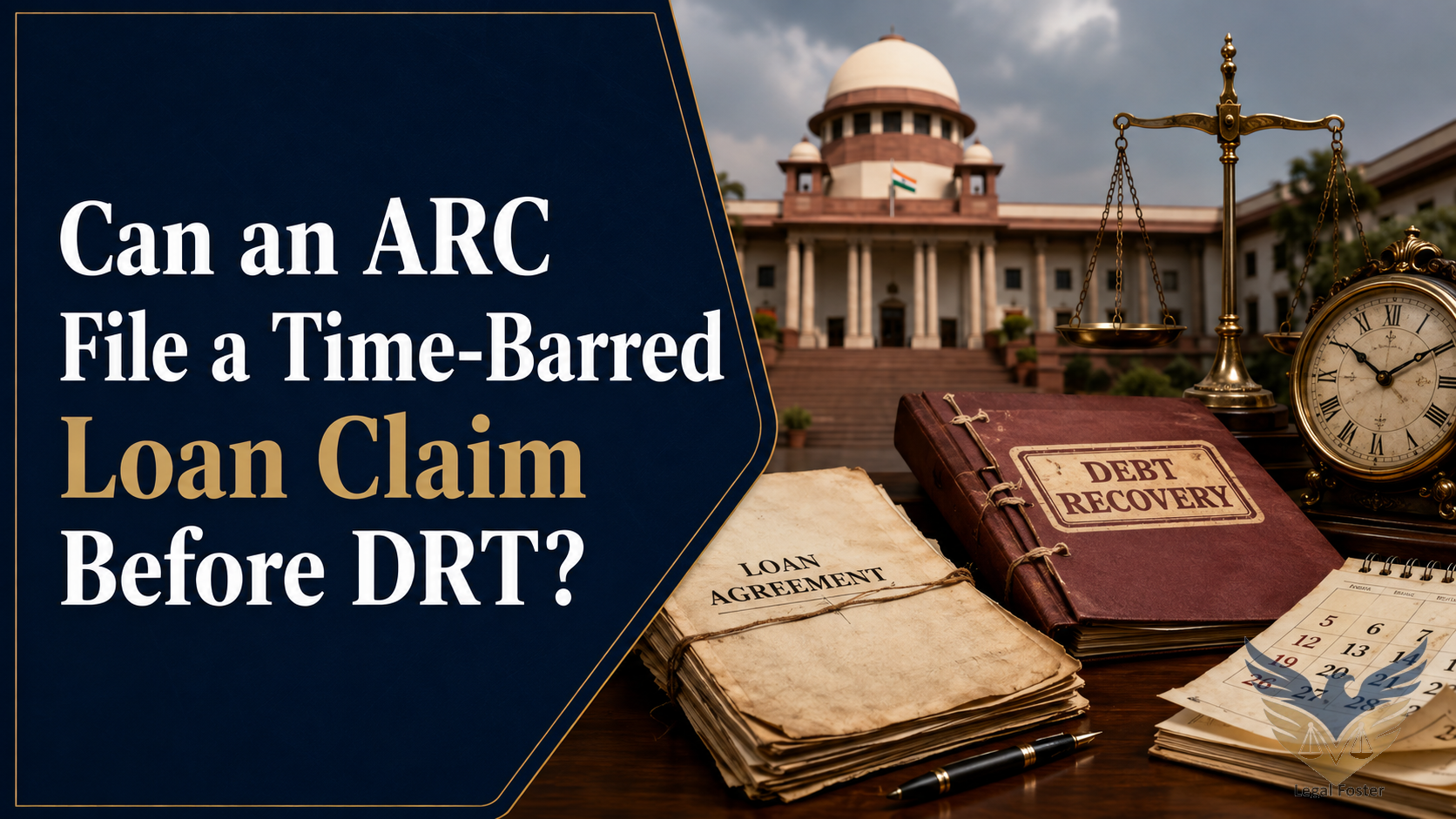
Can an ARC File a DRT Case for a Time-Barred Loan Claim?
A borrower has been served with a recovery application by an ARC. It has been years since his bank account was declared irregular. The loan was sold through an assignment deed, interest has been charged on the outstandings and now the ARC wants its dues. The matter is still before DRT. The natural question that comes to mind is: Can ARC spring back a time barred loan before DRT just by purchasing the debt?
Ans: Not ordinarily. All that an assignment does is transfer the lender’s existing rights to the ARC; it does not start a new limitation period or revive an otherwise time barred claim. An ARC generally steps into the shoes of the assignor bank and purchases the financial asset subject to the same legal limitations, defences and documentary infirmities.
However, the answer could change if there is: (i) a valid acknowledgment or part payment (which qualifies as a) written revival of the loan; (ii) a written revival document; (iii) an existing mortgage, decree, recovery certificate or other legally relevant act impacting limitation. Dates matter. So do specific words.
Borrowers tend to think that an old loan automatically becomes unenforceable after three years. Banks and ARCs sometimes think precisely the opposite and treat assignment as creating a new cause of action. Both are incorrect. Limitation will depend on the nature of the relief sought, the underlying security (if any), repayment terms, the history of defaults and any subsequent acknowledgments or part payments.
Did the borrower sign statements acknowledging the balance while undergoing restructuring talks? Is there an acknowledgment in the financial statements of the company? Did the borrower make a part payment anytime before the currently running period of limitation? On the flip side, while internal bank entries or the later date of an assignment deed might restart the clock for purposes of limitation between bank and ARC, such acts generally do not extend time in favour of the bank against the borrower.
BK Singh Advocate goes through loan documents, dates of default, bank’s recall notices, acknowledgments by the borrower and assignments before advising his clients whether an objection on limitation is tenable. Lawyer at DRT also highlights the difference between a typical money recovery suit versus enforcement of mortgage, decree or recovery certificate because Limitation Act, 1963 may not apply in the same manner to both.
Why Does an ARC Limitation Dispute Matter Across India in 2026?
ARC Limitation Defenses Matter because a otherwise time barred claim can create enormous amount of practical stress. Despite the age of the loan, DRT / SARFAESI notice of possession / auction can be served on the borrower. Non compliance of the notice may result in a potentially strong defence being lost at the onset.
Assignment receivables typically involve accounts pulled from multiple cities. There are many possibilities. A loan could be disbursed in Delhi against a property in Noida to a borrower based in Gurugram and assigned to ARC office in Mumbai. I have handled ARC matters from Ghaziabad, Faridabad, Jaipur, Chandigarh, Pune, Bengaluru, Hyderabad, Chennai, Kolkata and Ahmedabad to name a few.
Old files have peculiar challenges. People change. Email ids get updated. It is difficult to find original statements. It is even more difficult to expect borrowers to remember if they signed any balance confirmation / settlement request or loan modification ages ago.
Higher stakes are involved when the debt is against a family home, factory or shop. Sometimes borrowers make token payments or are scared into signing settlement agreements without understanding the contents if those documents contain an acknowledgment or new promise to pay. In the meantime ARC may simply rely on the face value of documents assigned to them by the bank, which in turn may not have been aware of the ground realities.
The best DRT Lawyers look at limitation from a practical document & date perspective instead of a memorized catchphrase. Because a debt is old, the DRT will not throw out the case. Similarly, limitation cannot be defeated by simply assigning the debt to a third party. BK Singh Advocate can guide you if the timeline of events as mentioned by ARC establishes an enforceable claim or a abuse of right after limitation.
Quick Facts About ARC and DRT Limitation
An assignment deed will pass existing rights. It does not revive
limitation against the borrower.
S. 24 Recovery of Debts and Bankruptcy Act. Extends Limitation Act, 1963
to suits brought before the DRT.
Section 18. For purposes of revival, an acknowledgment must be in
writing and ordinarily made before expiration of the current limitation
period.
Similarly, the part payment referred to in Section 19 must be made
before expiry and must also meet the statutory requirements.
S. 36 SARFAESI Act prevents the secured-creditor from enforcing his
remedies if the underlying claim is time barred.
However, a mortgage nuanced claim may not be analyzed in the same way as
a simple money claim against an unsecured debtor.
What happens if there is a decree, recovery certificate, written promise
to pay or an unqualified acknowledgment.
The principles above are incorporated in RDB Act 1993, the Limitation
Act, 1963 and the SARFAESI Act 2002.
Can Assignment to an ARC Start a Fresh Limitation Period?
Generally, assignment alone cannot revitalize an already time barred claim. ARC can step into shoes no more than what bank had enforceable at the time of assignment.
ARC is entitled under Section 5 of SARFAESI Act to acquire financial assets from bank / financial institution. After acquisition ARC can exercise certain rights as secured creditor. But SARFAESI Act does not have any miraculous transfer mechanism to supersede Limitation Act or create ipso facto fresh acknowledgement of borrower.
Assignment deed is executed between bank and ARC. Borrower is no party to this deed. So ordinarily, deed itself cannot become acknowledgement of borrower under Section 18 merely because it specifies the outstanding amount due.
Similarly will be the case with internal account statements. Neither bank nor ARC can stave off limitation against borrower by mere continuation of debt in its internal books with or without addition of interest or alteration in loan- account number.
According to DRT Lawyer, the distinction therefore is that acquisition merely changes the person to whom the original cause of action accrued and not the date on which it accrued. For a deeper insight into this subject borrowers can visit ARC can revive time barred loan claim before DRT.
When Should a Borrower Consult a DRT Lawyer?
Speak to a lawyer sooner rather than later. Although the limitation
defence may be obvious to you after you get an ARC demand, DRT summons,
possession notice or auction notice , get legal advice based on the
facts of your specific case as soon as possible. Procedural delays can
put you at risk even if you believe the underlying limitation defence is
sound.
Particularly contact a lawyer if:
The Original Application was filed more than three years from the
date the loan became due.
ARC's main recent document is an assignment deed.
Your customer allegedly signed some balance confirmations, but ARC does
not produce them.
Your customer made some part payments as shown in the statement but he
denies giving them.
There have been earlier withdrawn, dismissed or transferred
proceedings.
The account was assigned twice or more.
Your customer applied for OTS after the limitation period.
Notice of possession or auction was already served.
There is a decree/recovery certificate from earlier proceedings.
Responding to a claim can be beneficial. Don't sit on a DRT notice hoping that a time barred claim will be rejected automatically. Limitation is often a legal issue that must be specifically pleaded along with facts that support your position.
Likewise, customers shouldn't feel pressured to sign a new compromise letter to get harassing phone calls to stop. The wording can have legal implications. DRT Lawyer can review the terms of any compromise and ensure they are acceptable to you before you sign. BK Singh Advocate will also advise if the letter appears to acknowledge a debt that already existed (which could reset the limitation period) or whether it would constitute a fresh promise.
How Can a DRT Lawyer Help?
It is possible to analyze whether ARC’s Original Application or SARFAESI proceeding is time barred by limitation by preparing chronology of transaction and reviewing documents that both parties will rely on.
Loan agreement, default / recall notice, NPAipping, mortgage, guarantee, confirmation of balance, payment entries, assignment and previous proceedings will be some of the documents analyzed. The legal counsel is then tailored to actual forum and remedy pursued.
BK Singh Advocate can determine whether ARC has taken cognizance of legitimate acknowledgment or mere date of its purchase. If negotiations are on, pointed documents can be vetted for its language before giving away more rights.
A debtor threatened with sale of his secured property can personally research upon legal validity of bank auction stay. If business compromise is an option, information on OTS in DRT proceeding would be relevant.
No DRT Lawyer will promise you that a prospective ARC claim will be stopped. Limitation depends on facts and circumstances of individual case i.e. when did cause of action arise, what type of security was created, any acknowledgments, any payments made and any previous adjudication.
Frequently Asked Questions
1) Does selling of loan to an ARC restart limitation?
Ans: No. Assignment does not normally revive the bank’original cause of action against the borrower. It only transfers the bank’rights as they stand against the ARC. Separate acknowledgment, qualifying payment or enforceable written promise would be needed to impact limitation, but not the date of assignment.
2) Can ARC file Original Application before DRT?
Ans: ARC, who has validly purchased a financial asset, can exercise any recovery rights that were available to the assignor including filing of Original Application where statutory preconditions are met. Whether ARC has any standing can be considered by DRT Lawyer along with aspects of assignment documents, pecuniary jurisdiction and limitation on its own merits.
3) Does limitation start from the date of NPA?
Ans: No. Date of NPA is relevant factor to consider but does not automatically apply to all claims. Terms of loan, instalment wise default, recall, demand and notice, acknowledgment, mortgage and nature of relief claimed are other factors that can impact limitation. Chronology can be prepared on your documents by BK Singh Advocate.
4) Can balance/Collection confirmation extend limitation?
Ans: Balance/Collection confirmation when signed can amount to acknowledgment if it admits to subsisting liability and was signed when the current limitation period was still running. Contents, date of signature and authority of signatory would need to be verified by DRT Lawyer.
5) Can an acknowledgment revive the limitation period after it has expired?
Ans: No. Standard acknowledgment under Section 18 operates prospectively. Signed promise to pay simply does not revive an already expired period of limitation. Any promise to pay a time barred debt, if made properly worded and signed, could open up a whole new question under Section 25(3) of Contract Act which DRT Lawyer can advise on.
6) Does mortgage debt get barred after 3 years as well?
Ans: Not necessarily. Enforcement of a mortgage debt or money secured by a charge on immovable property could invoke a different period of limitation. DRT Lawyer would first have to analyze if the relief being claimed under the mortgage deed is truly for the enforcement of mortgage and if the mortgage/charge/security itself is still valid.
7) Can ARC exercise SARFAESI after limitation period is over?
Ans: Section 13(4) of SARFAESI Act is prevented by Section 36 from being invoked if the claim is time barred. ARC can still rely on any acknowledgments, payments or specific mortgage rights it has to prove that the account is indeed still outstanding.
8) Does part payment of loan restart limitation?
Ans: No. Part payment would typically need to have been made before the existing limitation period had expired and would still need to fulfill all the requirements of Section 19. DRT Lawyer would have to verify who made the payment, when was payment made, how much was paid and whether it was supported by an acknowledgment.
9) What should a borrower do if he gets a demand notice from an old ARC?
Ans: Some old demand can precede actions before DRT or even filing under SARFAESI. So do not disregard such notices altogether. Preserve the envelope with postmark, notice received, account statement showing what balance is being claimed and take all previous loan documents received to BK Singh Advocate at the earliest.
10) Can disputed claims from ARC’s that are time barred be settled?
Ans: Yes. However parties are free to settle their disputes and DRT Lawyer can help review the wording of any settlement document to ensure that it does not inadvertently admit liability, create a new enforceable promise, waive any objections or specifically states that the account will be closed once payment is received.
Final Thoughts
ARC can’nt resurrect a time barred loan claim before DRT by merely purchasing it from bank. Assignment only transfers the claim from one creditor to another. It does not change the status quo as regards limitation in retrospect. However, if there has been any valid acknowledgement, part payment, written promise to pay, mortgage, decree or recovery certificate then the result may be different.
Debtors should not presume that age of account is in their favor. Create timeline, preserve all documents and carefully read the relief sought. Get document centric advice on ARC recoveries and limitation from DRT Lawyer. You can speak to BK Singh Advocate before DRT reply date, settlement or SARFAESI deadline.
Author Bio
BK Singh Advocate is one of the advocate from DRT Lawyer . He drafts borrower,guarantor,company /proprietor submission before DRT,DRAT as well as handles SARFAESI and ARC recovery cases. He has expertise in studying loan agreement,mortgage deeds,assignment notes,account ledgers,receipts,acknowledgements,possession notices,auction notices. BK Singh Advocate has fought many cases for clients across Delhi NCR and other business hubs in India regarding issues such as filing of limitation pleas,filing of reliefs available from tribunal and effects of compromise agreement. He will provide you the legal counsel as per the statute which is relevant to the facts and timeline of documents related to the matter. No instant dismissal or any kind of stay order /compromise or any legal matter can be guaranteed.