Supreme Court Upholds NCTE Authority to Seek Performance Appraisal Reports From Teacher Training Institutes
SC Upholds NCTE Mandate Asking TEIs To Submit Annual Performance Reports
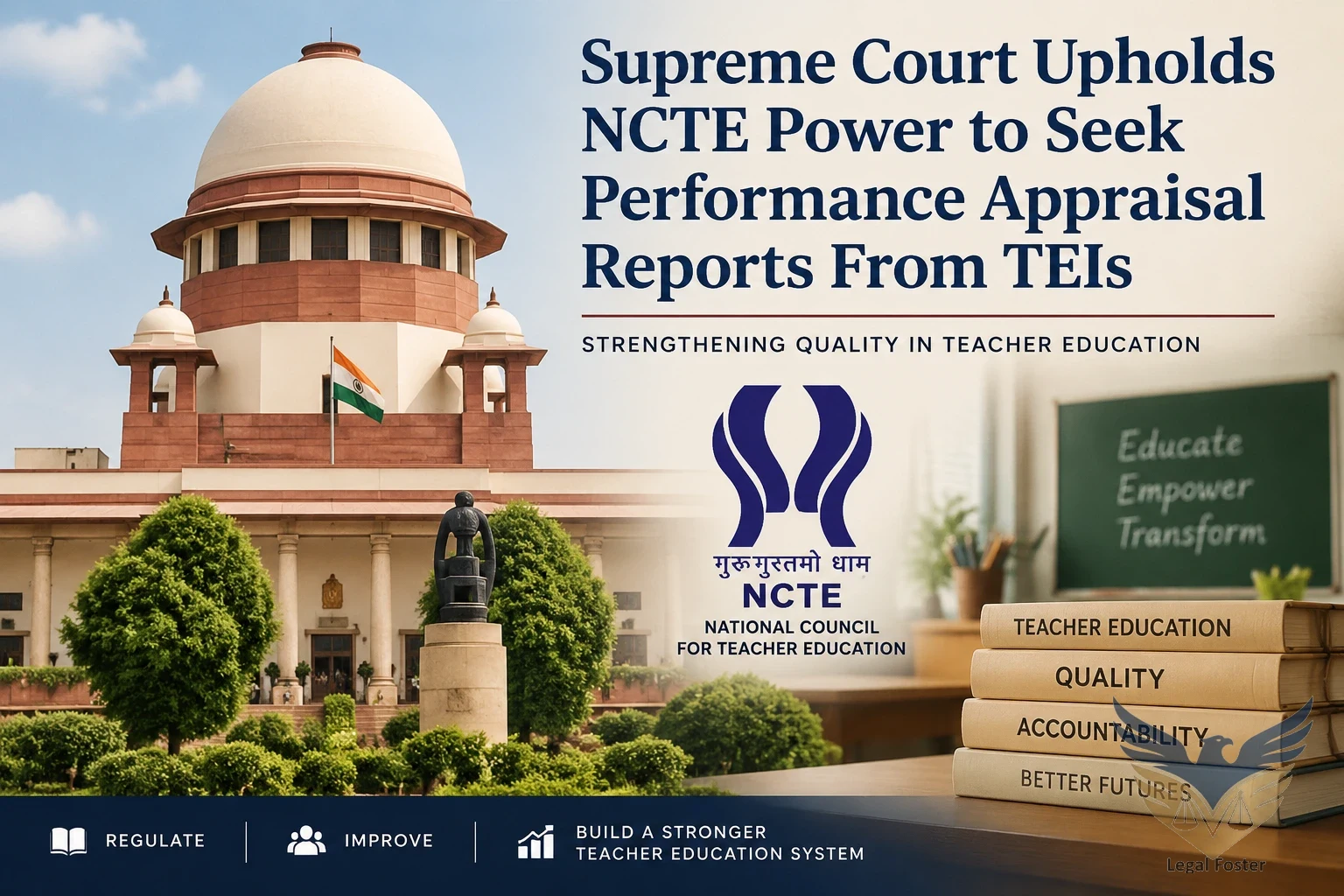
The Supreme Court has ruled in favour of the National Council for Teacher Education’s (NCTE) requirement for Teacher Education Institutes (TEIs) to submit annual performance reports.
A Bench of Justices PS Narasimha and Justice Alok Aradhe gave the order on an appeal filed by NCTE against the Delhi High Court judgment which in 20 23 had set aside a notice issued in 2019 by it asking TEIs to submit Performance Appraisal Reports (PARs).
The HC had upheld the TEIs’ argument that the requirement of filing PARs could not have been framed by NCTE’s executive committee alone without the approval of NCTE’s general body.
The top court found that NCTE’s general body had at its 48th meeting decided to do away with the earlier mechanism of submission of “Annual Renewal of Recognition” and instead introduce PAR, thereby empowering NCTE to implement it by way of a proforma which it itself may design.
“The executive committee was only carrying out the mandate given to it by the general body when the impugned notice was issued. We are at a loss to understand as to how the appellants (NCTE) can be restrained from calling upon TEIs to file PARs,” the bench said.
“We fail to understand as to how a regulatory measure of a statutory body, empowered to achieve planned and coordinated development of the teacher education system in the country, could be restrained from calling upon the TEIs to file a Performance Appraisal Report,” the bench added.
On September 22, 2019, the member secretary of NCTE’s executive committee had issued a public notice asking TEIs to upload PAR in its web portal and warned of initiating action if the condition was not complied with.
Delivering the verdict on September 3, the apex Court said that the power for a regulator to initiate such a measure need not necessarily come from the statute alone.
“Even without an express empowerment under the statute, such a regulatory measure can always be incidental and ancillary to the functions of a regulator,” it said.
The Court said TEIs and even NCTE itself would have to be seen as “duty bearers” as the sixth and seventh category along with government, local authorities, schools, parents and teachers under the right to education edifice.
“The TEIs have duties cast upon them under the Act and the Regulations made thereunder. In terms of the right to education framework, TEIs and even the appellant NCTE itself must be recognised as duty bearers as the sixth and seventh category of the duty bearers identified above, that is, after the government, local authority, school, parents and teachers,” it said.
“We have no hesitation in declaring that the duties to be performed by the Council and the bodies that are constituted along with it, such as the Executive Committee and the Regional Committees, are perhaps the highest of all the duty bearers,” the top court ruled.
The apex court further cautioned against judicial intervention in the working of regulators.
“The practice of courts, more particularly Constitutional courts, has to be to ensure that authorities, more particularly, the regulators do exercise their powers effectively, efficiently and in an accountable manner. In this context, Courts cannot adopt a technical or a pedantic view of the action taken by the regulators,” the bench noted.