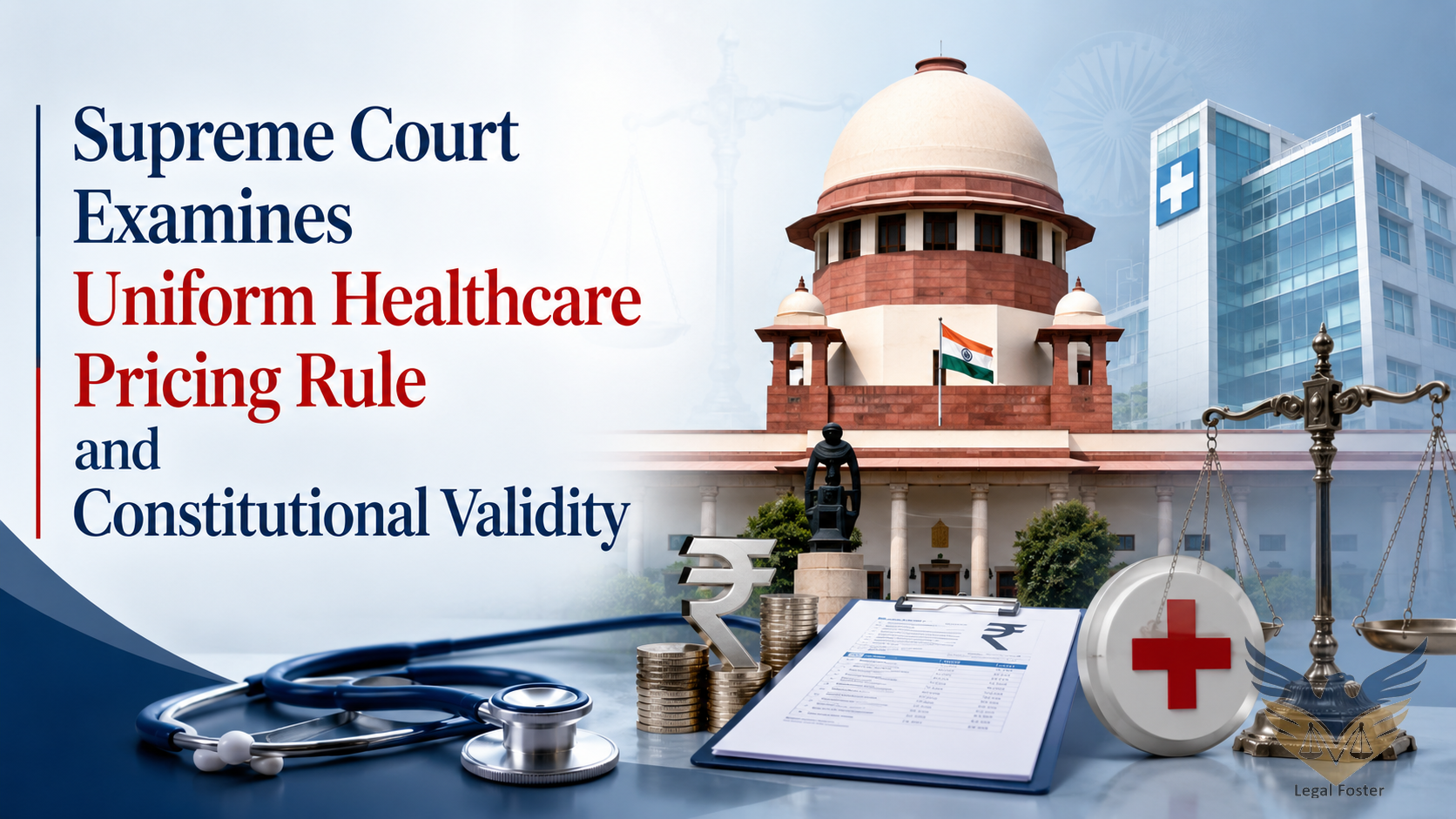
Supreme Court Told Uniform Healthcare Pricing Rule Is Constitutionally Valid
The Centre has defended the rule requiring hospitals to charge medical procedures within a government-determined range, while acknowledging that States have not yet agreed on what those rates should be.
- The Centre defended Rule 9(II) against challenges based on Articles 14, 19 and 21 of the Constitution.
- Hospitals would remain free to determine charges within the range eventually prescribed by the government.
- States have so far failed to arrive at a consensus on a concrete range of healthcare rates.
- The Centre says the rule is presently only on paper because the applicable rate range has not yet been finalised.
In a recent affidavit filed before the Supreme Court, the Centre defended its rule requiring hospitals to charge medical procedures within a government-determined range of rates.
At the same time, the government acknowledged that States have been unable to reach an agreement on what the proposed range of rates should actually be.
Challenge to Rule 9(II) Before the Supreme Court
The submission was made in a counter affidavit filed by the Union Ministry of Health and Family Welfare in response to a petition by the All India Ophthalmological Society.
The Society has challenged Rule 9(II) of the Clinical Establishments (Central Government) Rules, 2012. The provision requires clinical establishments to fix charges within a range determined by the Central Government after consultation with the States.
The petitioners had earlier raised concerns about the practicality of having comparable pricing standards for medical specialists working in metropolitan areas, tier-2 and tier-3 cities, and rural regions.
Centre Relies on Public Health Obligations
In its affidavit, the Centre justified Rule 9(II) by referring to the State's obligation under Article 47 of the Constitution to improve public health.
The government also stated that private healthcare in India had historically remained substantially unregulated in relation to pricing before the introduction of the Clinical Establishments Act, 2010.
Centre Rejects Article 14 Challenge
The petitioner has argued that the pricing rule violates Article 14 by treating healthcare establishments and patients in different economic and geographical circumstances in the same manner.
Responding to this argument, the Centre said hospitals would still have flexibility because they could determine their charges at any point within the prescribed range rather than being subjected to one single mandatory rate.
Right to Profession Under Article 19(1)(g)
The challenge also alleges that the provision interferes with the right to practise a profession or carry on a trade, occupation or business under Article 19(1)(g) of the Constitution.
The Centre rejected this contention and argued that medicine carries an inherent public interest dimension. Consequently, reasonable restrictions regulating medical practice may be protected by Article 19(6).
Healthcare Pricing and Article 21
On Article 21, the Centre argued that implementation of Rule 9(II) could advance the right to health by preventing completely unregulated medical pricing.
According to the government, greater pricing predictability may also benefit patients and insurers by creating more certainty regarding the cost of medical procedures.
States Unable to Agree on Uniform Rate Range
The affidavit stated that States have been consulted on the issue since March 2024 but have not proposed any concrete nationwide range of rates.
According to the Centre, States have raised concerns about major regional variations in healthcare requirements and operating conditions.
Another concern is that the quality of healthcare could potentially be affected if hospitals are prevented from charging rates that reflect local market conditions, infrastructure expenses and service quality.
Different Healthcare Regulation Across States
According to the affidavit, the Central legislation has been adopted by nineteen States and Union Territories, while another seventeen States have their own laws regulating clinical establishments.
The Centre stated that those State-level laws do not provide for standardisation of healthcare costs, although several States require hospitals and clinical establishments to publicly display the rates charged for medical services.
Government Points to Ayushman Bharat
The affidavit also referred to government healthcare schemes, including Ayushman Bharat, as measures aimed at improving the affordability of healthcare services.
It stated that out-of-pocket expenditure on healthcare declined from 62.6 percent in 2014-15 to 43.4 percent in 2022-23.
Centre Opposes Stalling of Rule 9(II)
The Centre maintained that the petitioner society should not be permitted to stall the operation of Rule 9(II) merely because the State governments have been unable to reach a consensus on the applicable range of healthcare charges.
According to the government, States have already been provided sufficient opportunity to participate in consultations over the proposed pricing framework.
The dispute therefore places before the Supreme Court wider questions involving healthcare affordability, regulatory control, professional freedom and the constitutional obligation of the State to protect public health.