Supreme Court Says Children Have Fundamental Right to Internet Access Despite Online Safety Concerns
“The safety of our children and their freedom are not two rights at odds with each other. Our children are entitled to both,” the Court said.
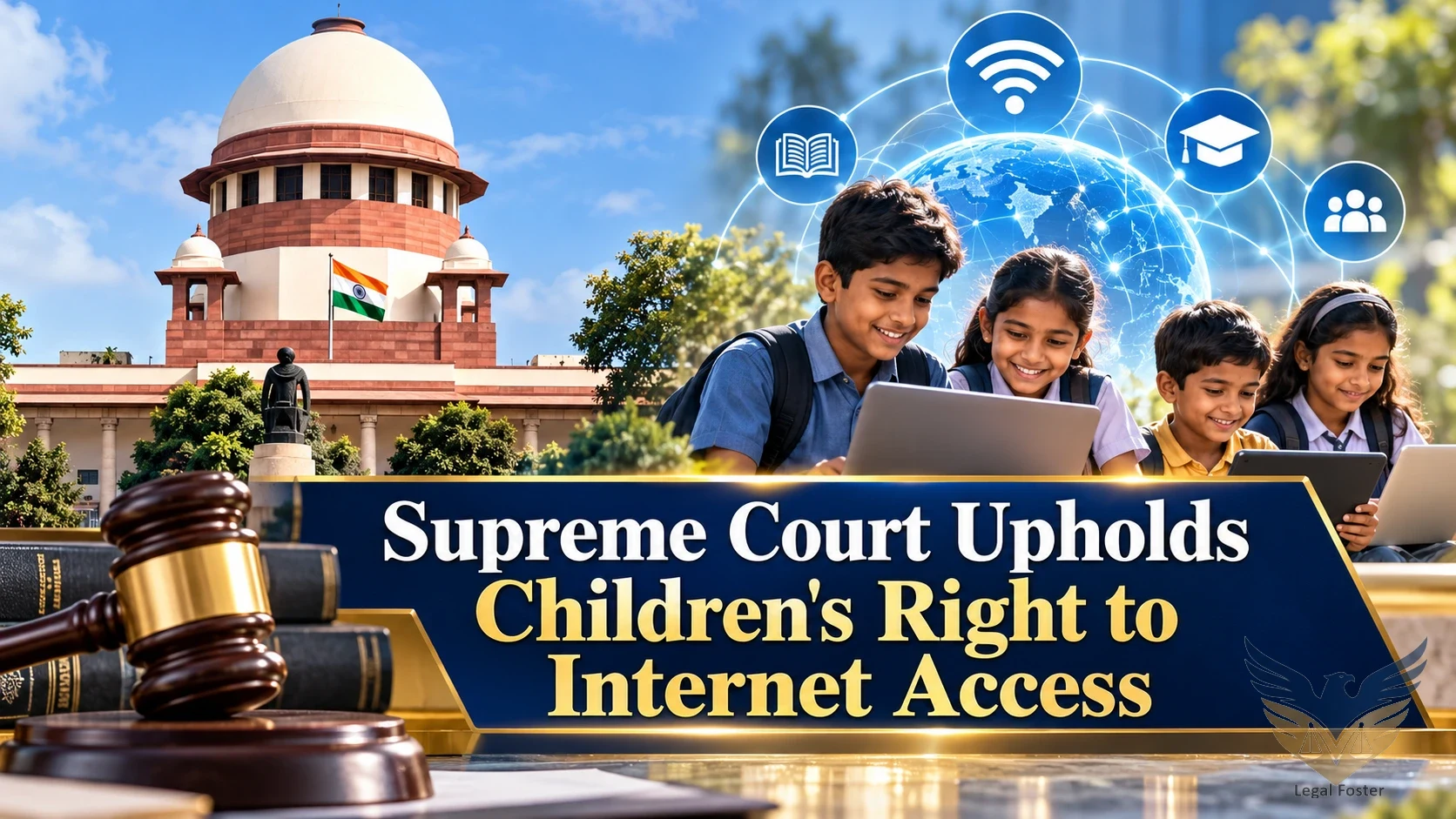
In the order, the Supreme Court also observed that children have a fundamental right to access and use the internet.
A Bench of Justices JB Pardiwala and K Vinod Chandran passed the order while issuing detailed directions to detect and take down child sexual exploitation and abuse material (CSEAM) from online platforms.
Internet access available as a fundamental right under Article 21 read with Article 19(1)(a) of the Constitution is available to children too.
“We have no hesitation in saying that the right to access and use the internet is a fundamental right of every individual under Article 21 read with Article 19(1)(a) of the Constitution. Our children, irrespective of their age enjoy the same rights, and to deny the same altogether would be as absurd as saying children below a certain age do not have a conscience worth protecting or a freedom of speech worth expressing.…” the Court said in its order passed on Friday (15 October).
Supreme Court says the right to access and use the internet is a fundamental right of children too
The Supreme Court reasoned that while children must be protected from harm online, any measures taken to ensure their safety must focus only on harmful content and those who perpetrate it, rather than punishing or restricting children themselves.
“In cases of CSEAM, perpetrators are those who create, disseminate, sell or solicit such material, as also intermediaries that fail to detect and remove it. To keep the child away from the internet on account of such failures would be to mistake the victim for the problem.…” the Bench said.
While clarifying that it was not endorsing unfettered access for children to all material on the internet, the Court listed several possible safeguards that could be proportionately employed. These include parental controls, a dedicated child mode for social media accounts and restrictions on material intrinsically harmful to children.
The order was passed on a plea by NGO Just Rights for Children Alliance seeking continued monitoring of intermediaries’ efforts to tackle online child sexual exploitation material following the Court’s judgment on September 2024.
While issuing directions on Friday, the Bench said it was concerned to note that despite more than two years passing since it issued directions in its earlier judgment, there appeared to have been “no progress worth the name.”
It said reports brought to its attention in the meantime alleged that such material was being paid promoted through redirect links and standalone websites.
The Bench thus issued the following directions:
Guidelines for detection and removal of CSEAM
The Court directed the Centre to file an affidavit listing the technological solutions used by intermediaries to detect and remove material containing child sexual abuse.
It also ordered the government to frame guidelines for all significant social media intermediaries regarding use of hash-matching and URL listing technologies to identify and take down CSEAM.
National database to identify and remove verified CSEAM:
The Court directed the Centre to create a National Hash & URL List Database that is used solely for the detection and removal of CSEAM from online platforms.
It said such material must undergo at least two levels of verification before being added, with the final assessment made independently by a minimum of three trained human analysts. Hash identifiers and/or URL links of material confirmed as CSEAM will then be entered into the database. Platforms will be required to disable and immediately take down content that matches an existing hash or URL, without verification at their end.
Reporting and grievance redressal:
A number of directions were laid down by the Bench in relation to the reporting and grievance redressal infrastructure for dealing with complaints regarding CSEAM.
The Bench required platforms to display the details of grievance officers prominently on their sites/applications and ensure that reporting is available within a maximum of two clicks or steps.
It added trained grievance officers must make the final decision in every complaint, though automated tools can be used to assist in initial screening. Platforms were directed to place in place systems to track and report the actions taken against specific complaints to the reporting agency.
The Bench also asked the Centre to consider imposing exemplary fines on default by intermediaries in relation to obligations regarding CSEAM, based on the nature and gravity of failure and the size and turnover of the company.
Content being sold through paywalls or subscription must be subject to stricter scrutiny. The Bench ordered safeguards to be put in place such that children cannot access sexual content that is intrinsically harmful. Where material identified as CSEAM or otherwise banned for minors is sold through such arrangements, the revenue generated must be forfeited and disgorged.
Digital safety and sex education in schools :
Children must receive age-appropriate digital safety and sex education as part of their schooling, the Bench said while listing out topics for NCERT and SCERTs to cover in consultation with experts. Students should learn about consent, distinguishing between safe and unsafe touch, and ways to recognise and report sexual abuse or exploitation online. Children should not face reprimand from parents or teachers for making such complaints, the Court added.
The Bench further directed training of teachers and conducting regular workshops and awareness programmes for parents. Platforms must provide free counselling and psychological support to victims as long as is needed.
The Centre will take all steps for implementation of these orders and file a report before the next hearing on December 10.
Solicitor General (SG) Tushar Mehta appeared for the Centre while Advocate Rajat George appeared for NGO Just Rights for Children Alliance.