Supreme Court Questions Centre Over Rising Acid Attacks, Says Guidelines to Restrict Sales Have Failed
“If the number of incidents is increasing, it means the policy has failed,” the Court said.
Guidelines Fail: SC Says Centre Over Continuing Incidents Of Acid Attacks
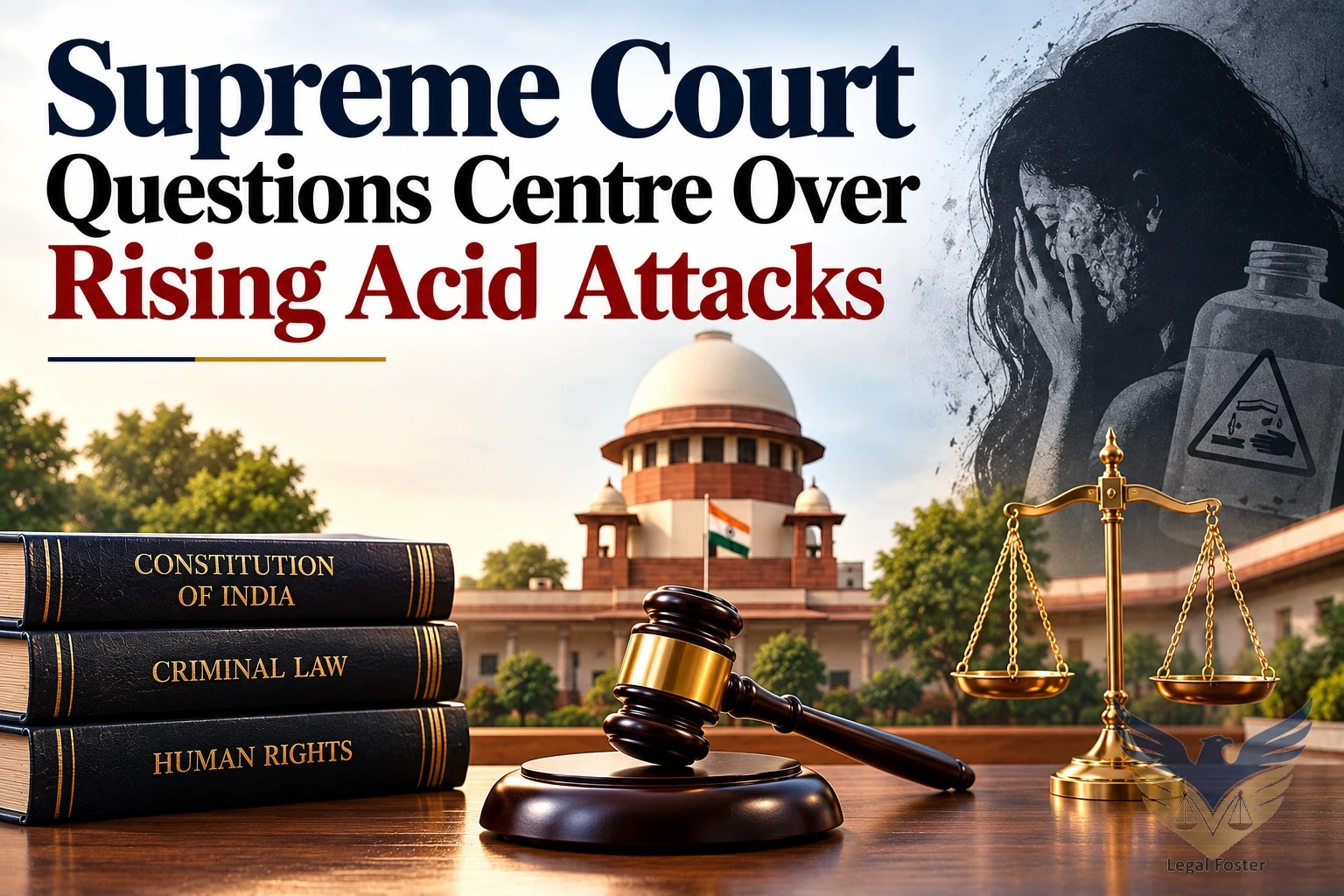
The Supreme Court severely criticised the Central government on Tuesday over the unabated incidents of acid attacks across the country and said its guidelines issued to States to check illegal sale of acid had failed.
A bench of Chief Justice of India (CJI) Surya Kant, Justice Joymalya Bagchi and Justice V Mohana which was hearing pleas related to rehabilitation of acid attack survivors and regulation of acid sale came down heavily on the Centre.
“Despite your guidelines, unfortunate incidents are happening. In fact, these incidents are increasing. That means something is wrong. Your guidelines have not served the object for which they were framed. That itself is reason enough to revisit them,” CJI Kant told Additional Solicitor General (ASG) Aishwarya Bhati, appearing for the Union government.
The bench said guidelines would not help tackle the problem unless proper enforcement accountability is fixed on officers concerned.
“You cannot say we have issued guidelines and remain happy and satisfied,” the CJI said.
Kant asked if the Central government had asked States for their explanations and fixed responsibility and accountability on officers and enforcement agencies. “Merely passing circulars… in very good words, compassionate and passionate language…will not help,” the CJI said.
The Court added that it understood that India follows the federal structure in which law and order is primarily a State subject. But the Centre should make sure that States followed its guidelines,
“We understand your limitations and federal structure. You may not like to take over that responsibility because law and order is a State subject. But at the same time saying States remember your responsibility, and see my guidelines are implemented…that on your part is also required,” he said.
Justice Bagchi also asked the rationale for acid being sold over the counter at all.
“There are several substitutes available today and at very cheap rates. Why should acid be available over the counter in the market?” he asked and added that Bangladesh has a very strong law dealing with the issue.
The bench noted that purchases by industrial units are generally wholesale transactions and would be on a different footing altogether.
“It would be better if you identify the purposes for which retail sale was originally allowed. Then, you form a committee of experts and examine whether substitutes are available,” the Court said, adding that wherever acid was indispensable, there could be a strictly regulated mechanism.
Last week, the Union government had been asked to file an affidavit indicating its stand on the plea that sale of acid be banned over the counter.
Pressing for time-bound directions on the issue, the petitioners today clarified that they were not opposing legitimate industrial use of acid.
ASG Archana Pathak Dave informed the Court that detailed guidelines had already been sent out to States, which have framed rules.
However, she added, the problem lay in implementation of the guidelines and that was “extremely weak”.
She further said the Centre would take instructions as to either a complete ban should be imposed or stricter regulations like record of purchasers being maintained, sales permitted only at wholesale outlets etc.
The Court then sought the trend of acid attacks as to whether there had been any increase over the years.
“If number of incidents are increasing, it means policy has failed,” he said.
Directing that survivor-centric rehabilitation scheme placed on record by an intervenor NGO be given to National Legal Services Authority (NALSA) for consideration, the bench said NALSA and the Union government will invite suggestions from stakeholders, including acid attack survivors.
It further urged the authorities to consider allowing an acid attack survivor, who is undergoing treatment at Sir Ganga Ram Hospital, to shift to a private room so that her mother could be with her. “We have to walk that extra mile,” the Court said.
The matter will be next heard in two weeks.