Supreme Court Petition Raises Concerns Over Lack of Accessible Housing for Persons with Disabilities
The PIL asks for directions to make it mandatory for residential buildings to conform to accessibility requirements before occupation certificates and building permissions are granted.
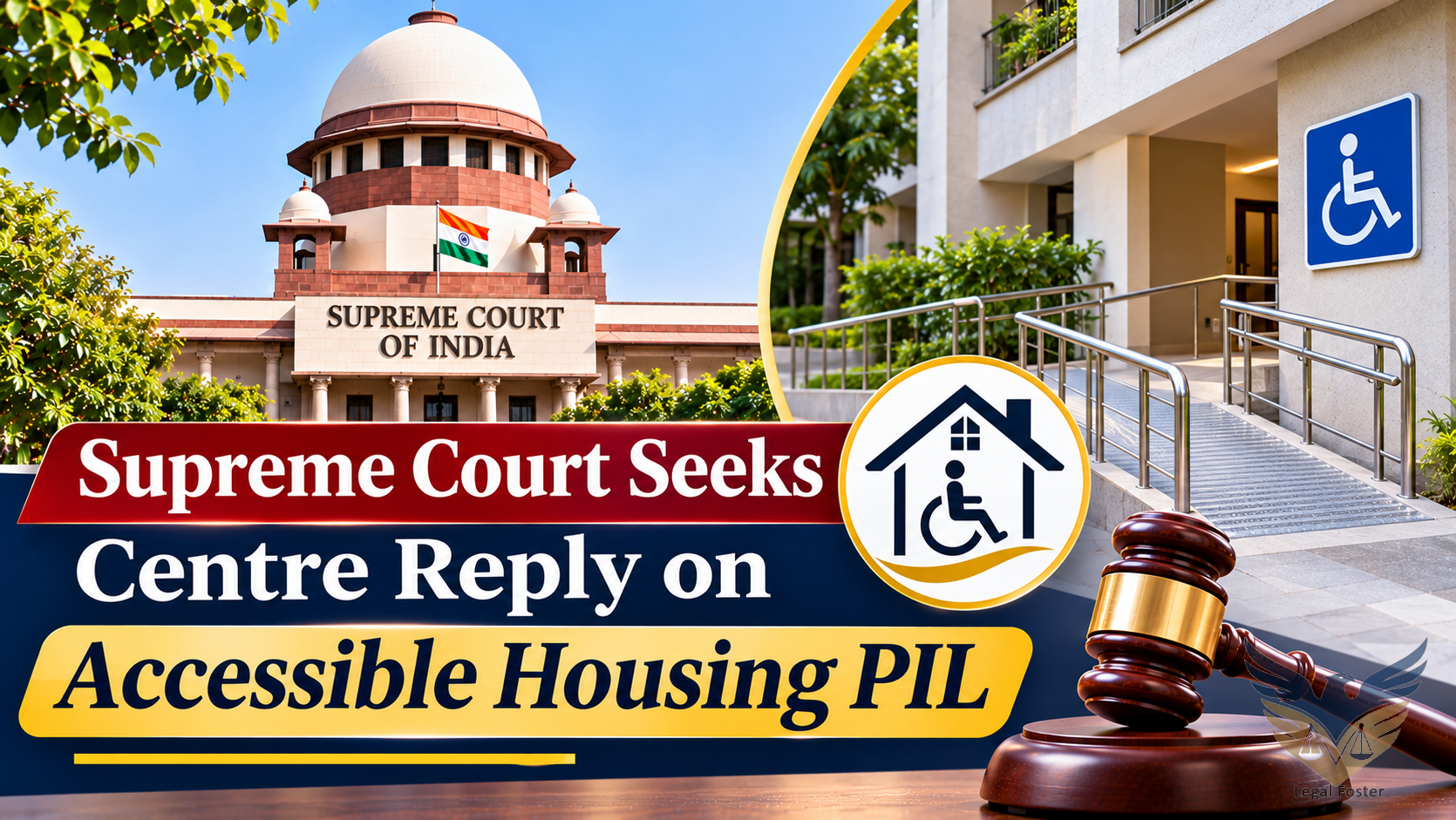
The Supreme Court on Thursday sought the response of the Centre, Ministry of Housing and Urban Affairs (MOHUA) and Ministry of Rural Development on a plea seeking directions to make accessibility standards mandatory for residential buildings and housing complexes for persons with disabilities.
A Bench of Justice Vikram Nath and Justice Aparesh Kumar Singh was hearing a PIL plea filed by accessibility activist Prakash Narayan Andhare, who uses a wheelchair.
The petitioner has sought directions for enforcement of accessibility requirements under the Rights of Persons with Disabilities Act, 2016 (RPwD Act).
The plea states that Sections 40 and 44 of the RPwD Act make accessibility standards mandatory and prohibit authorities from granting permission for construction, issuing completion certificates and occupation certificates until the prescribed accessibility standards are complied with.
"The legislative intention made clear by Sections 40 and 44 of the RPwD Act is very clear. No establishment is to be given a building certificate or completion certificate until such time as it conforms to accessibility norms. Violation of these provisions renders any permission granted by a District Officer automatically void," the petitioner's counsel said today.
The Court issued notice in the matter and listed it for four weeks.
The PIL seeks to direct authorities to include accessibility requirements in building rules and processes for approval of residential constructions across India.
It also seeks a direction that no permission shall be granted to construct residential buildings until the prescribed accessibility standards are complied with. Further, it says no building completion certificate or occupation certificate shall be granted until such time as buildings are verifiably accessible for persons with disabilities.
Further, the petition states that buildings, apartment complexes and group housing projects across India are being constructed and occupied, even today, without suitable provisions for access by persons with disabilities. This leaves persons with disabilities unable to independently access or use their own homes.
"The doorways may be too narrow to allow a wheelchair user to enter their home. The bathroom and toilet may not be designed with accessibility in mind. Internal level differences and circulation spaces may be too tight to allow a wheelchair user to maneuver around their home. These architectural barriers trap millions of PwDs in their own homes," the plea said.
It argues that Section 2(x) of the RPwD Act, "expressly provides that housing is included in the definition of public facilities and services".
The plea highlights that there are discrepancies in rules framed by various States for buildings and constructions.
Further, it argues that requirements for accessibility to buildings for persons with disabilities vary from State to State.
"Where Kerala has chosen to extend the ambit of the accessibility requirements to apartment buildings and residential flats, the Model Building Regulations issued by the Maharashtra Government under its Unified Development Control and Promotion Regulations, 2020 expressly excludes residences, both private and public, from the ambit of the accessibility law," the petition said.
"The accessibility of homes for persons with disabilities is dependent on the particular State in which they reside. A person with disabilities is subjected to the arbitrary will of State governments as to whether accessibility norms would apply to their home or not, despite Parliament having enacted a Central legislation governing the same matter," it further said.
The plea cites Section 37 of the RPwD Act which reserves five per cent of the houses allotted under any scheme or programme for persons with benchmark disabilities, with a priority for women with benchmark disabilities.
Reliance was also placed on operational guidelines of the Pradhan Mantri Awas Yojana- Urban (PMAY-U) 2.0, which directs States and Union Territories to make suitable provisions for ramps and other facilities in the housing projects being developed under the Scheme to ensure barrier-free access.
"The gratuitous reservation of five per cent of houses under Government housing schemes for persons with benchmark disabilities would be but a hollow gesture if the houses allotted to PwDs under these schemes themselves remain inaccessible to them," it said.
"Today, wheelchair users in India can be allotted houses they cannot live in independently. Such a consequence would fly in the face of the very purpose of reserving 5% of housing under Government schemes for persons with benchmark disabilities," it added.
The plea also relied on the November 20 judgment by the Supreme Court in Rajive Raturi v. Union of India, wherein the Court had observed that accessibility standards for buildings should be mandatory and non-negotiable under the RPwD Act.
Advocates Ashutosh Senger, Rahul Bajaj and Sarah appeared for the petitioner.