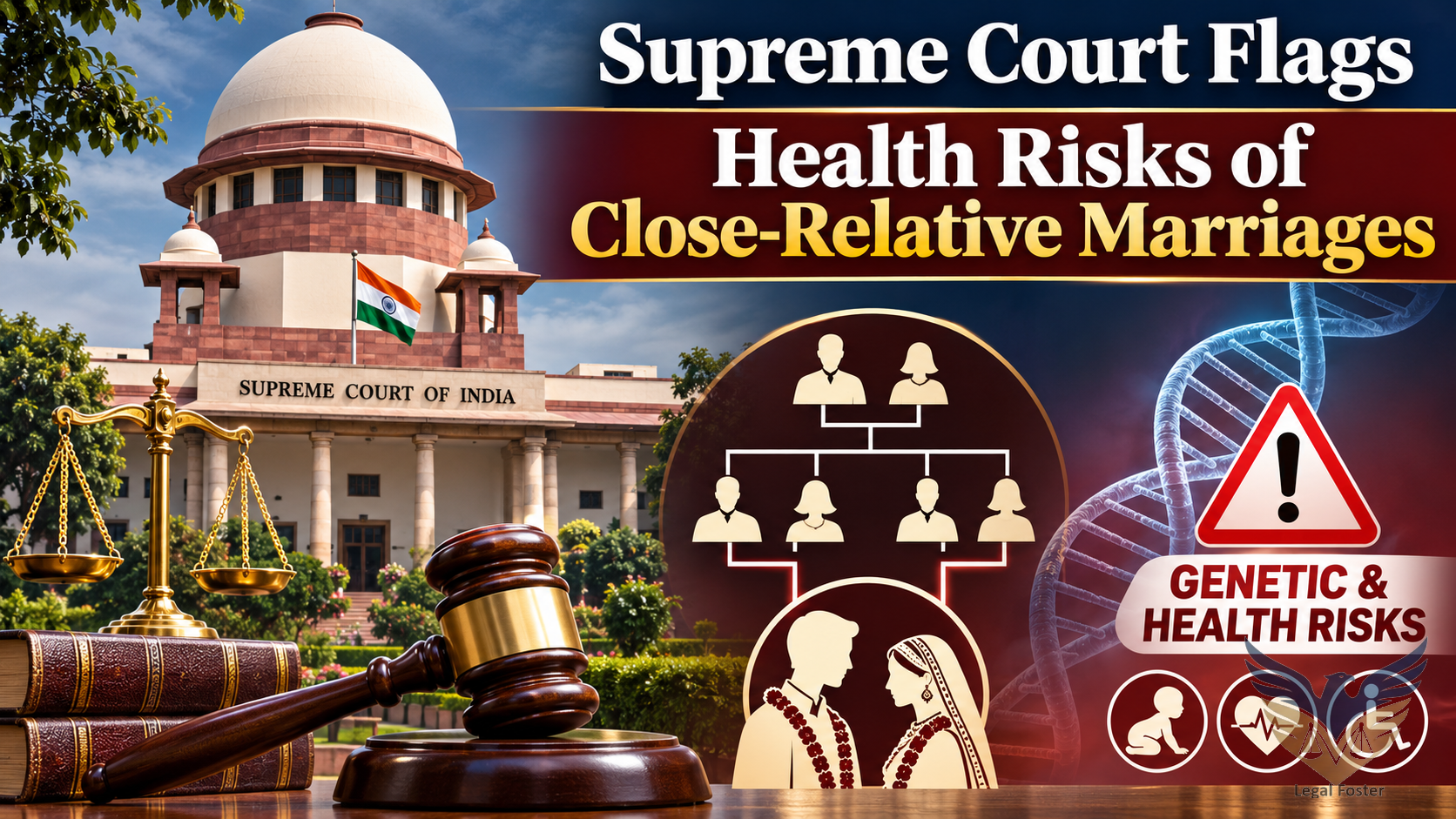
Supreme Court Highlights Health Risks of Marriages Between Close Relatives, Urges Centre to Introduce Law and Spread Awareness
Speaking to the Court on a petition for steps to be taken against marriages between closely related persons, CJI Surya Kant stated that this was something all of them would be concerned about.
Marriages between blood relatives to this degree may have adverse consequences on health, the Supreme Court said on Friday, and directed that the Union of India may want to legislate or take other steps to create awareness. It issued notice on the matter to the Union of India for its views.
The Bench comprised CJI Surya Kant, and Justices Joymalya Bagchi and V. Mohana. It directed that notice be issued "to the Union of India, to consider enacting appropriate legislation or causing maximum publicity by all means, and by suitable syllabus at the school and college level, to develop a scientific approach to the ill-effects" of such marriages.
Charvi S, a law student from Bengaluru, filed the petition. She is visually impaired, suffering from Retinitis Pigmentosa and Cone Dystrophy, both of which progressively deprive a person of good eyesight. Both her parents were first cousins to each other. She praying for appropriate steps, including by the Court, to discourage people marrying within such close degrees, which is common in many sections of the population. The petition prayed for awareness of, and precautions against, various diseases and infirmities which may be inherited by the off-spring.
At the commencement of the matter, CJI Kant remarked: "We would all be concerned on this subject."
While noting that it would not be open to the Court to direct whom a person may or may not marry, Justice Bagchi said:
"In a matter concerning marriage to an HIV affected person, this Court has held that it would be a choice open to any person to marry such a person, and it would not be open to the Courts to place any direction on the parties."
"It is always desirable, however, that a person would take such a decision with full knowledge," Justice Bagchi said.
But to look at the desirability of continued practice of such marriages, prevalent in many parts as custom and tradition, and enact legislation for social change, would be solely for the legislature.
"It is not something which we would like to venture an opinion upon," Justice Bagchi added.
It was brought to the notice of the Court that there was considerable incidence of such marriages, mainly in the rural areas, with little or no awareness of the ill effects to the progeny. In some of the southern States, the incidence may go up to 28 per cent.
CJI Kant was of the view that Anganwadi workers, panchayats and others could also play a role in creating such awareness.
CJI Kant paid tribute to the efforts of the petitioner, who had 40 per cent impairment of vision.
"We are very sympathetic to her cause, and appreciate you for doing this work," he said.