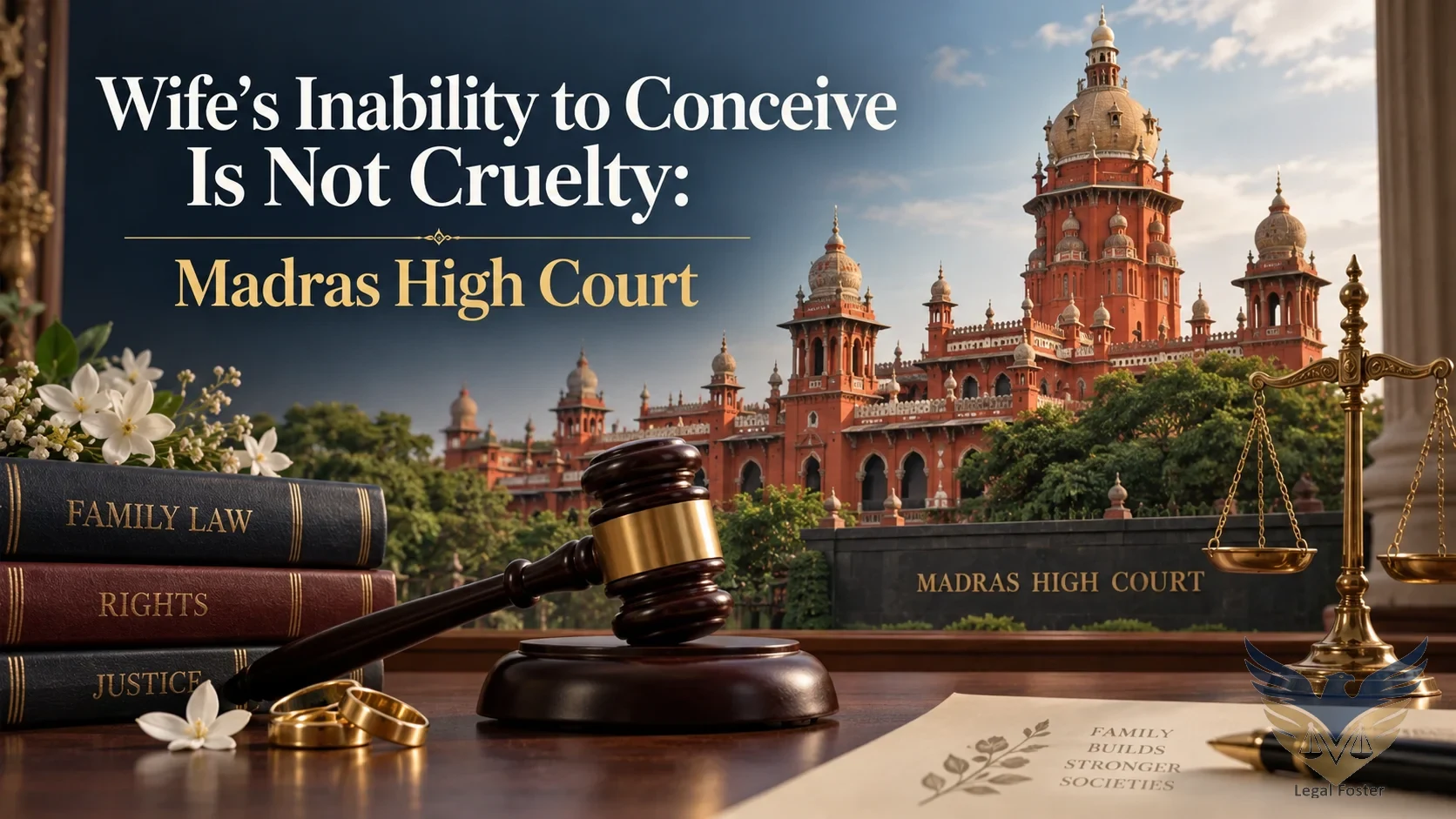
Madras High Court: Wife’s Inability to Conceive Cannot Be Treated as Cruelty for Divorce
Childlessness cannot by itself amount to cruelty and a wife cannot be blamed merely because she is unable to conceive along with her husband, the Madras High Court recently observed.
A Division Bench of Justices GR Swaminathan and MD Sumathi said that “the inability of a spouse to have a child cannot be converted into a matrimonial fault of the wife.”
“The Court cannot be pressed into service for declaring that a marriage is doomed simply because the parties failed to bear children,” the Court added.
The Court said marriage cannot be reduced to the sole object of procreation and inability of spouse to have a child cannot be converted into a matrimonial fault of the wife.
The Court made the observations while dismissing an appeal filed by a husband challenging the order of a family court refusing to grant him a divorce on the ground of cruelty by his wife.
The family court had dismissed the husband’s petition for divorce and the husband filed an appeal before the High Court.
The couple got married in June 2007. The husband submitted that initially the marriage was peaceful, but thereafter his wife began humiliating him, suspected him when he returned late from office, left the matrimonial home on regular intervals and denied him matrimonial consortium.
He further alleged that in June 2016, his wife told him in public that he was incapable of having sexual intercourse, struck him with her footwear and thereafter with a broom. She removed his thali, destroyed their photographs and left the matrimonial home.
The wife contested the allegations. She said she had undergone surgery for uterine fibroid and also received treatment for the hope of having a child and continue her married life.
The High Court upheld the family court’ decision to dismiss his divorce petition finding that there was no evidence to support his claim that his wife was cruel to him.
While declining the husband’s claim that his wife was cruel to him by not having a child with him, the Court noted that “cruelty must be seen in the context of the matrimonial relationship as a whole and cannot be judged by isolating specific incidences, however egregious they may be.”
“In fact, unproved allegations, when accumulated, gain no strength but become weaker. Therefore, accumulation of such unproved allegations cannot turn them automatically into proved cruelty,” the Bench added.
Echoing its earlier statement, the Bench said, “Marriage cannot be reduced to the sole object of procreation. A spouse cannot be treated as having failed in the matrimonial relationship merely because the parties did not have a child.”
“On the contrary, the Respondent-Wife’s conduct in repeatedly subjecting herself to hormonal injections, repeated scans and blood tests, invasive procedures, bodily discomfort, anxiety and cycles of hope and disappointment shows that she had not abandoned the matrimonial bond,” the Court said.
Highlighting the physical and emotional trauma associated with fertility treatment, the Bench noted that such procedures may involve hormone injections, repeated scans, blood tests, invasive surgery, bodily discomfort and pain, anxiety and repeated cycles of hope and disappointment.
The Court said while both partners experience the emotional consequences of infertility equally, the “tears shed in a hospital corridor” before a medical report is revealed, the “pain experienced during treatment and the hope carried forth from one failed attempt to the next are borne solely by the woman.”
“There cannot be a more distressing example of the specificity of marital cruelty than this,” the Bench said.
The Court also dismissed the contention that long physical separation between the parties was enough to presume cruelty or state that there is irretrievable breakdown of marriage. The Bench noted that the wife had always made it clear that she wished to continue the marriage.
“The Respondent-Wife has consistently expressed her willingness to resume matrimonial life, which suffices to hold that there has been no ‘unreasonable withdrawal’ from the society of the petitioner,” the Court held.
Rejecting the husband’s contention, the Court dismissed the appeal and held that the family court was justified in refusing to dissolve the marriage between the parties.
Advocate R Murali appeared for the husband.
Advocate S Vaidurya appeared for the wife.