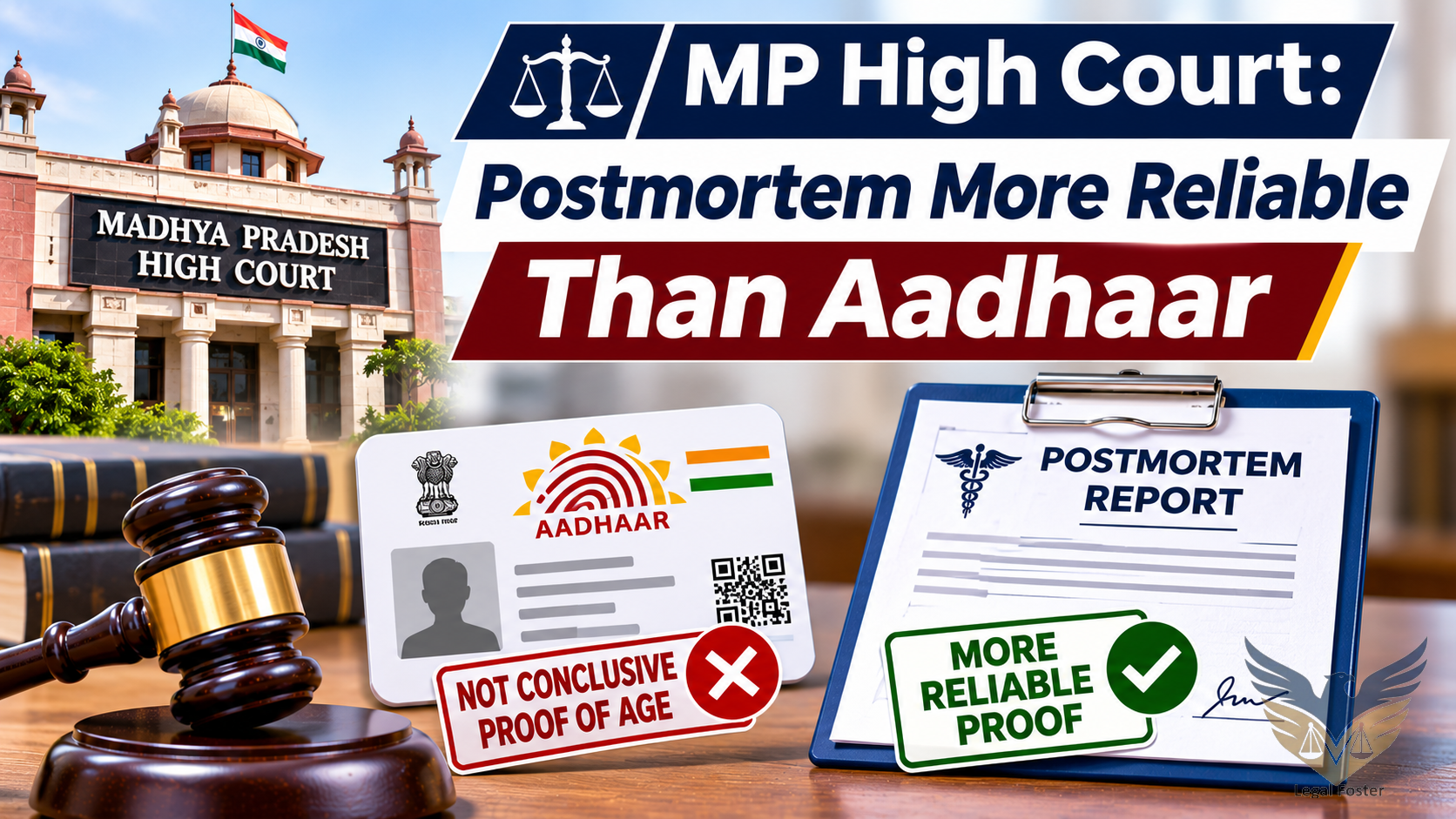
Madhya Pradesh High Court Rules Aadhaar Card Is Not Conclusive Proof of Age, Gives Greater Weight to Postmortem Report
“The postmortem report is a better record which can reliably indicate the age of the deceased rather than an Aadhaar card”, the Madhya Pradesh High Court said recently.
Observed while allowing a Motor Accident Claim petition filed by the parents of a boy who died in a road accident in December 2019.
An earlier Tribunal had relied on the boy’s Aadhaar card which showed his age as 14 years.
However, the insurance company had produced the postmortem report which stated the boy’s age as 13 years at the time of his death.
Allowing the parents’ claim that their son was indeed 13 years old at the time of his death, the High Court remarked:
“Aadhaar Card is primarily an ID proof and cannot by itself be treated as a document that can conclusively prove the age of its holder. On the other hand, the age of the deceased recorded in the postmortem report is based upon medical assessment which is conducted in the course of postmortem.”
Therefore, relying on the postmortem report, the Court held that the boy’s age was indeed 13 years and six months.
“In the facts and circumstances of the present case, this Court finds the medical opinion recorded in the postmortem report to be a more reliable basis for determining the age of the deceased”, held the Court.
Coming to the fixation of compensation, the Court also rejected the Insurance Company’s argument that the age of the boy should lead to a multiplier of 15 (as opposed to 18 that was applied) being used while calculating compensation.
The insurance company’s main argument for why the age of the boy should be accepted as 14 years and some months rather than 13 years and six months was rebutted by the Court observing that reliance on an Aadhaar card cannot determine age.
“The first respondent’s counsel… contented that since the deceased was below 15 years, a multiplier of 15 and not 18 should have been applied. Learned counsel for the petitioners opposed the said contention relying upon a judgment of this Court reported as Ku Aarti v. Udayveer Singh (20)252 wherein compensation was awarded in a case of death of a nine-year-old child by applying a multiplier of 18 years.
However…the Apex Court has recently settled the issue deciding that for deceased children below 15 years of age, a multiplier of 15 years would be applicable”, the Court said while citing Divya v. National Insurance Company Limited .222
Thus, applying a multiplier of 15, the Court fixed the deceased boy’s notional income at ₹7,950 per month (based on minimum wages prescribed for an unskilled worker).
This amounted to a loss of dependency of ₹7,15,500 after reducing the income by 50% for personal expenses and multiplying it with 15.
In addition, the Court awarded ₹40,000 to each parent towards loss of parental consortium, ₹15,000 towards funeral expenses and ₹15,000 towards loss of estate of the deceased.
Enhancing the compensation awarded from ₹5.45 lakh to ₹8,25,500, the High Court allowed the appeal partly on these terms.
The Court further ordered that the increased amount of compensation ₹2,80,500 would accrue interest at 6% per annum from the date of filing of claim petition till realization.
The parents were represented by Advocate Dharmendra Rishishwar while Advocate Bal Krishna Agrawal appeared for the insurance company.