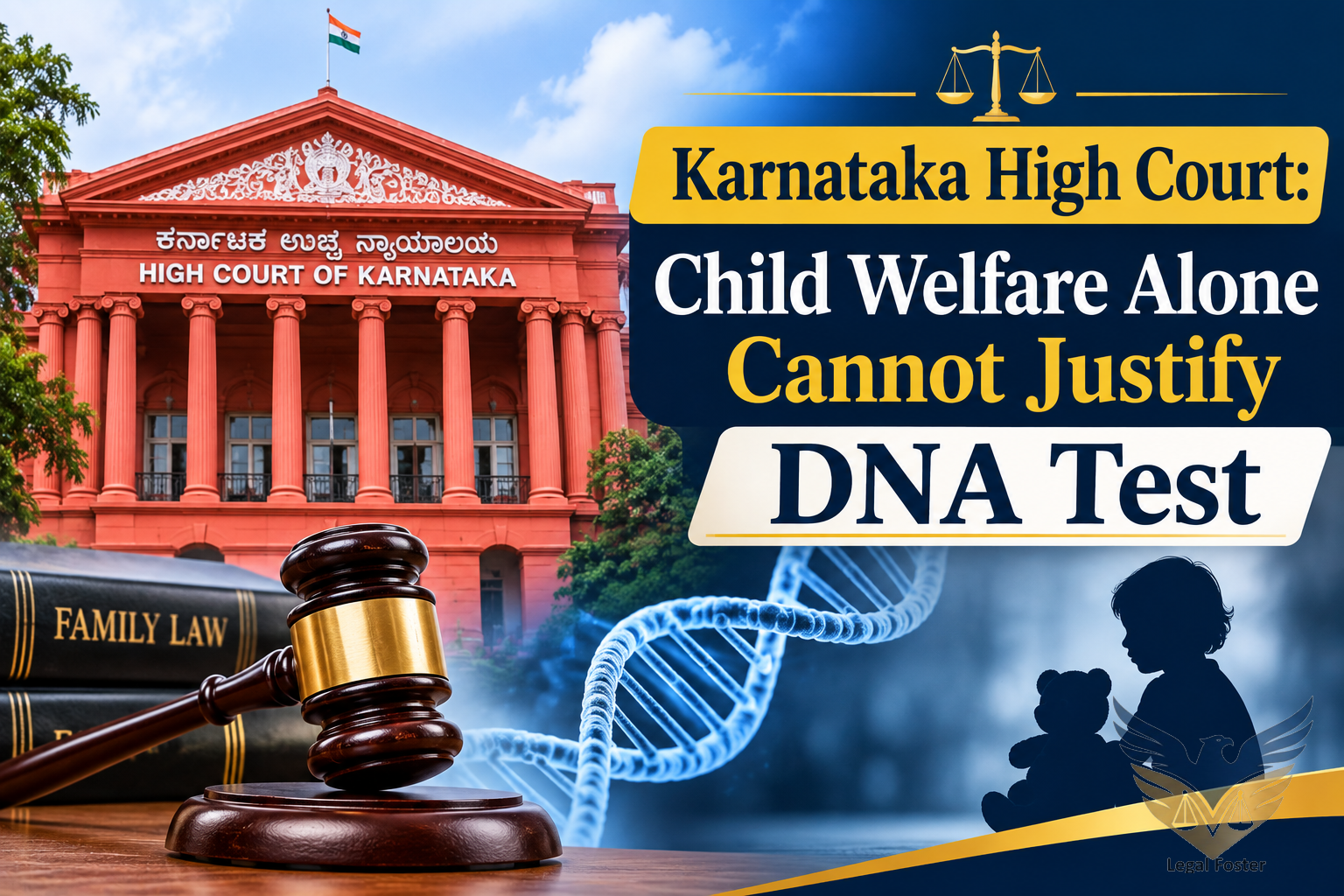
Karnataka High Court Says Child Welfare Alone Cannot Be the Basis for Ordering a Paternity Test
Remanding the matter back to family court, the High Court said the reasons for issuing such a direction have to be recorded, in accordance with principles enunciated by the Supreme Court.
The Karnataka High Court recently clarified that trial courts cannot rely on the ground of welfare of child trump cards in order to direct paternity tests.
“In my considered view, the trial Court has not recorded sufficient reasons for concluding that hard scientific evidence was necessary to resolve the dispute between the parties in accordance with the requirement of law as laid down by this Court in Ivan Rathinam v. Milan Joseph.” Justice Lalitha Kanneganti observed.
“The learned trial Court has not countered the petitioner’s constitutional grievance by conducting the aforesaid balancing exercise. To simply say that welfare of the child is paramount consideration does not respond to the question as to whether the proposed examination is necessary and proportionate.” she added.
Thus setting aside a family court order which had directed a man to give a DNA test to ascertain if he was the biological father of a child of the petitioner-wife, the High Court held that the trial court needs to consider a range of factors before issuing such directions.
The minor child had filed a petition seeking maintenance and was represented through his mother in the court. Meanwhile, during the pendency of the application, mother had filed an interim application seeking direction for DNA test in order to ascertain the paternity of the child on the grounds that the father denied fathering the child. The family court had directed the minor as well as the father to give their blood samples to determine paternity.
The father challenged this order before the High Court and stated that there was an earlier order by a civil court whereby the mothers application seeking DNA test was rejected. He contended that the family court asking him to undergo DNA testing would amount to an abuse of the process of the court.
However, Counsel appearing for the minor child and the mother contended that child has a right to know her biological parentage as a part of her right to dignity, identity and personal liberty under Article 21 of the Constitution. He submitted that previous order rejecting the test did not mean that the same cannot be sought through another proceeding.
The High Court after noting that the father had not denied having physical relationship with the mother of child said that the DNA examination cannot be ordered by the trial court if the material on record was found to be sufficient.
Stating that the Court has to balance the right to privacy and bodily autonomy of the father and the welfare of the child, the Court observed that rejection of such application shall not mean that the biological relationship between the father and the child was nonexistent.
“The court may decline such an examination because the evidence already available is sufficient, because the request is premature, or because the circumstances do not justify interfering with the privacy of the person concerned. Rejection of such an application does not invariably amount to a finding that the alleged biological relationship does not exist.”observed the Court.
“We are of the view that the obligation of a father towards his child is not dependent upon whether he was married to the mother of the child. A child born out of wedlock cannot be deprived of monetary assistance merely because the parties were not united by the tie of marriage.” the Court added.
The Court observed that family court would have to take into consideration the principles laid down by the Supreme Court before issuing direction for DNA test.
The High Court thus remanded the matter back to family court and directed it to reconsider the application filed by the mother and the minor child after considering the facts afresh to arrive at a conclusion whether a DNA test was needed to be conducted.
Advocates Ravinson M and Denny Muthiah appeared for the father.
Minor child and the mother were represented by advocates Mithun U, Shubhasri MV and Usha Reddy KP.