Jammu and Kashmir High Court Quashes Water Usage Charges on Hydropower Projects Under 2010 Law
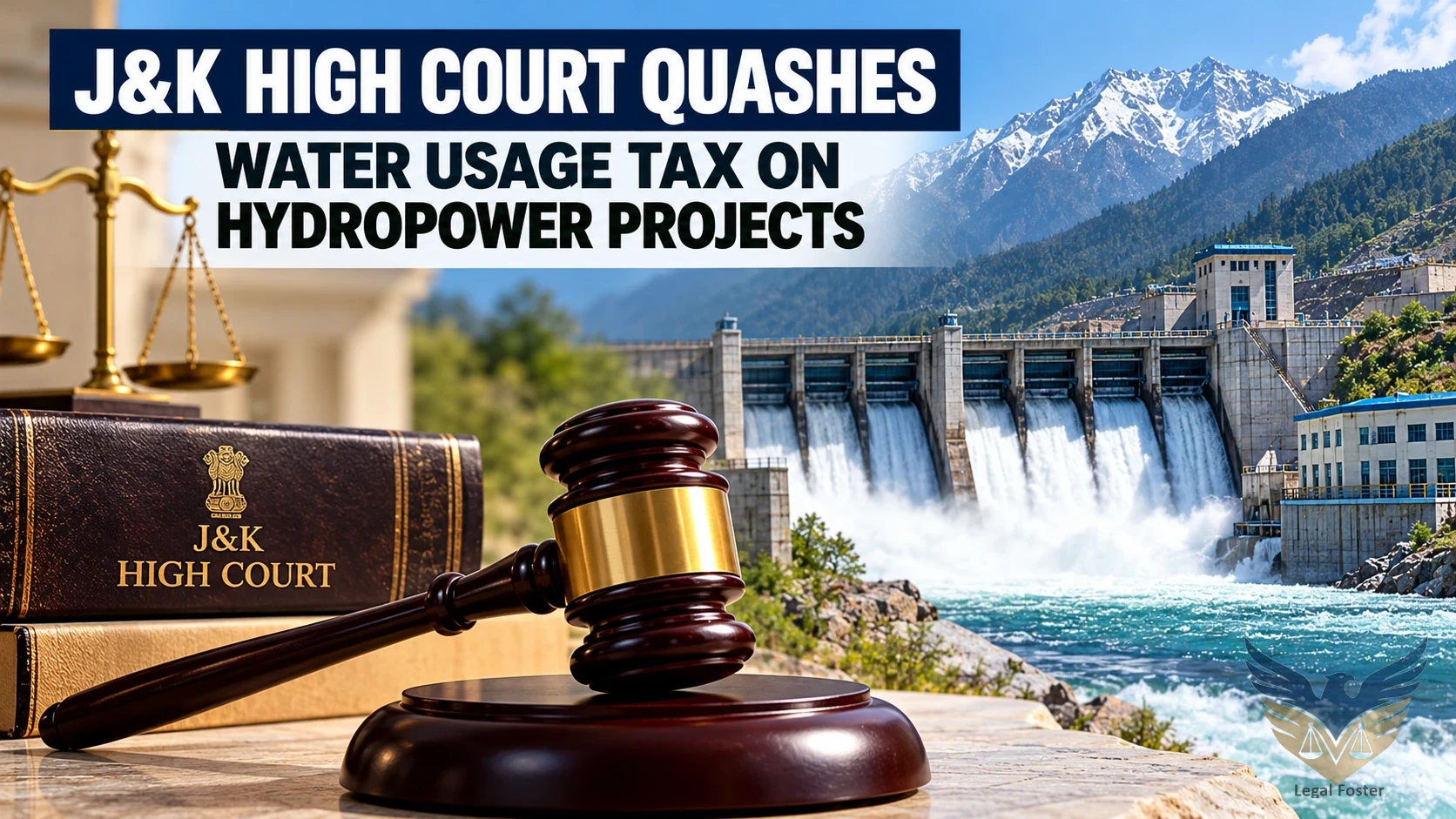
The J&K High Court has struck down provisions of Jammu and Kashmir Water Resources (Regulation and Management) Act, 2010, which levies water usage charges on hydropower projects, producing power referred to water bodies for generating electricity.
The High Court was hearing a batch of petitions challenging the levy of charges for using water for the purpose of power generation under the J&K Water Resources Act, 2010 and the rules made thereunder.
“Any levy charge or tax imposed by the State Government upon generation of power amounted to taxation with respect to power. Taxation with respect to power is dealt with in Entry 60 of List I of the Seventh Schedule and State Legislatures are prohibited from making laws with respect to such taxes as are mentioned in List I”, a Division Bench comprising Justice Rajnesh Oswal and Justice Sanjay Dhar observed while passing the ruling.
“The impugned Jammu and Kashmir Water Resources (Regulation and Management) Act, 2010, to the extent it provides for levying water usage charges upon the hydro power projects, amounts to imposing a tax on the generation of electricity and, therefore, the State Legislature did not have the competence to impose such tax…“,the Court said.
“The impugned enactment, to the extent it imposes water usage charges upon the petitioners, is held to be ultra vires the Constitution and is struck down to the said extent”, the Court held in its ruling.
Passing detailed reasons for holding the levy unlawful and unconstitutional, the Court reasoned that when collected by the State government, the so-called water use charges are not used for the benefit of hydropower project licensees.
On the contrary, Section 185-A of the impugned Act 2010 itself said that water charges collected from hydroelectric power projects will form part of the “Water Fund” to establish hydroelectricity projects, provide for buy back of hydroelectric power projects shall be credited to Fund established by that Act and shall be applied for capital investment in transmission and distribution networks and purchase of power by the State.
Stated differently, the water charges collected from hydropower project licencees does not result in quid pro quo (a favor or service done in return for something else) .”In view of aforesaid analysis…it can safely be stated that the water usage charges sought to be levied upon power-generating hydro projects in terms of the Act of 2010 is nothing but tax”, the Court held.
Further commenting on the nature of levy, Court added that “In fact, any tax on generation of electricity cannot but be a tax on sale or consumption of electricity because such tax is sought to be levied not when electricity is sold or consumed but at the stage of generation.”
The Court noted that “utilization and non-consumption of water…constitutes an inextricable and indispensable facet of generation process; consequently, any statutory levy, charge or exaction imposed at any stage prior to or during the generation of power tantamounts, in substance and effect [to a] tax upon the generation of electricity itself.”
The Court also noted that the erstwhile State of Jammu and Kashmir (since the State’s special status was abolished through the Presidential notification which extinguished Article 370 of the Constitution and it was reorganized into a Union Territory) had no legislative competence to impose such a tax under the Act of 2010.
“The legislature of the State of J&K, when it enacted the impugned legislation in 2010 was not competent to impose a tax upon generation of electricity.”
“The State Legislature could have levied tax only on consumption or sale of electricity (Entry 53 of List II of the Seventh Schedule) and not upon generation thereof“, held the Court while striking down levy of water “charge” imposed under the 2010 law and rules made thereunder.
The writ petitions were filed by independent power producers (IPP’s) having river based hydroelectric power projects functioning in Jammu and Kashmir. The petitioners had challenged the impugned Act 2010 and the rules made thereunder, to the extent they sought to levy charges on water used for generation of electricity. The IPPs had also challenged notices issued to them for levying water use charges.
Holding in favour of IPP’s the Court struck down provisions of the law that authorized levy of water usage charges on hydroelectric power projects for generation of power.
Arguing in defence of the legislative enactments, the State of Jammu and Kashmir had contended that water which includes water power projects is mentioned specifically in Entry 17 of List II of the Seventh Schedule and therefore the State was competent to regulate matters concerning use of water, including levy of water charges.
Further contending that even if water usage charges were to be characterized as tax upon generation of electricity (which the State has no powers to tax), the legislative competency of the State to pass the impugned Act of 2010 was ratified when Parliament adopted the law subsequently by enacting the Jammu and Kashmir Reorganisation Act, 2019 after abrogation of Article 370 of the Constitution.
“The impugned Act having been adopted by Parliament and not been negatived by it till date can be presumed to have got the assent of Parliament”, relied upon the Jammu and Kashmir government.
Rejecting the submissions made by the government of J&K at every stage, the Court said on the above argument that
“Merely because the (2019) Act provides for adoption of State enactments and saves their application to UTs of J&K and Ladakh, the said enactments do not become the enactments passed by the Parliament.”
“The contention that the impugned Act, being unconstitutional when it was passed by the Legislature of the State of J&K, can survive thereafter by reason of its subsequent adoption by the Parliament, is also untenable. A piece of legislation, which is ultra vires the Constitution at the time of its enactment cannot be legitimized by its adoption by the Parliament subsequently”, the Court made it clear.
All notices issued against the writ petitioners (IPP’s) for levying charges under the impugned Act 2010 and its rules were also quashed by the Court.
“The respondent-State is restrained from imposing any tax on the generation of electricity under the garb of water usage charges or any other tax.”, ruled the Court.
Petitioners were represented by Senior Advocate Pranav Kohli with advocates Raunak Gupta, Rahul Sharma, Rupali Sharma and Akshaj Rahmatra and advocates Shariq J Reyaz, Humaira Sajad.
Respondents were represented by Senior Additional Advocate General AR Malik with advocate Nisha Kangotra and Deputy Solicitor General of India TM Shamsi with advocate Rehana Qayoom.