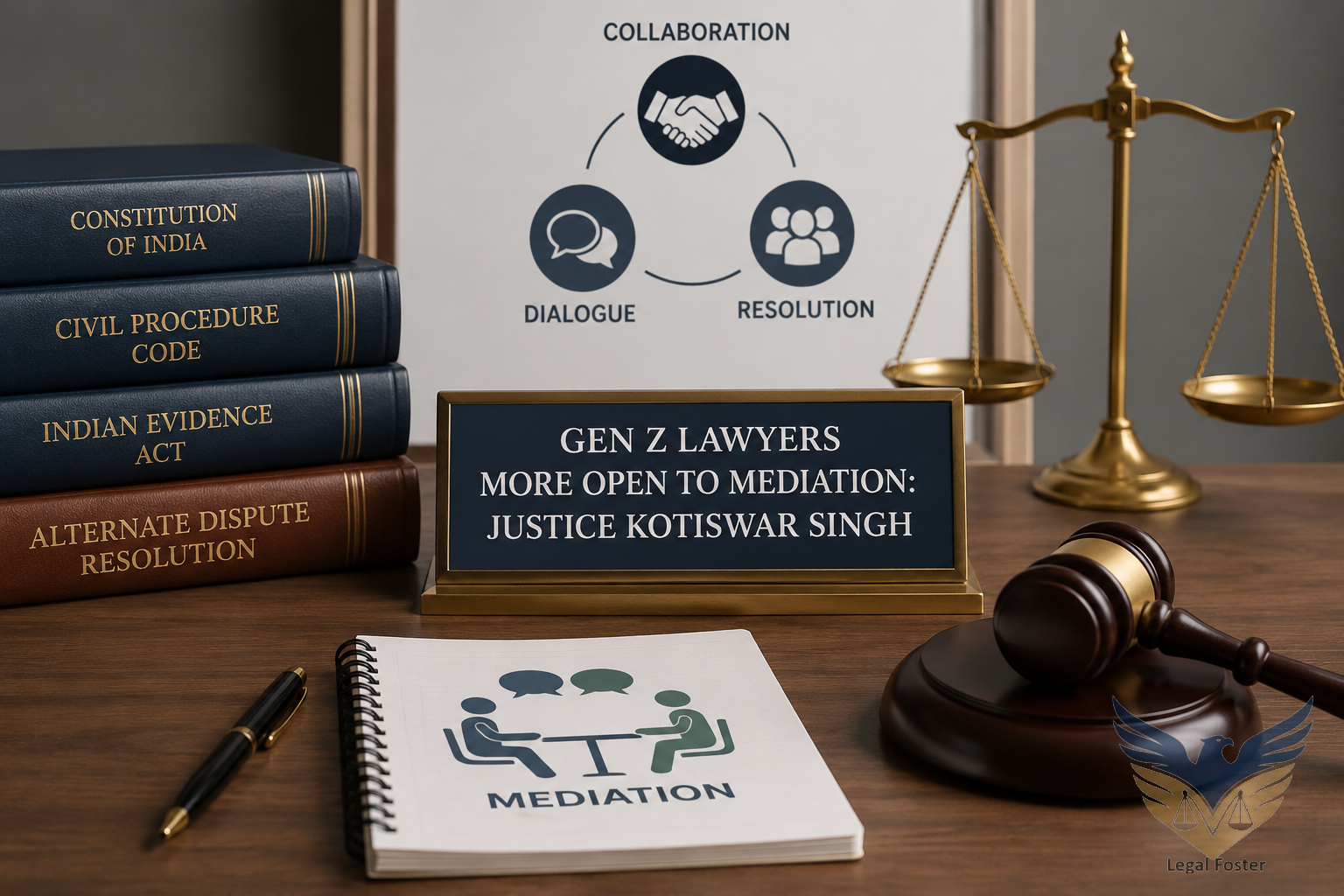
Gen Z Lawyers Show Greater Openness to Mediation, Says Supreme Court Justice Kotiswar Singh
Justice N Kotiswar Singh said younger lawyers could take mediation more seriously as a career if law schools provide stronger training, practical exposure and greater institutional support.
Gen Z lawyers are likely to embrace mediation more readily than previous generations if they are properly trained and shown that mediation can offer a meaningful professional career, Supreme Court Justice N Kotiswar Singh recently observed.
Speaking about legal education and the future of alternative dispute resolution, Justice Singh said greater exposure to mediation at the college and university level could encourage students with different skills and aptitudes to consider it as a profession rather than merely a compulsory academic subject.
Mediation Needs Greater Attention in Law Schools
Justice Singh recalled interacting with approximately 15 interns during a training programme and asking them how mediation was being taught in their respective law colleges.
According to the judge, the students' feedback showed that mediation was often taught without the same level of emphasis given to other areas of legal education.
"I don't want to criticise my generation, but this Gen Z generation are very, very sensitive. Given the proper training, the proper approach, they are going to accept mediation."
Justice Singh said law institutions should consider giving mediation the kind of organised exposure that moot court competitions currently receive. Better training, he suggested, could allow students to understand not only mediation theory but also its potential as a professional field.
He added that if students are shown the positive aspects of mediation and its potential as a long-term career, they are likely to take the field much more seriously.
Key Observations by Justice Kotiswar Singh
- Gen Z lawyers may be more receptive to mediation as a professional career.
- Mediation requires greater emphasis in universities and law colleges.
- Practical exposure should accompany classroom teaching.
- Many disputes reaching courts may be capable of settlement.
- Mediation remains underutilised across large parts of India.
- Government departments must also improve their approach towards settlement.
Remarks at International ADR Conference 2026
Justice Singh made the comments on August 8 while participating in a fireside chat with Senior Advocate Rajeev Virmani at the International ADR Conference 2026 organised by the Maadhyam International Council for Conflict Resolution in New Delhi.
During the discussion, the judge also addressed the broader problem of excessive litigation and the continuing need to strengthen India's mediation ecosystem.
Many Court Disputes Could Potentially Be Settled
Justice Singh observed that several disputes that ultimately reach courts may not necessarily require prolonged litigation and could have a reasonable possibility of settlement.
While acknowledging that Delhi has made substantial progress in mediation, he said the mechanism remains significantly underutilised in several other parts of the country.
Referring to the more than five crore pending cases, Justice Singh said around 80 per cent of them are pending before the district judiciary.
He observed that initiatives such as the Supreme Court's Samadhan Samaroh would remain limited in their overall impact unless the larger system is strengthened through improvements involving courts, governments, mediators, trainers, lawyers and law students.
Government's Approach to Settlement Comes Under Criticism
Justice Singh was particularly critical of the government's approach towards settlement despite the State being one of the country's largest litigants.
Recalling a national conference attended by Law Ministers in 2012 for discussions around a national litigation policy, the judge said the question of reducing unnecessary government litigation had been considered years ago.
However, he indicated that there appeared to be little visible change in practice even in 2026.
"I frankly don't see, at least I have not seen in court, the impact of the policy."
Justice Singh said unnecessary appeals and review petitions filed by government authorities continue to contribute to the burden on the judicial system.
He also referred to difficulties at Lok Adalats, where government representatives may be unwilling or unable to take responsibility for settlements because they lack sufficient decision-making authority and must refer proposals to senior officials.
"So, there is a clear lack of a kind of responsibility to be given to certain official officers, stakeholders."
Centre and States Should Empower Officials to Settle Disputes
Justice Singh urged both the Central and State governments to formulate clearer policies governing settlement of disputes and to delegate adequate authority to designated officials.
Such officials, he suggested, should be capable of taking settlement decisions within their assigned responsibilities instead of referring every proposal through multiple administrative levels.
"Charity has to begin at home."
The judge emphasised that the government's responsibility towards mediation cannot be restricted to merely providing infrastructure. Its own conduct as a litigant must also be examined if settlement mechanisms are expected to become genuinely effective.
Mediation Act, 2023 Faces Implementation Gaps
Justice Singh separately highlighted gaps in the implementation of the Mediation Act, 2023.
He referred to the Mediation Council of India, which is intended to play an important role in implementation of the legislation and in developing standards for mediation.
According to the judge, the Council has not yet been constituted, resulting in a gap particularly in relation to standardised mediator training and accreditation.
A stronger institutional framework, together with structured education and professional standards, could therefore become central to expanding mediation across India.
IP Disputes and ADR Also Discussed at Conference
The conference also featured a panel discussion examining whether Intellectual Property disputes are more suitable for mediation or arbitration.
Participants included Anand and Anand Managing Partner Pravin Anand, International Arbitration and Mediation Centre Registrar AJ Jawad and PSL Advocates & Solicitors Partner Aakanksha Nehra.
The session was moderated by INTTL Advocare Founder and Managing Partner Hemant Singh.
The wider discussion reflected growing attention within India's legal community towards mediation, arbitration and other forms of alternative dispute resolution as mechanisms capable of resolving suitable disputes without prolonged conventional litigation.