FSSAI Proposes Red Hexagon Warning Labels for High Sugar, Salt and Fat Foods
A Bench of Justices JB Pardiwala and K Vinod Chandran took note of the submission by FSSAI seeking time to file an updated affidavit, informing the Court that it has proposed front-of-pack warning labels similar to those mandated in Uruguay. The Court had earlier also taunted FSSAI for its delay in coming up with such a proposition, and questioned whether the agency was “standing before the corporates”.
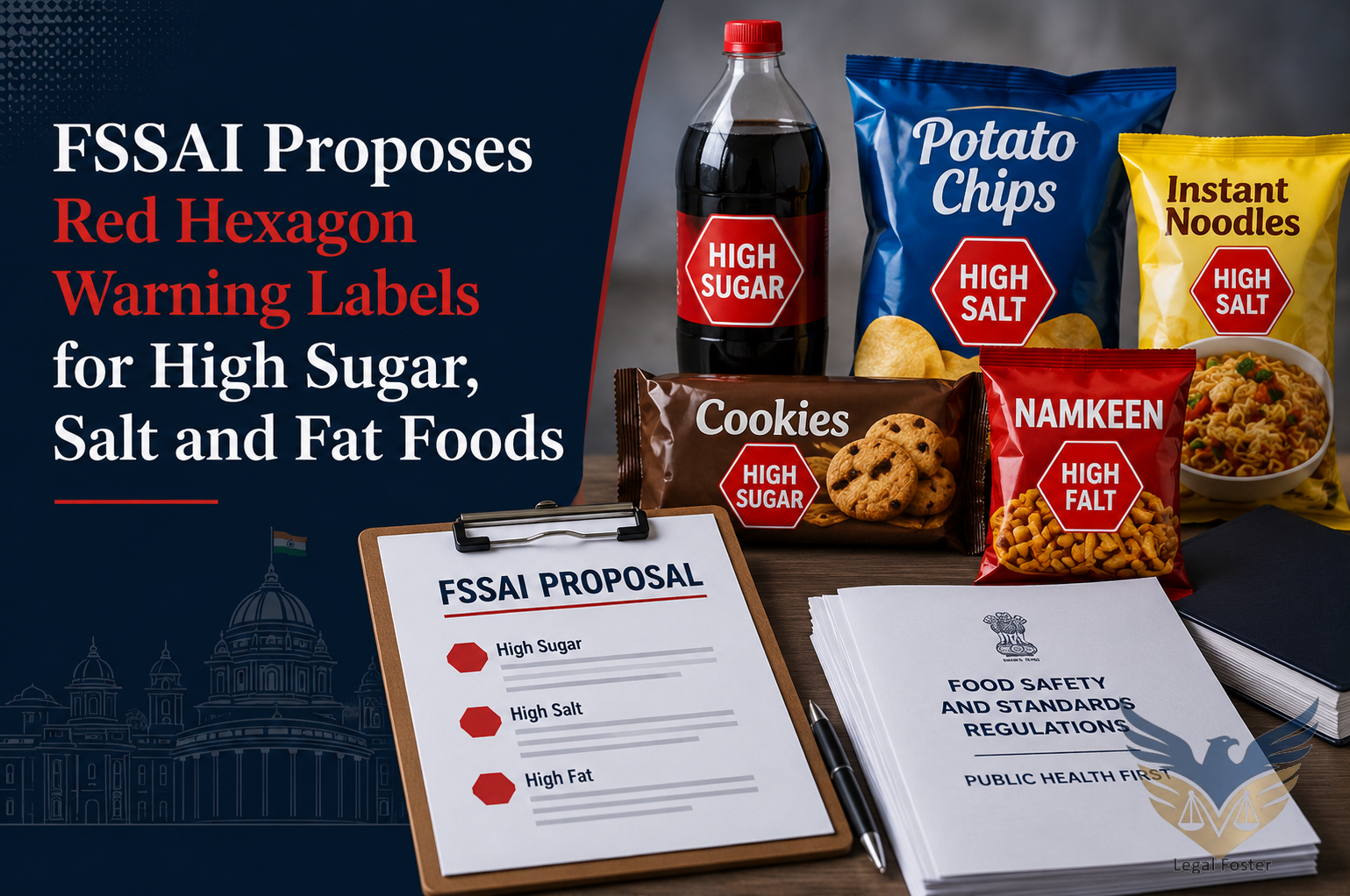
The Food Safety and Standards Authority of India (FSSAI) has submitted in an affidavit that it has proposed a red hexagon-shaped warning label on packaged food products high in fat, sugar or salt.
FSSAI filed the information in response to an order passed by the Supreme Court earlier last week asking the regulator to examine the use of front-of-pack labels containing health warnings on packaged food products in the larger public interest.
Seeking time to file a further affidavit, FSSAI has now informed the Court that it has decided to implement front-of-pack labels with colour-coded nutritional information warning people about products high in nutrients of concern.
“A proposal has been prepared by FSSAI to provide information on Added Sugar, Added Fat and Salt in a pictorial form on front-of-packaging so as to provide a simple and easily comprehensible warning on packaged food products which are high in nutrients of concern,” FSSAI said in an affidavit.
The proposal envisages the use of a front-of-pack warning label which would be displayed prominently in a red hexagonal shape for food products which are high in any two or more of the three nutrients – added saturated fat, added sugar and salt – based on thresholds specified under the Dietary Guidelines for Indians, 2024 issued by the Indian Council of Medical Research-National Institute of Nutrition (ICMR-NIN).
“This will carry text declarations such as ‘HIGH FAT’, ‘HIGH SUGAR’, ‘HIGH SALT’ or in case of beverages ‘HIGHLY SWEETENED BEVERAGE’ as the case may be, depending upon which of the nutrients they are high in,” the affidavit added.
As to the size of the font used on the labels, it would be larger than that used for the nutrition information table provided on the back of the pack, the affidavit further said.
Products that would be exempted from the labelling requirements would be classified under two broad categories – single-ingredient food products, and foods that are inherently high in fat, sugar or salt such as ghee, edible oil, salt, sugar, jaggery and honey. All other labelling requirements under food safety regulations would continue to apply to these exempted products, it added.
“Insofar as children and other vulnerable groups are concerned, the proposed labelling mechanism is intended to nudge consumers towards making informed food choices through an effective and consumer-friendly labeling strategy,” FSSAI told the Court in its affidavit.
The affidavit said that specific label formats have been proposed for each combination of two high nutrients. These include separate red hexagon shaped labels with text reading “HIGH FAT / HIGH SALT”, “HIGH SALT / HIGH SUGAR” and “HIGH FAT / HIGH SUGAR” for food products high in two of the three nutrients, and a separate and distinct red hexagon shaped “HIGHLY SWEETENED BEVERAGE” label for sweetened beverages.
FSSAI has also sought to phase out the implementation of these labels in two phases.
While Phase I will include food products high in 2 or more of the specified nutrients and specified sweetened beverages, Phase II will expand the scope of the warning label to products high in even one of these nutrients.
It said that the phased implementation was proposed so as to build consumer acceptability and to provide industry time to appropriately reformulate products. The regulator has told the Court that it intends to notify these changes through an amendment to the relevant rules.