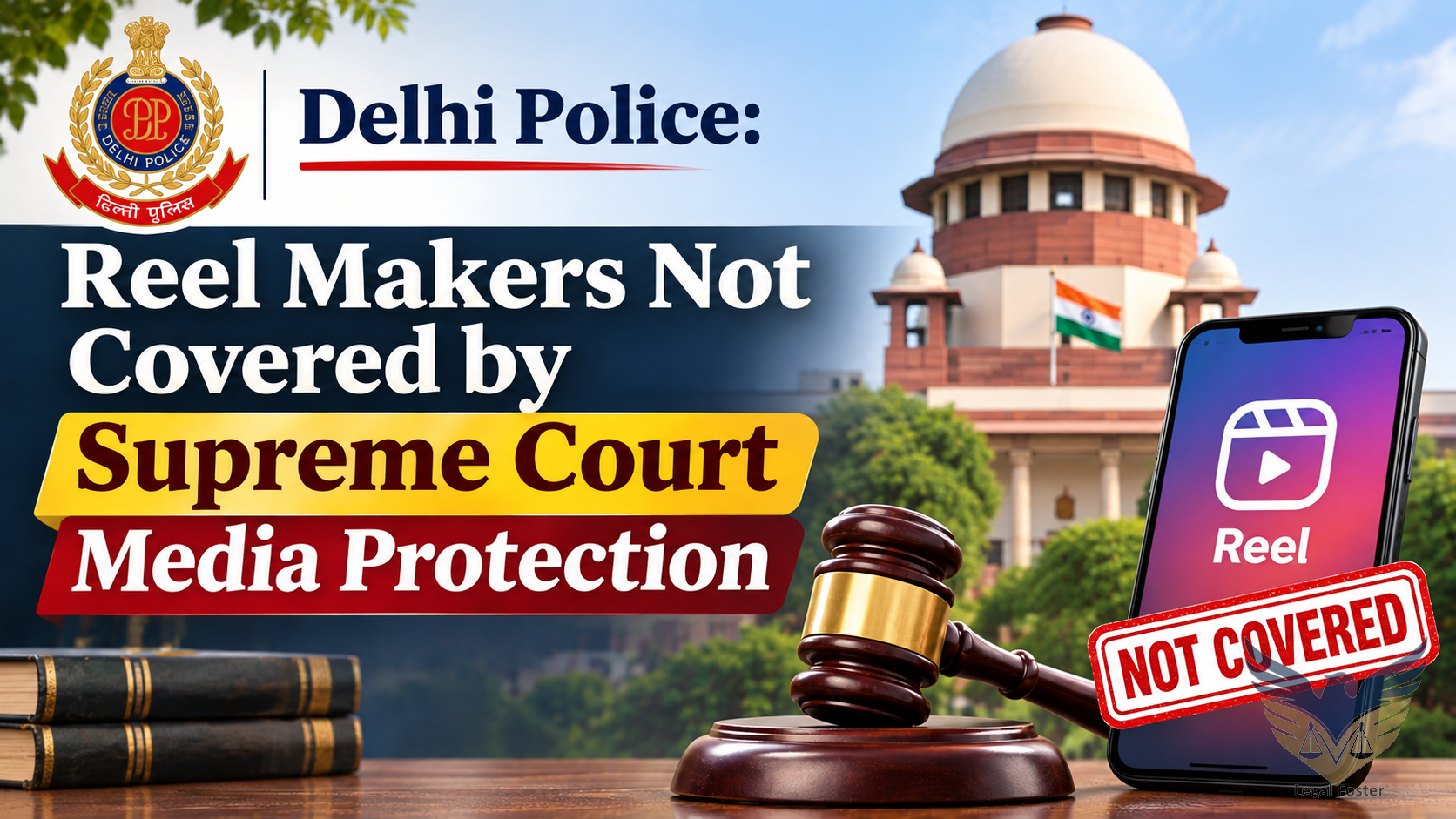
Delhi Police Says Reel Creators Cannot Claim Supreme Court Protection Granted to Journalists During Protests
They can collect and collate information and news as any other citizen may, subject to the general law, including crowd-control measures, if required at the time of protests, the police said.
Reel makers and social media influencers would not be entitled to any protection under the order passed by the Supreme Court in relation to journalists freely reporting on any protest, Delhi Police submitted before the top court.
By way of an affidavit, the Police informed the Court of various aspects in connection with petitions challenging their actions while controlling the CJP protest seeking CEC's resignation on various alleged malpractices during SIR of the electoral roll.
At the previous date of hearing, the Court had observed that the media should be allowed free access to report on these protests, after some journalists had complained of restrictions being placed on them.
Delhi Police submitted that none of these instances came to their notice, and in any event, they had not intentionally restricted any journalist.
"It is submitted that neither during the protests nor at any other time, the Delhi Police have wished to prevent, hinder or in any way interfere with any bona fide journalistic activities."
At the same time, according to the police, there would be a difference between genuine journalists and reel makers.
Any restriction placed by them on people moving around and gathering at a particular place during these protests would apply to such people as they did not fall within the scope of this direction, the Police submitted.
"Clearly, the purport and effect of this direction was to allow freedom to Journalists while discharging their duties. There is no manner of doubt that it would not extend to reel-makers, social media influencers or any other miscreants to shield them from the general law and directions of Law Enforcement Agencies in maintaining order at the locus of any unlawful assembly."
It said it was open to consideration whether reel-makers and social media influencers deserved to be placed on par with journalists.
"Nowadays, many persons, creative or otherwise, have taken to making reels and uploading them and earning revenue out of it. While there may be nothing wrong in doing this, it would require consideration if all such persons would merit being treated as Journalists or reporters."
Many of the protesters at the site had cameras and mics in their hands, impersonating journalists, which made it difficult for the Police on ground, the affidavit submitted.
The Police, therefore, requested the Court to consider the difference between someone who genuinely wished to gather and report news impartially, and one who only wanted to shoot some footage to use to create reels.
"It may well be that their principal purpose in doing so would become a relevant consideration," it submitted.
Of course, anyone, including independent journalists, freelance journalists, ordinary citizens, and those reporting through their own channels, such as YouTube, had a fundamental right to gather news lawfully and broadcast or publicise the same, the affidavit stated.
So long as it was lawful, the absence of accreditation by the PIB or press credentials issued by their employer, or working for any established newspaper or media house, would not preclude them from exercising this right, it continued. But they would be bound to abide by any applicable law and directions by Police like any other member of public.
The affidavit dealt at length with various complaints alleged to have been suffered by individual journalists at the hands of the police.
With regard to the allegation of sexual harassment by a policeman, levelled by three women journalists in respect of events on October 3, it was submitted that of these three, two had stated they would not press on with the complaint, while the remaining one did not turn up before the investigating officers. On going through available CCTV footage no instance of any such behaviour came to light.
"There is thus nothing on record to substantiate these allegations. All these complaints have accordingly stood registered and closed."
About Peek TV journalists who alleged that they were pulled away from the protest and detained, it was brought to the notice of the Court that a DCP met them and apologised.
"This would go to show that upon identification of such persons as Journalists, the higher officials took immediate steps to see that no such persons were taken away. Any inconvenience that may have been caused was only incidental to crowd-control measures then being undertaken and not deliberate."
That The Caravan journalist, Ryan Thomas, was assaulted and detained on October 11 was denied and it was submitted that he had only been taken away from the area to maintain order.
"He was taken away only pursuant to lawful powers of the Police to keep check on the situation prevailing at that time."
Insofar as a lady reporter of The Hindu was detained, the Police stated she was let go off once she could establish her credentials as a journalist. Likewise, the three Indian Express reporters had also been released within about 45 minutes once established to be so, the Police pointed out, relying on their own averments.
The allegation that journalist Paranjoy Guha Thakurta had been detained unlawfully was also denied.
"As per his own rendition of events, he was never taken to any Police Station. He only states that he was put into a car, taken around for 20 minutes or so and dropped somewhere about half a kilometer away and set free, at about 1 pm."
It was also submitted that there was no illegality or restriction on the movement of Shyam Meera Singh.
"As can be seen from his own words, he was involved in shouting slogans when various groups came face to face with each other at Connaught Place and was thus himself participating in an unlawful assembly. Only when he reached the Police Station, he claims to have attempted to flee the illegal detention. All these would suggest that he too was actively participating in whatever transpired, rather than merely being present as a 'journalist' gathering news of the happenings."
There had been no seizure of cameras or other items belonging to any journalists, the affidavit stated.
"No articles belonging to any Journalist were seized. Various articles were seized from others lawfully pursuant to their powers, many of which were lying scattered around with no one claiming them, such as cell phones."
They submitted that all the petitions should accordingly be dismissed.
A number of organizations, inter alia Network of Women in Media, Free Speech Collective, Delhi Union of Journalists and the Kerala Union of Working Journalists, have filed petitions questioning the conduct of Delhi Police vis-a-vis media personnel reporting on the protest.
Relying on an order passed by this Court on October 11, directing that advocates, journalists or others engaged in any other profession should be permitted to freely carry on with their work, they submitted that all the aforesaid instances were contrary to this direction.