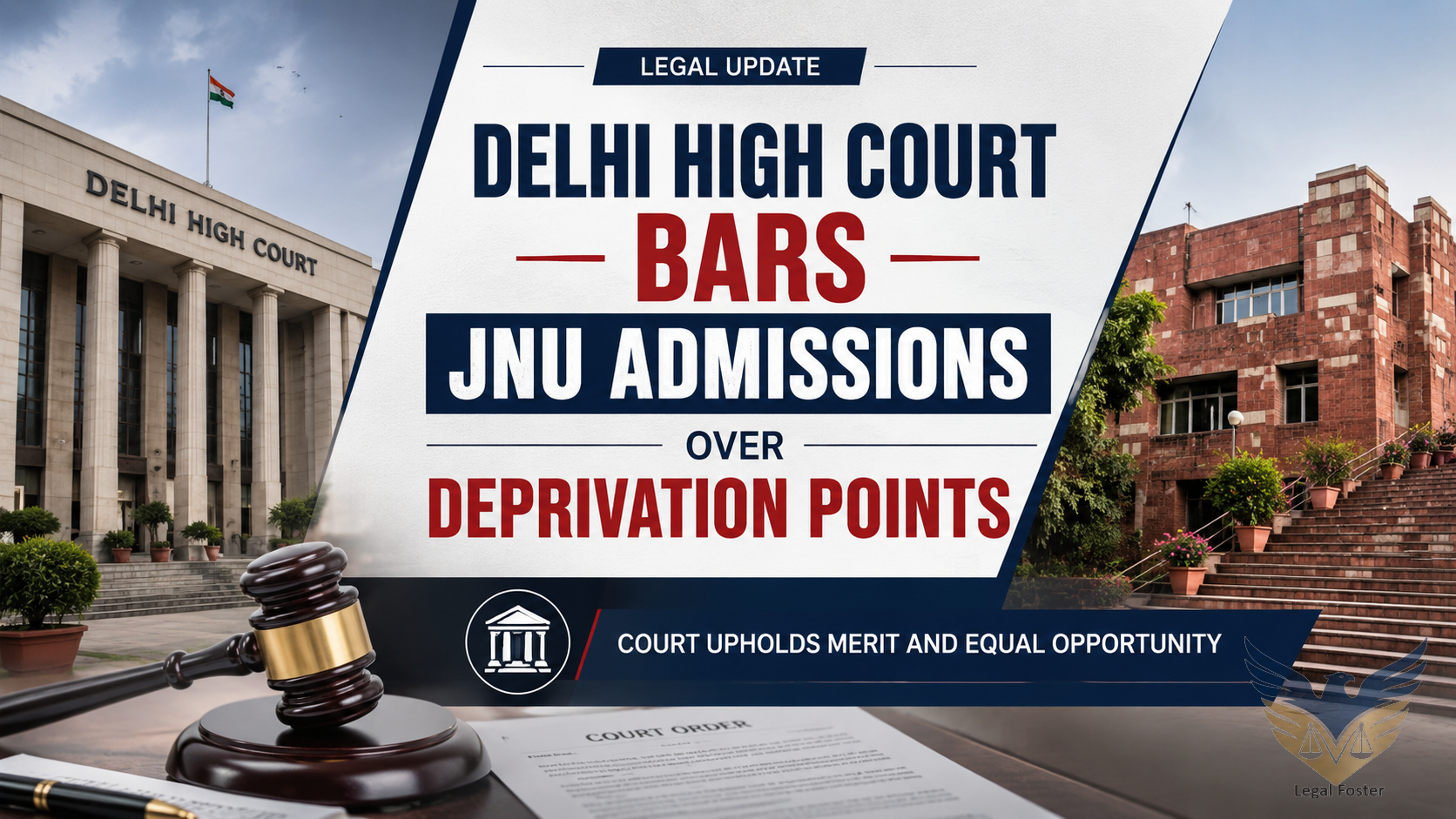
Delhi High Court Bars JNU From Admissions Based on Deprivation Points
The Court passed an interim order observing that granting deprivation points effectively alters CUET scores and may undermine the purpose of a common competitive entrance examination.
The Delhi High Court has passed an interim order restraining Jawaharlal Nehru University (JNU) from finalising admissions to its postgraduate courses on the basis of "deprivation points."
Deprivation points provide additional marks to candidates depending upon factors such as the region or educational institution from which they studied. Under JNU's prospectus for the 2026-27 academic session, candidates may receive up to 12 deprivation points, with each point translating into three additional marks.
Justice Jasmeet Singh passed the interim order on August 14 after examining a challenge to the University's admission policy.
Delhi High Court Questions Modification of CUET Scores
During the hearing, JNU defended its deprivation point policy by stating that it was intended to ensure adequate representation of students from different parts of the country.
The High Court, however, observed at the interim stage that granting additional points after candidates had secured marks in the Common University Entrance Test (CUET) effectively resulted in modification of those scores.
Based on its prima facie view, the Court restrained the University from finalising admissions made on the basis of deprivation points.
JNU Appeals Against the Interim Order
JNU subsequently filed an appeal challenging the interim order of the single judge.
The appeal was mentioned by advocate Karan Prakash for urgent hearing, following which the High Court agreed to take up the matter.
The original interim order was passed on a petition filed by Amit Mehra, who had applied for admission to postgraduate courses at JNU.
JNU Defends Deprivation Points Policy
JNU argued before the Court that its policy was designed to ensure adequate representation of students coming from different regions of the country.
The University also relied upon provisions governing Jawaharlal Nehru University and submitted that the deprivation point mechanism had been considered and approved by its Academic Council after deliberation.
According to the submissions made before the Court, the University had already issued approximately 1,500 offer letters for postgraduate courses and 451 offer letters for undergraduate programmes.
Key Details of the JNU Admission Dispute
- JNU's 2026-27 prospectus permits up to 12 deprivation points.
- Each deprivation point translates into three additional marks.
- The interim order was passed by Justice Jasmeet Singh.
- The petition was filed by postgraduate admission applicant Amit Mehra.
- JNU has challenged the interim order before the High Court.
Court Says CUET's Purpose Could Be Defeated
The High Court noted that the purpose of conducting CUET could be undermined if the marks obtained by candidates in the common entrance examination were subsequently altered through deprivation points.
The Court was also concerned about the consequences of allowing the admissions to become final while the legality of the deprivation point system remained under judicial examination.
For that reason, the High Court considered it appropriate at the interim stage to prevent admissions based on deprivation points from being finalised until further consideration of the matter.
Lawyers Appearing in the Case
Amit Mehra was represented by advocates Amit Kumar, Vaibhav Mahal, Nishi Sharma, Sakshi and Nishu Kumari.
Jawaharlal Nehru University was represented by advocates Karan Prakash, Om Bali and Deepshikha Kumar.
What Happens Next?
The dispute will now continue before the Delhi High Court, where the University's challenge to the interim order and the legality of the deprivation point mechanism may receive further consideration.
The interim observations do not amount to a final determination on the legality of JNU's deprivation point policy. The ultimate outcome will depend upon the Court's consideration of the University's statutory powers, its admission rules, the CUET framework and the arguments raised by the parties.