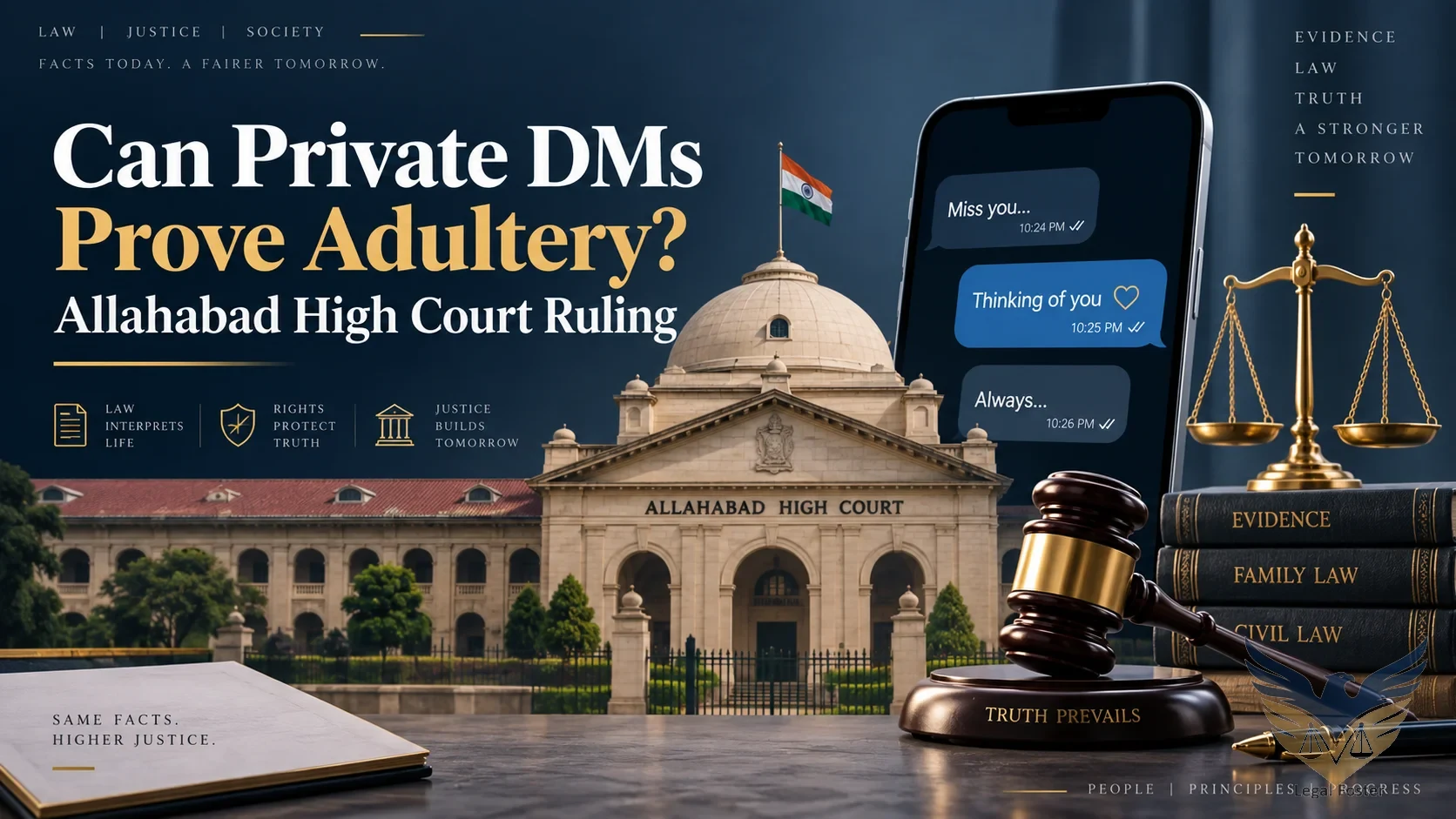
Can Private DMs Prove a Wife’s Adultery? Allahabad High Court Clarifies
A husband can’t simply rely on chats/messages from a social media platform to claim that his wife is “living in adultery”, said the Allahabad High Court adding that he must prove physical relationship or cohabitation.
While dismissing a man’s plea challenging the order granting maintenance to his wife, the Allahabad High Court said that the husband has placed sole reliance on printouts of chats of an Instagram account alleged to have been exchanged between the respondent wife and an advocate.
The husband claimed that his wife is “living in adultery” with the advocate.
“If such chats are ever considered, mere chats on social media platform about physical relations, without any evidence to show continuous physical relations, cannot opine that the wife is “living in adultery”.”
Judge Justice Jai Krishna Upadhyay
“In the present case, the learned petitioner husband has completely failed to prove that the respondent-wife was living in adultery at any point of time”, the Court said while dismissing the petition.
“A finding of fact that the respondent wife was living in adultery with the said advocate cannot be reached merely on the statements made in the said chats”, it added.
“A petitioner shall be required to prove continuous “adulterous lifestyle” of the respondent-wife to be denied a decree of maintenance. The chats/messages alleged to have been exchanged on social media instagram are certainly not enough,” the Allahabad High Court said.
“The expression ‘living in adultery’ – which is a ground to deny the claim of maintenance by a wife under Section 125 of CrPC or Section 144 BNSS – indicates a settled way of life. It signifies an ongoing and regular course of conduct marked by adultery.”
Judge Justice Jai Krishna Upadhyay
“It will not include an occasional stray act of adultery or can be drawn merely on the basis of conversations/association at workplace or due to suspicion”, the Court further observed.
The Court observed that Electronic evidence is required to be strictly verified in accordance with Section 65 – B of the Indian Evidence Act, as electronic and digital records are vulnerable. In the instant case, the petitioner husband did not produce the certificate required to be attached mandatorily under Section 65 – B of the Indian Evidence Act.”
The Petitioner was represented by Advocate Devdeep Malviya.
The Respondent was represented by Advocate Ashutosh Upadhyay.