Calcutta High Court Dismisses Plea Against Mosque Loudspeaker Removal, Citing Lack of Evidence
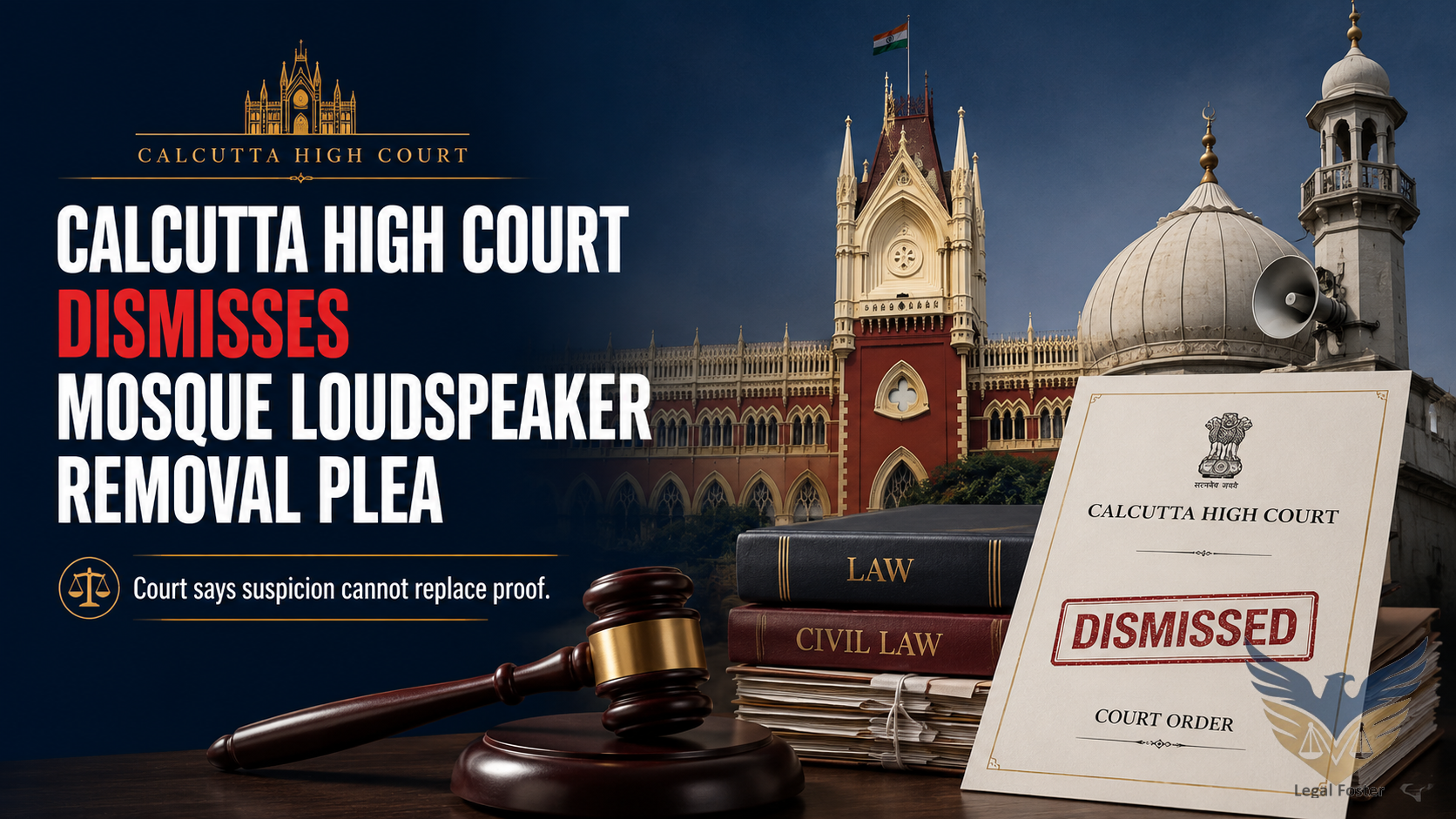
The Calcutta High Court has dismissed a plea alleging that police authorities across West Bengal had compelled mosques and other places of worship to remove loudspeakers, observing that the allegations were not supported by sufficient documentary material.
Division Bench Finds Plea Based on Hearsay
A Division Bench of Acting Chief Justice Tapabrata Chakraborty and Justice Atarup Banerjee considered the petition in Md. Danish Farooqui v. State of West Bengal and Others.
According to the Court, the petition appeared to have been filed on behalf of others on the basis of information allegedly received from imams, secretaries and presidents of management committees of various places of worship in Hooghly.
The Bench, however, noted that no supporting documents had been annexed to substantiate the allegations.
No Specific Police Action Shown, Court Says
The High Court further observed that the petition did not identify any specific overt act attributable to the police authorities.
The petitioners had alleged that loudspeakers were removed from as many as 4,000 mosques in West Bengal under threat of coercive action. The Court noted that no particulars regarding those mosques had been placed before it.
Court Notes Absence of Allegation of Forced Seizure
The Bench also noted that the petition did not allege that police officers had entered places of worship and forcibly removed or seized loudspeakers or related equipment.
One of the newspaper reports relied upon by the petitioner also did not, according to the Court, demonstrate that the authorities had acted arbitrarily or without any rational basis.
Finding that the allegations lacked supporting material, the High Court dismissed the plea and declined to grant the relief sought.
Key Observations From the Case
- The petition was found to rely largely on information received from third parties.
- No documentary evidence was produced to substantiate the alleged removal from thousands of mosques.
- No specific overt act was attributed to individual police authorities.
- The Court found no material showing forcible entry into places of worship or seizure of loudspeakers.
- The High Court held that suspicion could not replace actual proof.
What Did the PIL Allege?
The public interest litigation was filed by Advocate Danish Farooqui. It alleged that police authorities in Hooghly and other districts had issued blanket verbal directions requiring mosques, temples and other places of worship to remove loudspeakers installed at their premises.
The petition claimed that these directions were issued without a written order, notification or other legal sanction and without first measuring the decibel levels of the loudspeakers to determine whether there was any violation of the Noise Pollution (Regulation and Control) Rules, 2000.
Article 25 Argument Raised Before the Court
Advocate Farooqui submitted that azaan is an essential part of the practice of the Muslim religion and referred to Article 25 of the Constitution of India while challenging the alleged blanket restriction.
The petitioner argued that a general prohibition without a written order could affect the fundamental right to freely practise religion.
Claim That Loudspeakers Were Removed From 4,000 Mosques
Senior Advocate Kalyan Bandyopadhyay, appearing for Farooqui, had earlier informed the High Court that police officials had allegedly pressured mosque managements and secured removal of loudspeakers from around 4,000 mosques without issuing formal notices.
He also submitted that meetings had been held at different police stations in Hooghly district on August 3, during which representatives of mosques and temples were allegedly orally asked to remove loudspeakers.
It was further argued that no official order banning loudspeakers at places of worship had been passed and that alleged verbal directions would violate principles of natural justice.
West Bengal Opposes Maintainability of PIL
Advocate General of West Bengal Surajit Nath Mitra opposed the maintainability of the petition and argued that it lacked specific factual details.
Additional Advocate General Billwadal Bhattacharyya also appeared for the State in the proceedings.
High Court Refuses Relief for Lack of Supporting Material
Ultimately, the Division Bench held that the writ petition did not contain sufficient material to support the allegations made against the police.
The Court therefore dismissed the plea, emphasising that serious allegations against public authorities must be supported by specific facts and evidence rather than suspicion or hearsay.
Lawyers Appearing in the Matter
For the petitioner: Advocate Danish Farooqui and Senior Advocate Kalyan Bandyopadhyay.
For the State: Advocate General Surajit Nath Mitra and Additional Advocate General Billwadal Bhattacharyya.