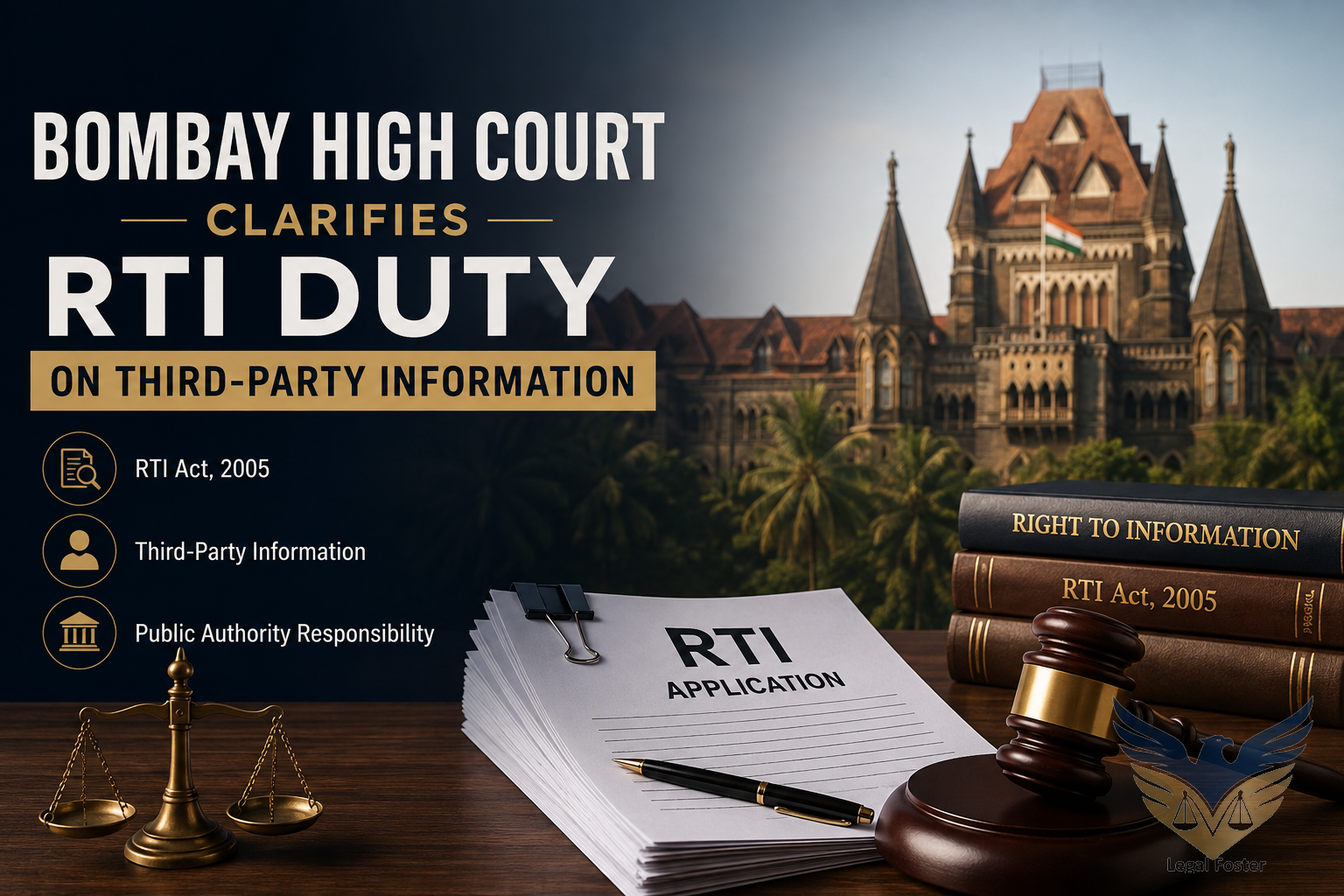
Bombay High Court Says Public Authorities Cannot Be Forced to Collect Third-Party Information for RTI Applicants
The Bombay High Court has held that a public authority cannot be compelled under the Right to Information Act, 2005 to obtain information from a third party merely for the purpose of satisfying an RTI application.
A Division Bench of Justices Manish Pitale and Shreeram V Shirsat made the observation while setting aside certain directions issued by the Central Information Commission to the Securities and Exchange Board of India.
CIC Had Directed SEBI to Collect Information From BSE
The dispute arose from orders passed by the Central Information Commission directing SEBI to obtain certain information from the Bombay Stock Exchange so that the information could subsequently be supplied to applicants who had filed RTI requests with SEBI.
Both SEBI and BSE challenged the CIC's directions before the Bombay High Court.
The central issue before the Court was whether the regulatory powers available to SEBI under its governing law could be used to require it to collect information from third parties solely for answering applications under the RTI Act.
RTI Act Requires Disclosure of Information Available With Authority
The High Court accepted the argument that a public authority is ordinarily required to disclose information that is available with it when an RTI request is received.
According to the Court, the RTI Act does not impose a separate obligation on an authority such as SEBI to exercise its regulatory powers merely to collect information from another entity for an RTI applicant.
CIC Had Relied on Definition of Information Under RTI Act
The Central Information Commission had relied upon the definition of "information" under the RTI Act to conclude that SEBI was not limited to supplying only material already available in its possession.
On that interpretation, the CIC had directed SEBI to obtain relevant material from third-party entities such as BSE and then provide the same to RTI applicants.
The Bombay High Court disagreed with this approach and held that such an interpretation expanded the obligations of a public authority beyond what is contemplated under the RTI framework.
High Court Relies on Supreme Court Precedents
The Division Bench also referred to decisions of the Supreme Court dealing with the obligations of public authorities under the RTI Act.
The High Court observed that the Supreme Court had already clarified that the RTI Act does not require a public authority to collect or create information that is not already held by it.
Bombay High Court Sets Aside CIC Orders
After examining the statutory provisions and the legal principles governing access to information, the Bombay High Court quashed and set aside the challenged orders passed by the Central Information Commission.
The ruling clarifies the distinction between information that a public authority possesses and information that it may have the regulatory power to obtain from another entity.
Key Points From the Judgment
- Public authorities are required to disclose information available with them under the RTI Act.
- The RTI Act does not generally require authorities to collect fresh information from third parties.
- SEBI's regulatory powers do not automatically create an RTI duty to obtain information from BSE.
- The CIC had directed SEBI to collect information from BSE for RTI applicants.
- The Bombay High Court found the CIC's approach inconsistent with Supreme Court precedents.
- The impugned CIC orders were quashed and set aside.
Lawyers Appearing in the Matter
For SEBI
Senior Advocate JJ Bhatt appeared along with Advocates Misha Patel, Omprakash Jha, Shivani Kumbhojkar and Mugdha Narkar, briefed by The Law Point.
For BSE
Senior Advocate Pesi Modi appeared along with Advocates Kalpana Desai, Kingshuk Banerjee, Arnav Mohanty, Ritvik Kulkarni, Arnab Ray and Surya Ravikumar, briefed by Khaitan & Co.