Legal Foster is a legal information and professional discovery platform that helps people explore lawyers, law firms, legal services and legal resources.
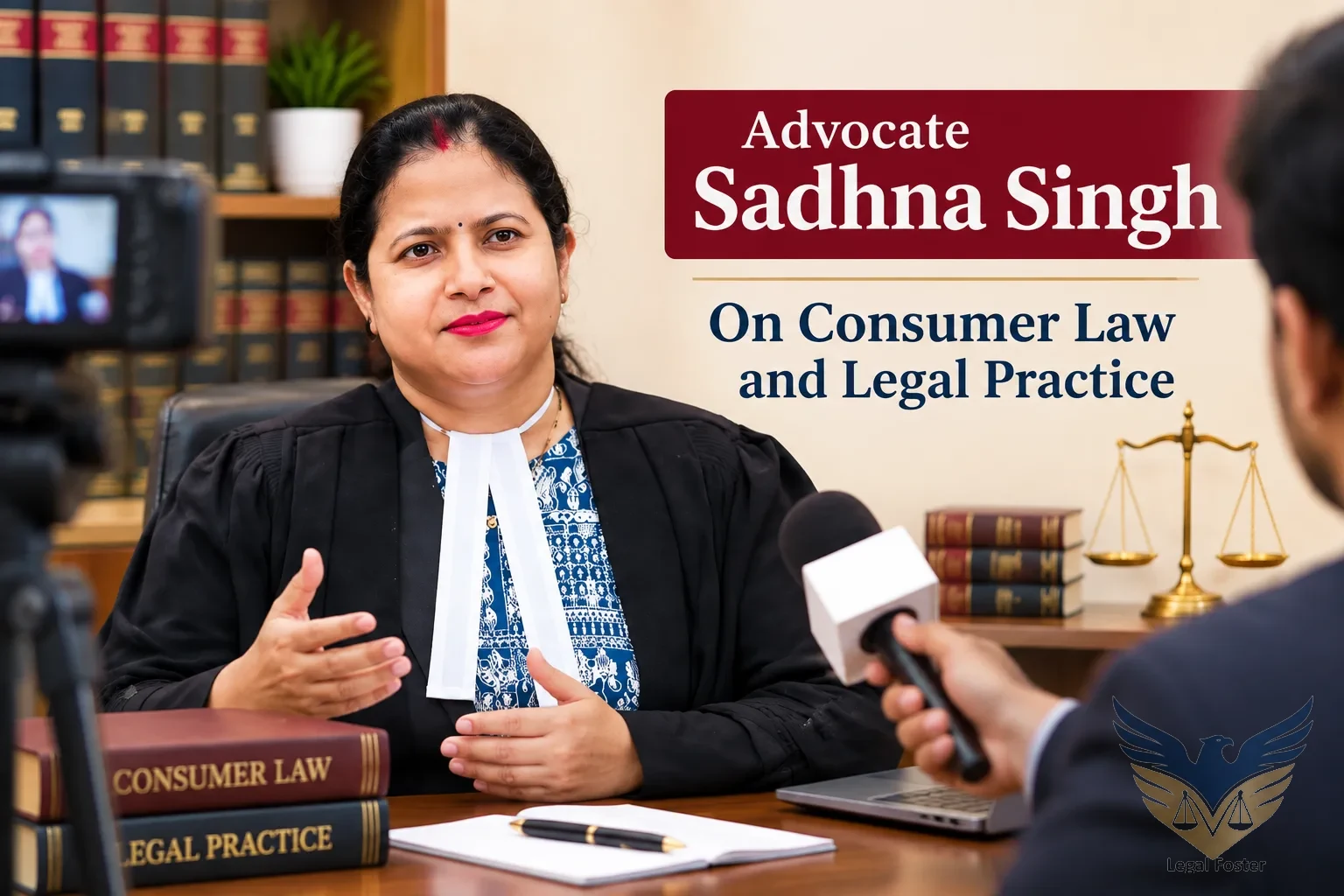
Advocate Sadhna Singh Shares Insights on Consumer Law, Client Trust and Practical Legal Practice
Advocate Sadhna Singh Shares Insights on Consumer Law, Client Trust and Practical Legal Practice
Exclusive Legal InterviewAn honest chat with Advocate Sadhna Singh on Consumer disputes, NCDRC matters, Banking and Insurance issues, legal paperwork, communicating with clients, Preparation,learning from actual court experience and giving Practical and Ethical legal advice to clients.
Introduction
Law practice is beyond just reading statutory provisions. Every matter for an Advocate is about understanding the facts of the client, documents, concerns of the client and the legal remedy that is available to him in the given circumstances.
Advocate Sadhna Singh has been practicing law for over 12 years now. She deals with matters related to Consumer Protection, NCDRC matters, Contract Drafting, Criminal Law, Cyber Law, Divorce and Matrimonial disputes, DRT and SARFAESI matters, Loan Settlement and OTS, Money Recovery, Environmental and NGT matters, Family Law and other allied legal services.
Her practice includes working with consumers, individuals, businesses and service providers by understanding their legal position and the legal remedy available to them. She believes in studying their documents, understand the real dispute and explaining the legal position to the client in simple terms.
In this exclusive interview with Lawsikho, Advocate Sadhna Singh talks about consumer litigation, preparation of legal documents, what clients should expect from their lawyers, importance of documents, being responsible as a lawyer and what budding lawyers can learn from ground level experience.
Self Introduction by Advocate Sadhna Singh
Consumer, Civil, Banking, Documentation and Litigation Lawyer
Hi there. My name is Advocate Sadhna Singh. I have practiced law for over 12 years.
I handle consumer cases at NCDRC, State Consumer Commissions and District Consumer Forums, contract matters, document review, banking disputes, real estate related consumer issues, insurance claims, medical negligence cases, cases related to defective goods, deficient services and delayed possession cases.
I handle DRT and SARFAESI matters, loan settlement and OTS, recovery of money, family and matrimonial disputes, criminal cases, cyber law issues and environment matters as well.
For me, every case starts with the facts.
Similarity two cases may look identical from outside but the paperwork, timeline, terms of contract, correspondence and legal standing can be entirely different.
This is why I feel that an advocate should listen to his client, go through the documents, understand the real legal issue and then lay down the legal options available to the client realistically.
Sound legal advice can only be provided only when it is rooted in facts and not assumption.
Exclusive Interview with Advocate Sadhna Singh
Q1. What inspired you to practise law?
Law lets you see a dispute not only from a legal point of view but also from a practical standpoint.
Clients usually consult a lawyer when they are already in trouble. They have received a legal notice. Or they have lost money. Or they have encountered deficiency in service. Or they have been sued by someone else.
To me, advocacy is not about quoting legal provisions in vacuum. First you need to understand what exactly happened. Only then you can say what provisions of law would apply to those facts.
That’s what makes law practice interesting – the law, the documents, and the practical problem-solving involved.
Q2. What type of consumer disputes do you handle?
Consumer disputes can arise out of many situations.
I have handled cases related to defective goods, deficiency in services, insurance claims, banking disputes, medical negligence, property disputes, delayed possession complaints, refund issues and various other consumer problems.
Typically a consumer dispute involves a lot of documents. The agreement, invoice, payment evidence, correspondence, notices, service records etc. everything can become important evidence.
That’s why it’s necessary to understand the transaction, relationship between the parties and documents before taking up the case.
Q3. Why are documents so crucial in consumer disputes?
Documents can show what was promised, what was paid, what service was actually provided and where things went wrong.
Say, you have a dispute against a property dealer. In that case, the agreement, payment evidence, possession agreement, and correspondence between the parties will be important.
If the dispute is regarding insurance or banking, the policy document or account passbook, correspondences and notices will help us understand facts.
Rather than listening to the client’s story in isolation, a lawyer should ask for the related documents which can prove that story.
Q4. What preparation should clients make before meeting a lawyer?
First and foremost, clients should preserve all the documents related to the dispute.
Keep the agreement, receipts/invoices, notices, emails/messages exchanged, bank statements or payment records. Don’t throw away any documents you received during the transaction.
Make a simple timeline of important events. When did you agree to purchase the product? When did you pay? When did the problem arise? etc.
This helps the lawyer understand when things happened and what documents you have to prove those facts.
Most importantly, clients should be open about the facts. If something went wrong on your end as well, tell the lawyer. Hiding facts from the lawyer will not help you in the long run.
Only when the lawyer knows the truth can they advise you on the legal options.
Q5. How do you take on a new legal problem?
I first listen to the client to understand their problem. Then I go through the relevant documents. After that I try to understand the real legal issue involved, the law applicable to those facts and what stage the matter is currently at.
Once I have a clear understanding of these aspects, I can discuss the legal options with my client.
Law advice should be realistic. The client should know how the law applies to the facts of their case. And the documents will also play an important role in deciding the outcome.
Q6. How important is it for a lawyer to communicate with their clients?
Extremely important.
Lawyers use legal terms and clients are not necessarily well-versed with the law. If I start explaining the legal position to the client using big legal words, they won’t understand their own case!
The lawyer should clearly explain the issues to their clients in simple language.
On the flip side, communication shouldn’t create false hopes either. Advise clients realistically. Yes, your lawyer should highlight the strengths of your case. But they should also be truthful about the difficulties involved.
Lawyers earn their client’s trust by being honest.
Q7. What are some of the challenges clients face in consumer disputes?
Sometimes consumers come to us without preserving the original documents. By the time they ask for legal advice, the documents necessary to prove their claims are missing.
Some clients only approach us after a long time. If a consumer dispute arises, it’s better to take legal advice sooner than later. Waiting too long can adversely affect the legal options available.
Some clients want to fight a dispute because they feel emotionally cheated. But they fail to notice the actual terms of contract or promises made to them. They try to argue on feelings rather than facts.
In law, disputes can only be settled by upholding the truth with evidence, documents and relevant laws.
That’s why it is very important for consumers to understand the real issue at an early stage. It will help them decide what legal step to take next.
Q8. Do you think legal drafting is important for an advocate?
Definitely.
Whether a legal notice, complaint, written reply, application or any other pleading, good drafting should tell your story. The reader should be able to understand:
- What happened?
- What is the legal controversy?
- What documents prove the material facts?
- What legal grounds are you relying upon?
- What are you asking the Court to do?
Lengthy, convoluted sentences do not make a pleading any better.
Drafting should be clear, accurate and consistent.
Q9. How do you handle matters involving banking, DRT or SARFAESI proceedings?
Banking and recovery issues involve reviewing loan documents, account history, notices, security etc. along with the facts.
Timing of the matter is also crucial.
Whether it's a borrower, guarantor or any other party affected by the action, they should know precisely what notice/proceeding has been initiated and what evidences the bank has to carry through with their claims.
Once we know the facts, documents, nature of the facility and timing, we can determine the appropriate legal response.
For these reasons, I feel these types of matters should be evaluated once we have reviewed all of the record, not just an oral recitation.
Q10. What about loan settlement and OTS matters?
Loan settlement &OTS matters also involve reviewing your financial/legal stance.
Before agreeing to a settlement make sure the client knows the deal being offered.
The dollar amount offered, terms of payment, penalties for default, paperwork/closing issues etc. may all come into play.
Treat a settlement like a legal/financial agreement don't just consider the upfront dollar amount.
Every matter is unique so consider the documents before making a decision.
Advocate Sadhna Singh on Practical Legal Practice
Know the Documents
A legal dispute cannot be explained to you adequately by oral discussions alone. Many times relevant documents contain crucial information regarding the transaction and the dispute.
Know the Facts
The facts of a situation will dictate how the law applies. Do not espouse a great legal theory if the facts do not support it.
Talk Straight
Ensure that clients understand your legal position and what their options are. This will help set reasonable expectations.
Think Before You Leap
Whether it is a consumer issue, banking matter, documentation dispute, family law matter or something else entirely, make sure you know what you're getting into before you take a legal stand.
Don’t Make Promises You Can’t Keep
The courts and other authorities will render their decisions based on the facts, evidence presented and the law. As an advocate, you should present possible outcomes to your client instead of promising results.
Never Stop Learning
Our laws are constantly changing through the enactment of statutes, regulations and court decisions. It is important to stay current.
Frequently Asked Questions
1. In what fields does Advocate Sadhna Singh practice?
She practices in Consumer Protection, NCDRC, Drafting Contracts, Criminal, Cyber Laws, Divorce/Matrimonial, DRT and SARFAESI, Loan Settlement/OTS, Money Recovery and Family laws. Environmental and NGT and related fields.
2. Does Advocate Sadhna Singh work on NCDRC cases?
Yes. On her Legal Foster Profile she has mentioned Consumer Protection (NCDRC) as a field she practices in. Also she has mentioned that she represents clients in National, State and District Consumer Commission cases.
3. What documents should you keep if you face any legal problem?
You should save all relevant documents depending on your problem. It could be Agreements, Bills, Receipts, Payments, Mails, Messages, Notices, Policy, Services provided and all other communication related to your problem.
4. Why is drafting important?
If drafted properly it can help in explaining the issues and what reliefs are being asked from the court in detail. This may also help the Court/Authority to understand the dispute at hand.
5. Can a Lawyer assure you of a successful verdict?
No. No advocate should guarantee a win in litigation. As it depends upon facts, evidences and law applied to it along with procedures followed and verdict given by proper court or statutory body.
6. What should you focus on as a young lawyer?
Focus on learning the file, work on your drafting, read laws, watch proceedings in the court. Learn procedure and listen to people around you. Be ethical.
7. Will Advocate Sadhna Singh work on Loan/Banking related issues?
As per her Legal Foster Profile she has mentioned that she works on DRT & SARFAESI, Loan Settlement/OTS and Money recovery.
8. Where does Advocate Sadhna Singh practice?
Delhi High Court is mentioned as a Court/Forum on her Legal Foster Profile. She also practices in areas such as Central Delhi, East Delhi, New Delhi, North Delhi, North East Delhi, North West Delhi, Faridabad, Gurugram, Ghaziabad and Noida.
Conclusion
An advocate must know not only law but also have knowledge of facts, documents, articulation and treat each case as per its requirements.
This is what Advocate Sadhna Singh does when she prepares for a case. She first understands her client problem and the documents in hand. It can be anything be it consumer protection, banking, documentation, matrimonial, recovery or any other issue that may come up. The process is always the same. Know your facts, find the issue and let your client know where you stand.
She wants her clients to remember this as well. Save your documents and know your facts. If there is any problem consult the right lawyer.
To all new advocates out there she says learn, keep reading your file. Improve your draftings and communications. Watch the court room and stay honest.