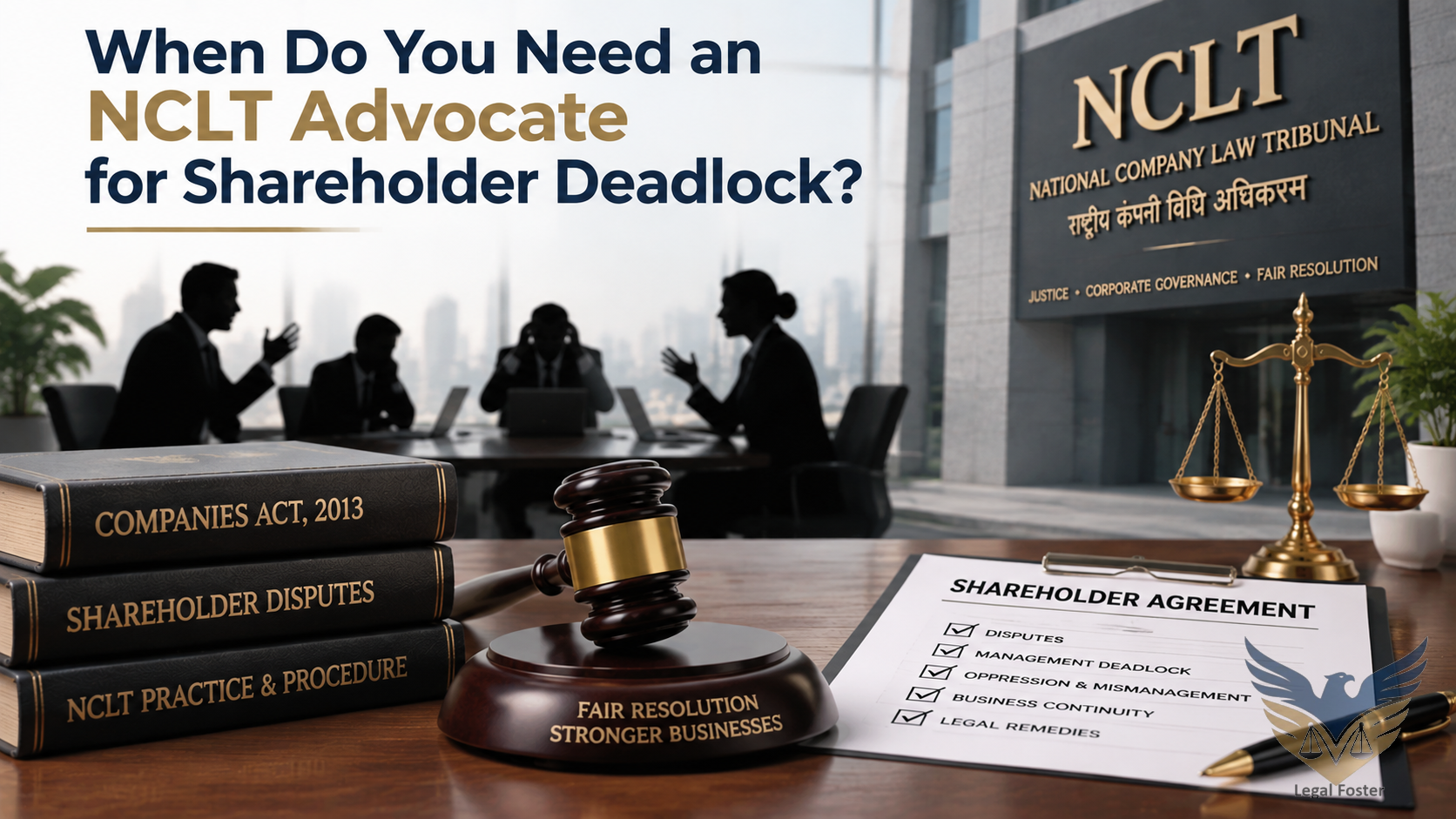
When Do You Need a NCLT Advocate for Shareholder Deadlock?
Similar to how a company can survive financial stress, increased competition or operational challenges. A shareholder deadlock can cause day-to-day business operations to completely stop. Two groups of shareholders not trusting each other can make running daily business functions like Board Meetings, business strategy, financial approvals, and management decisions unbearable.
At some point, most companies will go through a disagreement between two shareholders. Often business partners assume if a shareholder disagreement arises that it is a personal issue between two families or people on the management team. When shareholder disputes start to impact daily operations of the company, things like corporate governance, minority shareholder protections, or who has final say on company decisions may require legal intervention to prevent irreparable damage to the company.
If you find yourself stuck in a shareholder deadlock, your company is likely a closely held company, family business, or a startup where two groups of equal owners exist. With neither group being able to outvote the other, the company can often be unable to manage day-to-day business operations. There are many situations where two groups with equal shareholdings and who distrust each other take their battle to the company law arena.
Why Does Shareholder Deadlock Become a Serious Corporate Problem?
Shareholder deadlock refers to situations where shareholders or directors fail to come to an effective agreement on key aspects of the company’s affairs. Any disagreement between shareholders does not necessarily result in a legal dispute. However, ongoing disagreements which impact the management of the company can give rise to significant issues for the company.
Examples of situations that cause difficulties include:
- Inability to approve key board resolutions
- Disputes about the appointment or removal of directors
- Disagreements over financial matters
- Control issues
- Unfair prejudice between classes of shareholders
- Disagreements between promoters/investors/partners where trust has broken down
Disputes between shareholders can be particularly worrying for founders and family business owners. Not only can they be expensive and emotionally draining but they can also cause uncertainty for employees, nervousness for investors and slow down growth.
Quick Facts About NCLT Shareholder Deadlock Matters
- Corporate governance issues can also be a part of shareholder disputes.
- Issues of oppression and mismanagement are heard by NCLT under Companies Act, 2013.
- Deadlock is not construed merely because shareholders have disagreements.
- Records showing mismanagement and unfair treatment may become crucial evidence.
- Highly prone in closely held companies where shareholders have personal relations.
- Analysis of legal standing would vary depending on shareholding pattern, standing document and facts.
When Should You Consider Consulting a NCLT Advocate for Shareholder Deadlock?
You may find yourself requiring the services of a NCLT Advocate if disagreement between shareholders begins to impact day to day business operations. Letting conflict escalate until it reaches this point can cause further issues.
Legal assistance from a company shareholder may be required if you have absolutely no method of communication between parties, constant bickering over business decisions, or feel shareholders are being treated unfairly.
Some red flags include:
Stalemate between Shareholders of equal share
50/50 companies are susceptible to becoming deadlocked if two sets of owners cannot agree. Day- day operations can become difficult if one side refuses to work with the other.
Issues of Oppression or Mismanagement
If the directors of a company are being oppressive towards some of the shareholders, it may be time to bring those concerns in front of a judge. Remedies for some instances of oppression and mismanagement can be found in the Companies Act.
Board-Level Decision Failures
A company may face operational difficulties when directors cannot agree on essential decisions. Continuous board conflicts can impact business continuity and investor confidence.
What Legal Framework Applies to Shareholder Deadlock in India?
Shareholder deadlock cases usually deal with provisions of the Companies Act, 2013 dealing with oppression and mismanagement. As per Sections 241 and 242 of Companies Act, 2013 if any member entitled to be present and vote at a general meeting is of the opinion that affairs of the company are being conducted in a manner that is oppressive to any member(s) or prejudicial to the interests of the company, such member(s) can make an application to NCLT.
On receiving application NCLT then looks into the facts of the case, conduct of the parties involved, company's records, shareholding pattern and other circumstances of the case and then proceeds to grant relief. However, relief granted depends on facts and circumstances of each case. Courts/Tribunal have held that corporate law needs to step in when there is serious breakdown of trust between the shareholder groups.
How Does Shareholder Deadlock Affect Company Management and Growth?
A shareholder deadlock does not stop at crossing words between owners. As time goes by, corporate structure, decision-making and external relations can be impacted.
Since many privately held companies have shareholders who participate in management, an increasing number of disagreements can make it hard to get past routine issues. Approving expenses, entering into business arrangements, appointing key employees or developing plans for expansion can become stuck in a deadlock.
The company may survive legally but operations may become difficult. Employees become anxious. Investors might not be willing to give any more money. Business partners may worry about the company’s continuity.
If you’re running a startup or family business, shareholder deadlock can be a delicate matter. The people involved have personal relationships on top of their financial ties. What starts as a fight between founders or relatives can evolve into an issue between shareholders.
What Happens When Shareholders Lose Trust in Each Other?
Trust is one of the foundations of any close corporation. When relationships between shareholders break down, even the simplest business discussions can turn into disagreements.
Typical examples of disputes that shareholders argue about are:
- They feel like ‘outsiders’ in the company
- Arguments over information sharing Confidence in financial transparency Control
- How comfortable are you with how the company is being run?
Disputes due to a lack of trust can make shareholders feel uncomfortable and focus on the fight instead of wanting to grow their business. At NCLT Partition Lawyers, we will help you look beyond the business dispute and identify whether your disagreement is a normal commercial difference of opinion or if it escalates to shareholder entitlements.
Why Are Shareholder Agreements Important During Deadlock Situations?
Shareholder agreements set out the relationship between investors, promoters and management groups. These Agreements can include provisions for decision-making, ownership and transfer of shares, and arrangements related to disputes.
Uncertainty between shareholder groups can escalate if no clear arrangements were made during a deadlock.
If a company has failed to keep appropriate corporate records, it may face additional difficulty providing an explanation of its position when in dispute.
Relevant records can include:
- Shareholder agreements
- Articles of Association
- Investment paperwork
- Board meeting minutes
- Company correspondence.
Each document's significance will be determined by the facts and nature of your dispute.
Can Minority Shareholders Face Problems During Corporate Conflicts?
Minority Shareholders may feel aggrieved when their voices go unheard or when they are shut out of Company business.
There are remedies available to members under the Companies Act. However, whether the above situations apply will be dictated by statute and the facts of each situation.
Examples of situations with Minority Shareholders include:
- Being excluded from the affairs of the company
- Feeling that they have been treated unfairly
- Conflict over the management of the company
- Misappropriation of company assets
These types of situations should be reviewed by a lawyer as not every dispute between majority and minority shareholders will amount to oppression or mismanagement.
How Can Shareholder Deadlock Impact Directors of a Company?
Directors are tasked with overseeing the operations of the company. If shareholder disputes spill over to the board processes, then directors find themselves in a tough spot as well.
An extended dispute can cause issues with:
- Decision making at the Board
- Corporate governance duties
- Accountability for the management
- Meeting compliances
As directors, they still have to operate as per the fiduciary duties imposed on them by the Companies Act, 2013. Just because 2 groups of shareholders are at loggerheads, doesn’t absolve the directors from ensuring that the company meets its corporate governance expectations.
Why Should Companies Not Ignore Early Signs of Shareholder Conflict?
Many shareholder disputes become more complicated because parties wait until the disagreement seriously affects business operations.
Early signs may include repeated disagreements, communication breakdown, refusal to cooperate in important matters, or increasing conflict over management control.
Ignoring these concerns may increase uncertainty for:
- Promoters
- Investors
- Employees
- Business partners
- Other stakeholders
Corporate disputes often involve both legal and commercial considerations. Understanding the seriousness of the situation at an early stage can help stakeholders evaluate their position more clearly.
Why Is NCLT Expertise Important in Corporate Shareholder Matters?
Corporate law is a different ball game altogether. A commercial dispute means nothing special to NCLT matters. Matters related to shareholder disputes involve knowledge of company records, shareholding pattern, understanding of who's who in the management and relevant provisions of law.
Understanding of commercial dispute might fall short when it comes to corporate disputes as they have certain specific requirements.
BK Singh Advocate guides his clients through shareholder disputes, company law issues and NCLT matters by understanding the facts of the dispute and informing the client about the legal position.
If your business is facing issues with shareholder disputes you can speak to BK Singh Advocate and get advised on the corporate dispute and shareholders rights.
What Should Businesses Understand About NCLT Shareholder Deadlock Matters?
Shareholder deadlock situations are determined by facts. It depends on how the company is incorporated, its shareholding pattern, agreement and conduct of parties.
Every dispute doesn't need Tribunal intervention, all corporate disputes are not equal before law.
Understanding the nature of dispute,records and Corporation Law principles becomes crucial to determine the appropriate course of action.
BK Singh Advocate guides you in shareholder disputes related to issues in corporate governance,management disputes and NCLT matters. Owning Businessmen, Shareholders, Investors can get in touch to understand your rights.
What Problems Can Shareholder Deadlock Create for Businesses?
Shareholder disputes can have far reaching consequences beyond just ownership issues. They can damage the company’s reputation as well as hurt employees, customers and future opportunities.
Common business consequences include:
- Postponement of growth initiatives
- Loss of investor confidence
- Uncertainty in management hierarchy
- Internal financial conflict
- Higher litigation costs
- Missed business opportunities
This can be disastrous for startups and growing companies who rely on strong investor relations and fast decision making to thrive.
What Documents Are Important in a Shareholder Deadlock Matter?
The relevance of each will depend on the particular allegations and relief sought. However, before filing in any forum, it is usually wise to review the company records. These include:
- Memorandum and Articles of Association
- Shareholders agreements
- Board minutes
- Shareholder lists
- Financial statements
- Email and other communication among shareholders
- Investment agreements
- Company resolutions
- Evidence of management disputes
Why Do Businesses Need Legal Guidance Before Approaching NCLT?
A shareholder dispute raises intricate issues of company law, ownership, management rights and remedies. You don't want to file a matter without knowing your legal position and making the situation worse.
A skilled professional can determine if the matter is simply a commercial dispute or a shareholder dispute with company law issues.
Business owners often consult BK Singh Advocate when shareholder disagreements start to interfere with business operations. You can get a professional opinion on what your legal standing is, what documents you need and what concerns you.
How Can BK Singh Advocate Assist in Shareholder Deadlock Matters?
Shareholder disputes require a balanced understanding of corporate relationships and legal obligations. BK Singh Advocate provides legal assistance in matters involving company disputes, shareholder concerns, and NCLT-related corporate issues.
The firm focuses on understanding the background of the dispute, reviewing available records, and explaining the legal aspects connected with the matter. Every shareholder deadlock case has different facts, and legal assessment depends on the company's structure, agreements, and circumstances.
Businesses seeking guidance regarding corporate disputes may consult BK Singh Advocate through Legals365 for professional assistance related to shareholder and NCLT matters.
Frequently Asked Questions
1. What is shareholder deadlock?
When 2 shareholders are unable to come to a consensus on a subject matter for the better functioning of the company leading to a situation where company can’t function properly and there’s evidence of misconduct.
2. Can a shareholder file complaint in NCLT?
Yes. He can approach NCLT in certain circumstances relating to oppression and mismanagement subject to fulfillment of statutory conditions under Companies Act, 2013 .
3. Does NCLT look at every shareholders dispute?
No. NCLT may refuse to entertain frivolous shareholder petitions. Two shareholders being at loggerheads may not necessarily become a matter in NCLT. It all depends upon the nature of disagreement and the shareholder rights that get affected.
4. Why approach NCLT advocate for shareholders disputes?
You would want to approach a NCLT advocate if there is a corporate law issue inside your company which deals with shareholder dispute against your company agreement/documents and related legal affairs.
5. Are family business disputes entertained by NCLT?
Yes. If the rights of the shareholders are affected because of family dispute and better running of the company is affected.
6. What are the laws that shareholder disputes come under?
Mainly Companies Act, 2013 and other allied corporate laws under which company is registered.
7. Is directors dispute against each other covered under NCLT?
Yes. Directors dispute may also be covered if 2 directors are shareholders too and there is a deadlock at board level.
8. What if two persons have equal shares, will it lead to deadlock?
Not really.Shares held by two persons equally wouldn’t lead to shareholder deadlock. But if Company is unable to function as per the norms and there is a evidence of misconduct by shareholders, then yes.
9. What are the documents to be verified before going to Court?
All documents pertaining to company, company agreement, shareholders list and other relevant correspondence.
10. How can I contact BK Singh Advocate?
BK Singh Advocate can help you in case you have any queries relating to shareholders dispute, corporate disputes,NCLT . He can guide you after knowing the facts of your situation.
Final Thoughts
Shareholder deadlock slowly harms a company when conflicting parties can no longer agree on how the company should be run. Legal opinion at the incipient stage would make the parties realize the gravity of the dispute and the provisions of corporate law which would apply to such disputes.
If you are a company/promoters/shareholders and facing issues with management then you can contact BK Singh Advocate to know more about shareholder deadlock and NCLT related disputes. You may also consult Advocate BK Singh.